WORLD FOCUS: The Kissinger connection
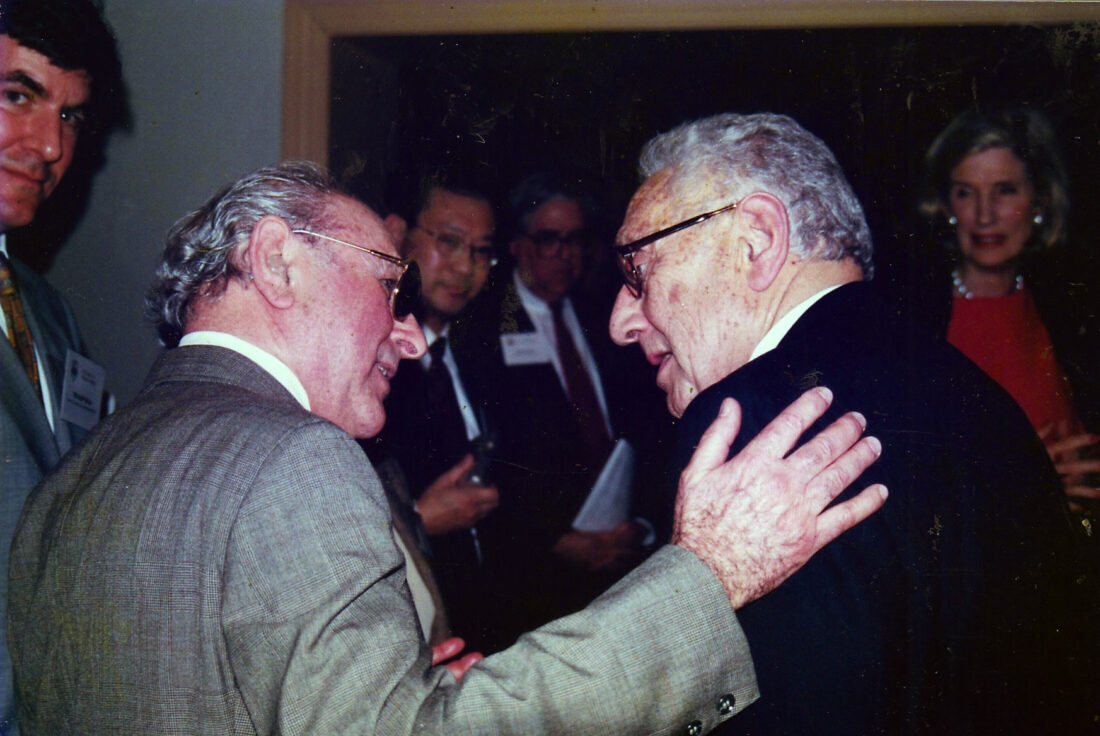
Dr. Henry Kissinger, chancellor of William & Mary, and Frank Shatz, at the Reves Center for International Studies (Photo provided)
On the 100th birthday of Dr. Henry Kissinger — former U.S. secretary of state and former chancellor of the College of William & Mary — his son David wrote an opinion piece published in the Washington Post titled, “My father, Henry Kissinger, is turning 100. This is his guide to longevity.”
“Not only has he outlived most of his peers, eminent detractors and students, but he has also remained indefectibly active throughout his 90s,” David wrote. “Since 2020, he has completed two books and began work on a third. … My father’s longevity is especially miraculous when one considers the health regimen he has followed throughout his adult life, which includes a diet heavy on bratwurst and Wiener schnitzel, a career of relentlessly stressful decision-making, and a love of sports purely as a spectator, never a participant.”
This is an accurate description of parts of Henry Kissinger’s remarkable life and times. But there are other chapters that deserve attention. One is Kissinger’s chancellorship at William & Mary.
At the end of the tenure of the chancellorship, of Lady Margaret Thatcher, former prime minister of Great Britain, William & Mary was looking for an equally prestigious candidate, to replace her. Mitchell Reiss, at that time director of the Reves Center for International Studies and vice-provost for international affair, suggested to W&M President Timothy Sullivan to offer the position to Kissinger.
“Kissinger is foreign born,” Reiss said. “He can’t run for president of the United States. He may accept the offer.”
Kissinger did accept the offer, but his nomination was opposed by a group of W& M students who organized a “teach-in” and invited Christopher Hitchens, a famous, controversial journalist, as a speaker.
Hitchens was the author of a piece titled, “The case against Henry Kissinger,” published in Harper’s magazine.
During his “teach-in” speech, Hitchens quoted extensively from his Harper’s article, accusing Kissinger of “war crimes” for his involvement in “conspiracies to commit murder, kidnapping and torture.”
In his opening statement, Hitchens acknowledged that his journalistic veracity is often questioned. “But my facts are always proven right,” he said.
After his talk, Hitchens opened the floor for questions. Several students asked for clarification, but no one challenged him. Finally, I asked him to respond to an accusation made by Edward Jay Epstein, author of the book “Dossier: The Secret History of Amand Hammer.”
Epstein reported that his presence, Hitchens at a dinner party, has proclaimed that the Holocaust never happened. I asked Hitchens, why should the students in his audience believe his accusations against Kissinger, when he is a Holocaust denier, despite all the historical facts.
Responding, Hitchens accused Epstein of being a notorious liar, but significantly, never answered whether he is a Holocaust denier. Instead, he argued, his mother was of Jewish origins, thus it would be ridiculous to assume he is a Holocaust denier.
I pointed out, it was Bela Imredy, Hungarian prime minister, (1938-1939) who introduced to parliament the first, harsh, anti-Jewish legislation in Hungary. When it was discovered that Imredy, was of Jewish origins, he had to resign.
The questioning of Hitchens by students became more pointed, and the student’s protest planned for the inauguration of Kissinger as William & Mary’s chancellor fizzled out.
Kissinger was selected as chancellor of William & Mary on the strength of his reputation as a world-class statesman who made history. At his inauguration, President Sullivan said, “Dr. Henry Kissinger is uniquely qualified to assist in the internationalization of the college.”
Once, I had interviewed Bernard Adler, then the president of the Lake Placid Chamber of Commerce in Lake Placid, New York. What he told me about the challenges he is facing, were less than sensational. Then, he said, “It may be of interest to you that Henry Kissinger’s and my family, were neighbors in Furth, Germany. Our family’s immigrated about the same time to the U.S. Henry and I were classmates at the same high school in New York City, the George Washington High School.”
Adler then added, “Henry was the brightest student in the class, very ambitious.”
(Frank Shatz is a former resident of Lake Placid and a current resident of Williamsburg, Virginia. He is the author of “Reports from a Distant Place,” a compilation of his columns. This column is used with permission by the Virginia Gazette.)
Columns
ON THE SCENE: Before there were trees
MARTHA SEZ: ‘This is what happens to the elderly brain, mine included’
Biff says he knew the war our country is now conducting with Iran didn’t surprise him one bit. It was in the ...
ON THE SCENE: Olympians on the Olympics
MARTHA SEZ: ‘Then there is the sad but true … story of the cow in the cemetery’
Every once in a while, I look back at columns I’ve written over the years and reminisce. There was the time, ...
LIONS CLUB LOG: Lions Club meets LPHS senior Joselyn Hernandez
The Lake Placid Lions Club has had a busy start to the 2025-26 seasons involving the Annual Radio Auction, ...