
ON THE SCENE: Before there were trees
A long-held belief is that the Adirondack Mountains, the land above 1,000 feet in elevation, were devoid of Indigenous peoples year-round; they mainly lived along the Lake Champlain, Mohawk, and St. Lawrence valleys. This belief was promoted, directly and indirectly, by retired banker Alfred L. Donaldson through his 1921 two-volume work, “A History of the Adirondacks.”
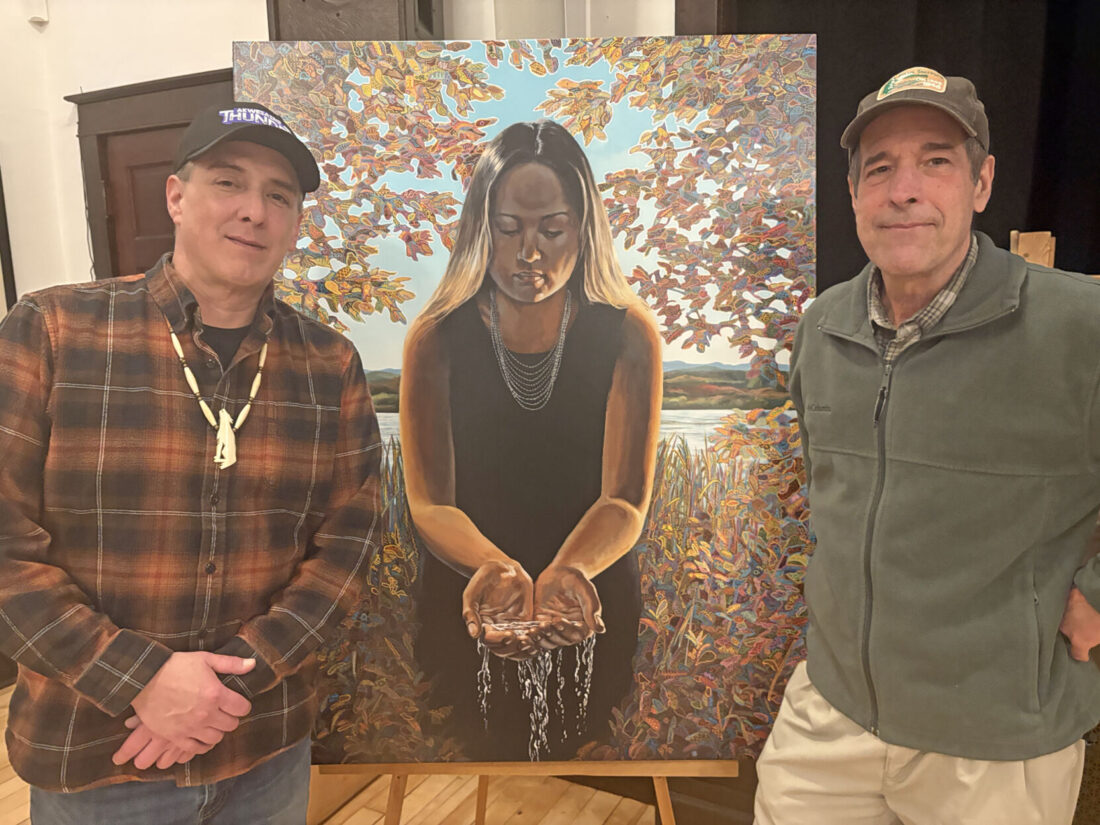
While there is much to commend in Donaldson’s work, his understanding of the Black and Native American experience has been shown to be deeply mistaken by a growing body of scholarship. On Sunday afternoon, March 1, authors Curt Stager and David Kanietakeron Fadden shared their research, documented in “The First Adirondackers: 12,000 years of the Indigenous Peoples in the Adirondack Uplands,” to a packed audience at the Whallonsburg Grange.
Curt Stager is a professor of natural sciences at Paul Smiths College and the author of four other books: “Deep Future: The Next 100,000 years on Earth,” “Your Atomic Self,” “Field Notes from the Northern Forest” and “Still Waters: The Secret World of Lakes.” Stager is known for his use of lake sediment cores to investigate ecological changes, his many research-based publications, his musical gifts on the banjo and guitar, and for using his research skills to reveal the Black experience as Adirondack homesteaders in the 1800s.
Artist, illustrator, storyteller, and writer David Fadden grew up in the hamlet of Onchiota, where his grandfather Ray Fadden and grandmother Christine Mary “Chris” Chubb Fadden, Skawennati, Turtle Clan, founded and led the Six Nations Iroquois Cultural Center, as did his father John and now he.
The Cultural Center was established to promote an understanding of Haudenosaunee and Mohawk culture. David, through his work leading the Center, collaborations with the Abenaki Arts & Education Center, The Wild Center, Paul Smiths College, and other regional institutions, and writings, has greatly increased an awareness and appreciation of the indigenous experience and life in the Adirondacks.
In 2022, in partnership with Adirondack Land Trust, the Center acquired 333 acres that will enable it to expand its facility and protect the land for future generations, and, if all goes well, will also include another significant land acquisition in the near future.
Fadden opened the presentation by sharing that his name, Kanietakeron, which means patches of snow, was given to him by his great-grandmother when he was born in mid-March, a time when the snow is very abundant in Onchiota, but, he later learned, not so near the St Lawrence in Akwesasne, where she lived. He said his Wolf Clan heritage was passed down to him by his mother, and before her, by his grandmother, as the Haudenosaunee are a matriarchal society in which lineage passes through the mother.
Fadden then began, as he did in their book, with Ohenton Karihwatehkwen, the Words that Become Before All others. Fadden took the attendees through the greeting and giving thanks to each part of Creation, words given that the Haudenosaunee use to share a recognition of our connection to one another and the natural world. He began with we, the people, and then addressed and gave thanks to Mother Earth, the Waters, the Fishes, the Vegetation, the Food Plants, the Animals, the Trees, the Birds, the Four Winds, the Thunderers, the Sun, Grandmother Moon, the Stars, and finished with a Closing.
“What inspired us to do this research and write this book was in response to a podcast,” said Stager. “The presenter said that indigenous people didn’t live here, gave the usual reasons, and added that anybody who disagrees with that doesn’t know what they are talking about. We took it as a challenge. I said, I guess we need a book too.”
Stager went on to list the standard reasons; The climate’s too brutal, it’s too hard to grow crops in the Adirondacks, there was nothing here for them, and they were only passing through. Fadden and Stager felt that these reasons were used to justify taking land from Indigenous peoples, and that the stolen lands, not then given to Revolutionary War veterans for payment of services, were made available as land grants, for sale, or kept by the State.
Stager then cited evidence that proved that the indigenous people were fully capable of staying warm, acquiring game to eat, and traveling by snowshoe in the harshest months, and growing their three main crops, beans, corn, and squash during the summer. Through carbon dating of canoes made from logs and fire pits, they placed indigenous people living here 1,000 years ago, and through arrowheads found in the Fulton chain, 5,000 years ago.
Fadden said, “There were no cities here, just pockets of people living in different parts of the region, just like today.”
He said that the First People’s sense of home was not a single building or village, but the whole region, as they moved about, never staying permanently in any one place, thereby avoiding over-impacting any one place and allowing the land to return to its natural state. At the same time, many artifacts have been found near state campgrounds and places people enjoy today, as such places were also attractive to indigenous peoples.
“We have thousands of artifacts in the Six Nations Museum,” said Fadden, “Most are found by accident. Through them, we can determine how long people have been here.”
Stager and his students, using sediment cores collected at different locations, date the end of the last Ice Age to 12,000 years ago. He said back then, there was no wilderness as we know it today, the trees came much later. The then-cold tundra-boreal landscape was populated by mammoths, mastodons, giant beavers, musk ox, caribou, and predators like short-faced bears, wolves, and indigenous peoples, as they were elsewhere. Their presence was identified by such finds as the Barnes or Michaud-Neponset spear points found near the Tupper Lake outlet, spear points common 12,200 – 11,600 years ago.
These and other artifacts demonstrate that before the forests that cover the Adirondacks today, indigenous peoples were here. What Fadden and Stager desire and need are more intentional archaeological digs and research so we can better understand the early presence of the first Adirondackers.
“They stayed here year-round, just like we do today,” said Fadden. “I love it here in the winter, why would my ancestors be any different?”
“I enjoyed the presentation,” said UVM professor of history Andy Buchanan. “I feel that it’s absolutely necessary and important to learn and understand the human history in the Adirondacks. The reasons people have used to justify their taking of the land have been corrected by the work that Curt and Dave are doing.”
“The presentation was very inspiring,” said Zizi MacDougall. “It made me want to dig around in my own backyard to see if I could find artifacts left by the first Adirondackers.”
“It was incredible,” said Katharine Preston.
(Naj Wikoff lives in Keene Valley and has been writing his column for the Lake Placid News since 2005.)
Columns
MARTHA SEZ: ‘This is what happens to the elderly brain, mine included’
Biff says he knew the war our country is now conducting with Iran didn’t surprise him one bit. It was in the ...

ON THE SCENE: Olympians on the Olympics
MARTHA SEZ: ‘Then there is the sad but true … story of the cow in the cemetery’
Every once in a while, I look back at columns I’ve written over the years and reminisce. There was the time, ...
LIONS CLUB LOG: Lions Club meets LPHS senior Joselyn Hernandez
The Lake Placid Lions Club has had a busy start to the 2025-26 seasons involving the Annual Radio Auction, ...
ON THE SCENE: Mountainfest magic in town of Keene
MARTHA SEZ: ‘You were born in a Pig year, but don’t think of yourself as a pig’
Yippee-ki-o-ki-yay, galloping all the way, here comes Year of the Horse! My apologies to Hanna-Barbera Animation ...