ON THE SCENE: On becoming a bobsled pilot
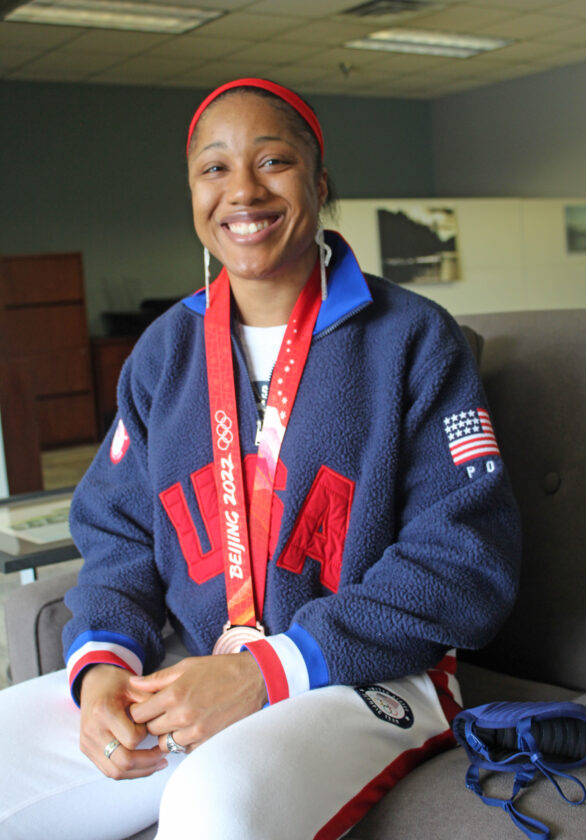
Sylvia Hoffman (Provided photo — Naj Wikoff)
Bobsled pilots tend to emerge one of two ways. They start young or, more recently, they are recruited from another sport initially as a brakeman or pusher now seeking to move up.
Last week, the International Bobsleigh and Skeleton Federation concluded a 10-day bobsled and skeleton development camp at the Mount Van Hoevenberg sliding track in Lake Placid. The participants were a mix of young athletes in both sports and brakemen learning to become pilots.
Maddy Cohen of Keene Valley is an example of the former. Kaysha Love and Sylvia Hoffman are examples of the latter; they recently returned from sliding in the Winter Olympics, Love with pilot Kaillie Humphries placing 7th and Hoffman with pilot Elana Meyers Taylor winning a bronze medal at Beijing.
Nicola Minichiello, head development coach for the IBSF, said the brake person is the engine, the speed, the power at the start and then basically the passenger on the way down.
“In the front seat, you have to navigate the sled at speeds up to a hundred miles an hour while pulling five-and-a-half Gs,” she added. “You have to spot those lines and find the most efficient way down the track. The big part of transitioning to driving is mental; that ability to go from a powerful athlete with pure adrenaline running through their system to being a person who can go from that to the calm, relaxed faze that you need to navigate the sled. With these candidates, I am looking for cool, calm, and focused people who have good attention to detail. To be a good pilot, you need to hit centimeter perfect lines at very high speed.”
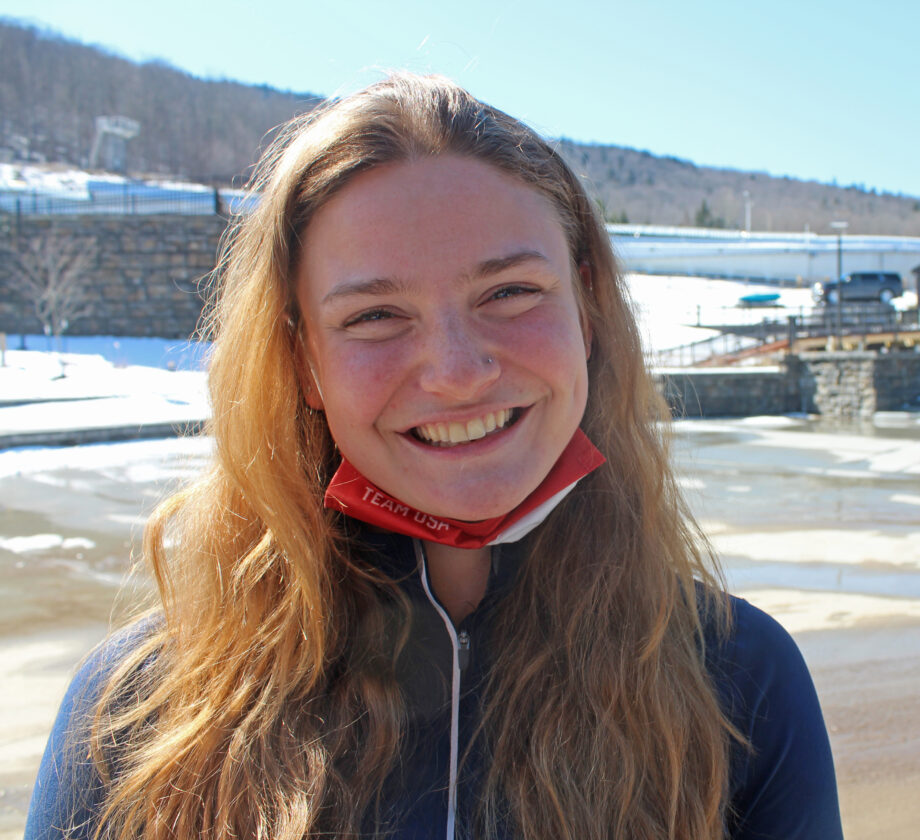
Maddy Cohen (Provided photo — Naj Wikoff)
Maddy was introduced to bobsledding by her then Northwood School ninth-grade biology teacher Matt Roy, who thought she’d take to a high-risk sport. Roy, a former bobsledder, knew his pupil as it took just one ride down the run to hook her interest and sign up for the Junior Bobsled program. Now a student at the University of Vermont in Burlington, Maddy is still at it. Fun for her this past week was shifting from a monobob to a two-person bobsled.
“In two-man, you point the sled somewhere, and it goes,” said Cohen. “Monobobs are a little squirrelly because you don’t have weight in the back holding it down. Sometimes, the backend will slide out from under you, making it a little more difficult to drive. Two-man are awesome; I struggled to drive them at first, but now I love them.”
During the concluding awards ceremony, Cohen won a medal for being the most consistent driver over two runs, they being about one-hundredth of a second apart.
Growing up in Arlington, Texas, bobsledding was not on Hoffman’s radar. Instead, her goal was to excel in sport, and she did both in track and field and basketball, going on to play at the collegiate level for Louisiana State University Shreveport. While at LSU, Hoffman discovered they had one of the most exemplary weightlifting programs in the country, which she joined making the three FISU competitions, including a Summer Games.
After college, Hoffman moved to Colorado Springs with hopes of making the USA weightlifting team. While there, she applied for the U.S. Olympic Committee’s second Scouting Camp: Next Olympic Hopeful. At the camp, Hoffman got the attention of USA Bobsled and Skeleton.
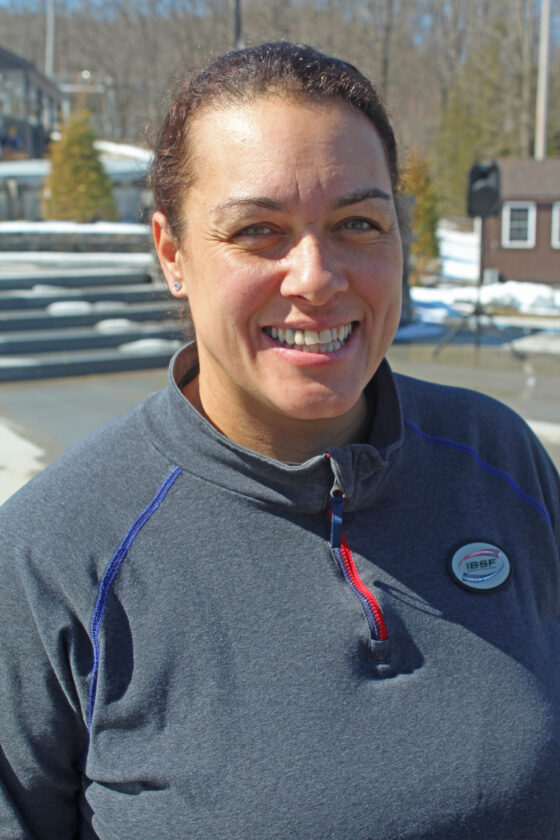
Nicola Minichiello (Provided photo — Naj Wikoff)
In Lake Placid, Hoffman met Meyers Taylor, also skilled at weightlifting, who advised Hoffman on the need to shift her focus. It was advice well taken as Hoffman won the national team push trials and made the national team her first year in a sled.
Four years later, with an Olympic bronze medal to her credit and three World Cup gold medals, Hoffman has decided to move into the driver’s seat.
“After my first ride down the track, I wanted to be a pilot,” said Hoffman. “I love being in the front seat. I like a little control in my life. I like seeing where I’m going. I like enjoying the process, the visual aspect of everything, and being involved in all aspects of getting the sled down. Braking wasn’t that, but I planned on being in the pilot seat regardless. It’s a step towards making it happen, and now I am in the pilot seat.”
Manfred Maier, the Development Coordinator for the IBSF, said that skeleton athletes, lying centimeters above the ice, have to feel the ice through their bodies. In bobsled, they have to feel the ice through their butt. Further, they don’t want to depend on their eyes; they have to feel the ice, the sled on the ice, and in the curve. They have to hear the ice, hear the hardness, and hear how they are steering on the ice. He also said that there’s a lot of work beyond being in the bobsled; weightlifting, the sprints, the conditioning, pushing the sled, sanding the runners, and getting them aligned with the sled.
“We start the new drivers in curve four six or eight times,” said Maier. “When they’re comfortable, we move them up. Our goal is not to get all the athletes to the top, but we did reach it. The track was in excellent condition; it was safe to drive.”
Hoffman learned a lot at the recent IBSF camp. She was able to ask questions and get opinions from coaches from different nations. She would look at her speeds and try to make adjustments every day to help her do better. She learned that there were tradeoffs. Improving her start resulted in coming into certain sections faster, which initially threw her off, particularly in curve seven. She’d talk to her coaches, try different things, and Thursday nailed it.
“It was great,” said Hoffman. “I like seeing where I’m going. It can be scary, frustrating, and fun at times; it’s the whole package. You have all these emotions. I got through curve seven but then went into nine and ten a bit weird. You have these celebratory moments, and then you’ve got to reel that in and fix the next problem. I am also learning that you need to take a break at times. You’ve got to pace yourself. You’ve got to find that midway point. You’ve got to aim for quality over quantity sometimes.”
Next up for Hoffman is further training in Lake Placid with USABS head coach and Olympic silver medalist Shauna Rohbock.
“I want to help the Federation succeed,” said Hoffman. “I plan on driving next year and, the year after that, making our World Cup team. I want to win a World Championships here in Lake Placid; that would be big. And, then I want to be the first Black American woman to win gold in bobsledding at the Olympics.”
——
(Naj Wikoff lives in Keene Valley. He has been covering events for the News for more than 15 years.)
Columns
ON THE SCENE: Before there were trees
MARTHA SEZ: ‘This is what happens to the elderly brain, mine included’
Biff says he knew the war our country is now conducting with Iran didn’t surprise him one bit. It was in the ...
ON THE SCENE: Olympians on the Olympics
MARTHA SEZ: ‘Then there is the sad but true … story of the cow in the cemetery’
Every once in a while, I look back at columns I’ve written over the years and reminisce. There was the time, ...
LIONS CLUB LOG: Lions Club meets LPHS senior Joselyn Hernandez
The Lake Placid Lions Club has had a busy start to the 2025-26 seasons involving the Annual Radio Auction, ...