ON THE SCENE: Speedskating – People who’ve made a difference
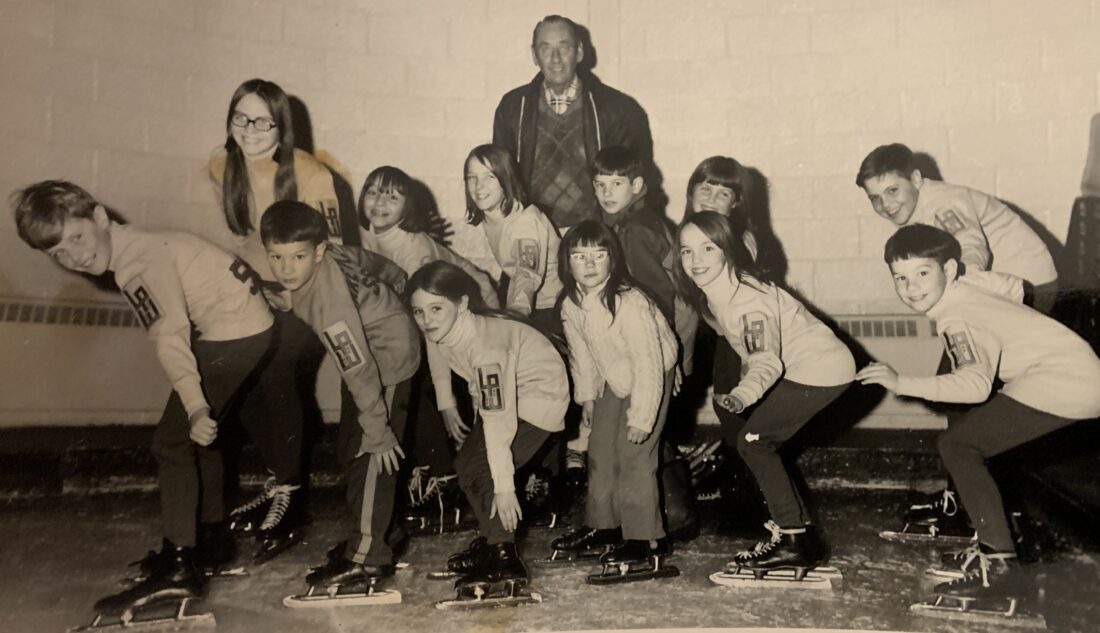
The Lake Placid speedskating kids pose in the early 1970s, then skating as part of the Pee Wee Association. (Provided photo)
When talking about sports, we often extoll the achievements of great athletes. In speedskating, it could be Charles Jewtraw, Jack Shea, Jeanne Ashworth and Eric Heiden.
When talking about what it took to win, they usually praise their coaches and, most significantly, their family and friends.
Also important, and there is often overlap, are the people who make the sport and the opportunities for training and competing possible. As the interest in any sport ebbs and flows, lifting it out of an ebb takes an extra effort as the spotlight for what’s hot moves elsewhere.
For example, back in the early years of the 20th century, Lake Placid and Saranac Lake were the capital of speedskating in America. That happened because of several elements coming together, exceptional talent, the rise of the Lake Placid Club and the Sno Birds, and people like Henry Uihlein II, a founding member of the Sno Birds and the Adirondack Skating Association.
Uihlein was a significant driver in growing the popularity of speedskating in Lake Placid. He supported local talent, organized competitions, and attracted events, such as bringing to Lake Placid its first international sporting event in 1920, the International Outdoor Speed Skating Championships. Through Uihlein’s efforts, Lake Placid gained worldwide recognition as a skating and winter sports center.
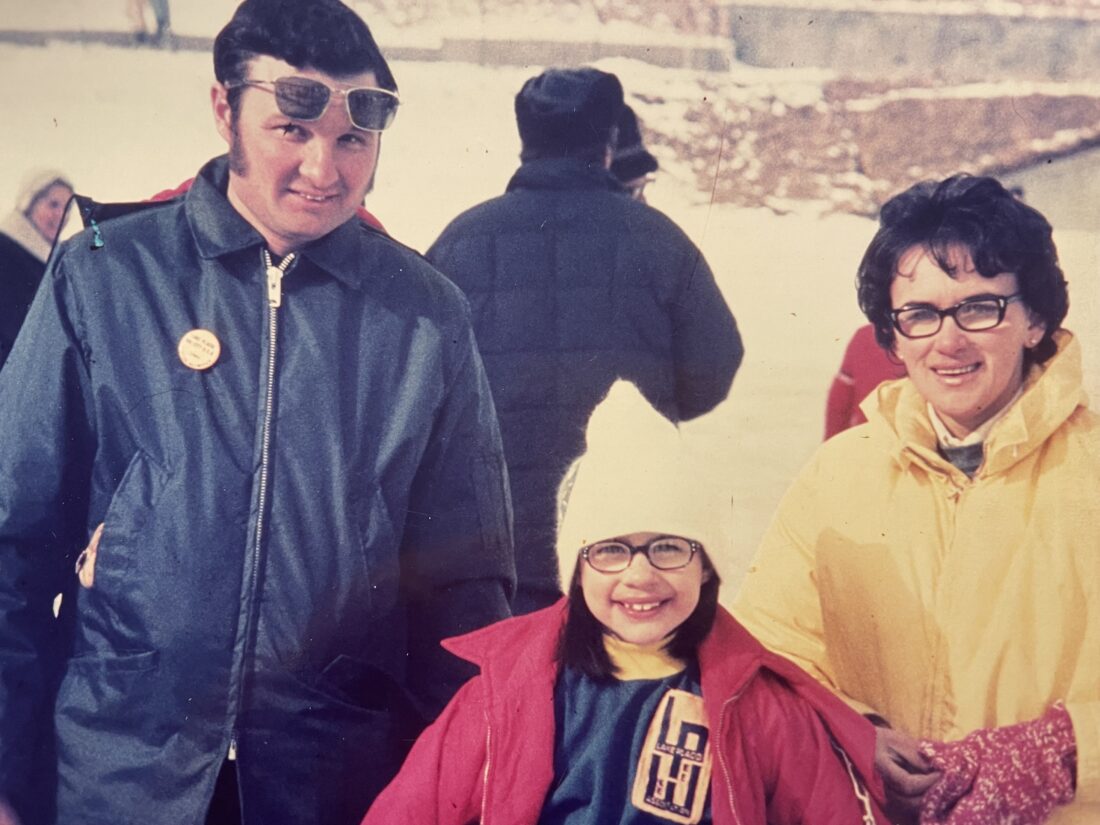
Gene and Donna Wood with their daughter Noelle (Provided photo)
As part of all that, Uihlein took a particular interest in helping Jewtraw, the eventual winner of the first gold medal won at the first winter Olympics in 1924.
Uihlein was not alone. Edmund Lamy of Saranac Lake and Jack Moffet of Lake Placid helped coach Jewtraw, and all three helped scrape the snow off Mill Pond and Mirror Lake so Jewtraw had ice for training. No coach was more vital to Jewtraw and later to Jack Shea than Lamy. During his career of 74 races, Lamy won 69, took 3 seconds, and two-thirds. He’d win at every distance, setting two records that were never beaten in his lifetime. If that wasn’t enough, Lamy set world records in barrel jumping. Consequently, he had a lot of skills to share, and share them he did.
After the 1932 Winter Olympics in Lake Placid, interest in speedskating took a dip as public attention shifted to figure skating popularized by three-time Olympic champion Sonja Henie, of Norway, who became a box office hit as a skating movie star. Additionally, Olympic arena manager H.L. “Jack” Garren and figure skating coach Gus Lussi organized a series of over-the-top ice shows that featured the best skaters in the world.
Garren and Lussi’s sets outdid many Broadway or opera productions, and the talent they amassed was breathtaking. Figure skating became the talk of the town and nation through the help of radio and television entertainer Arthur Godfrey. If not for former speedskater and barrel jumper James “Bunny” Sheffield, speedskating might have been doomed in Placid.
In 1930, Sheffield became very active as a local, national, and international speedskating official. Sheffield served as president of the New York State Skating Association, the Amateur Speedskating Union, and the United States Ice Speedskating Association, as a board member of the International Speedskating Union, and as chair of speedskating and luge for the 1980 Lake Placid Olympic Organizing Committee.
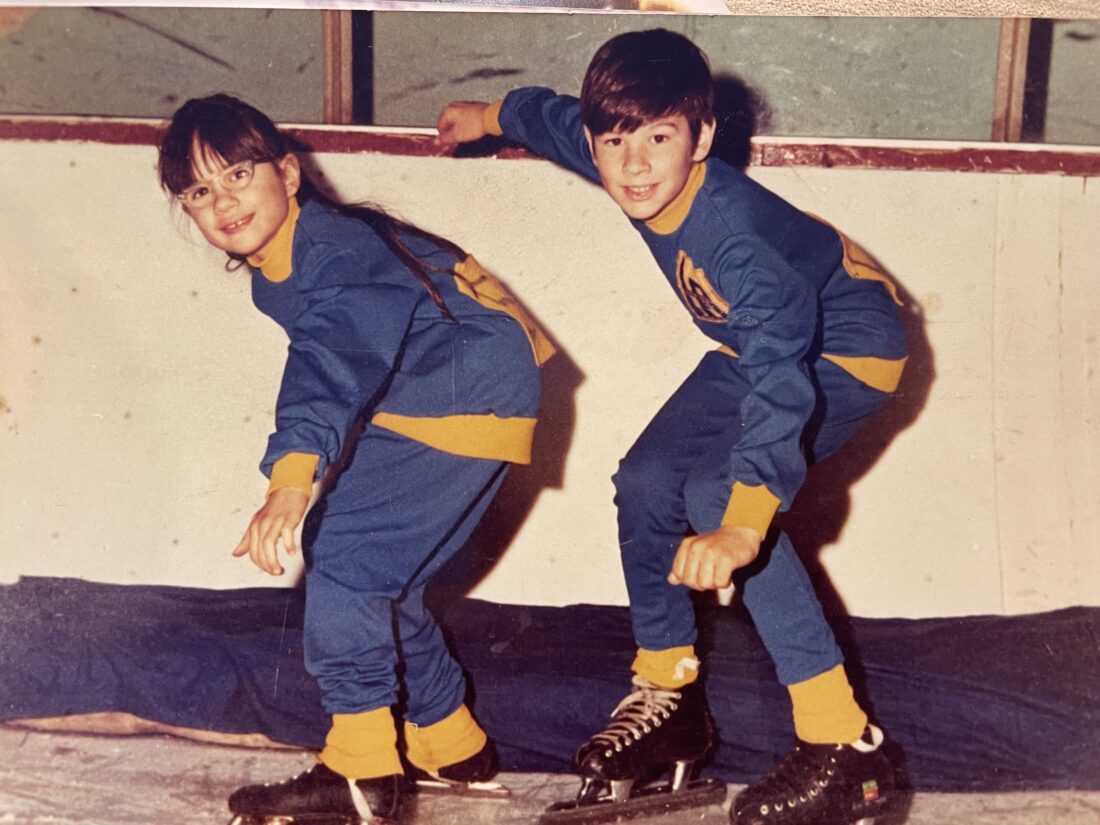
Noelle and Dan Wood (Provided photo)
Hard to believe doing all that, Sheffield had time to run his real estate business, much less take up bobsledding, which he did sliding with Stan Benham at the Olympics and winning the 1950 and 51 World Championships. Sheffield’s activism was critical to bringing the 1977 World Sprint Speed Skating Championships to Lake Placid and launching the North America Indoor Speed Skating Championships and North America Outdoor Speedskating Championships, both held in Placid. His activism wasn’t just in committee meetings or lobbying national and international sports authorities; he would help organize local meets, put up posters, and recruit people to fill a wide array of needed roles.
As his friend Luke Patnode said of Sheffield at his funeral, “He did more to keep competitive sports alive in Lake Placid than any other person.”
The people working where the rubber hits the road are no less crucial, such as family members and local organizers. Three such were gas station owner Eugene “Gene” Wood, Lake Placid High School science teacher Al Glass who often announced the races, and Doris Patnode, Lake Placid Speed Skating Association secretary. They were the backbone of keeping speed skating going and kids engaged in the late Sixties, Seventies, and into the Eighties.
Working through the Lake Placid Pee Wee Association, they assisted in the coaching and transporting local athletes to speedskating meets throughout the Eastern Seaboard and Canada. On weekends, they’d stuff their station wagons with luggage, skates, sharpening jigs, rambunctious skaters, and hit the road. Their greatest enjoyment was coaching, encouraging, and building confidence amongst their charges. They’d recruit leading athletes to coach Jeanne Ashworth and Jack Walters to Shelia Young whenever the opportunity arose. They dipped into their own pockets to ensure the kids had good skates, uniforms, warmup suits and ate well on the trips.
In 1975, Patnode, who had served as an official on a regional and national level, was appointed the Lake Placid Speed Skating chairperson for the 1980 Winter Olympics. Patnode oversaw the entire venue and was responsible for the safety, accuracy, and smooth running of the event, its athletes, and personnel. She became one of the first women to have the distinction of Olympic venue chairperson.
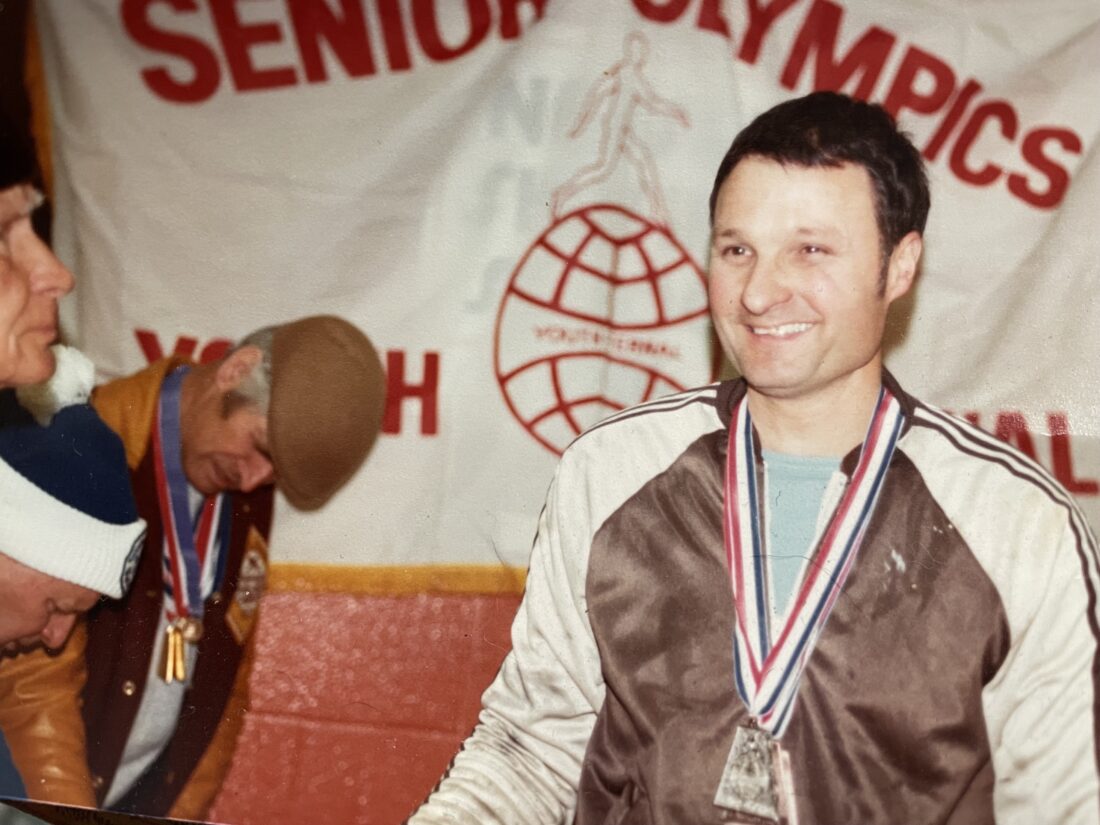
Gene Wood at the 1982 Senior Olympics, where he won several medals in his age group (Provided photo)
“We kids had it made,” said Noelle Wood. “My father was so in shape from chasing us all over that ice. If he didn’t see a skater out there for practice, he’d look for them and make sure they didn’t miss the next one. He was on top of it all the time. My mom was as well. Doris, I don’t think we appreciated all she did at the time. That poor woman had all the girls, Lisa and Cathy Corrow, the Jewtraw girls, Bev Reid’s girls, myself, and her daughters. From Al, Doris, and my dad, I learned to dream big, push hard, and persevere.”
Noelle is very proud that her father created ‘The Most Spirited Award’ for the skater who exemplified teamwork. Today, Gene would probably give the Most Spirited Award to local business leaders John Dimon and Tom Miller. With support from the Uihlein Foundation, they have breathed life back into the speedskating program, which is once again a stand-alone agency, now referred to as the Adirondack Speedskating Club. Like so many before them, they dream big, push hard, and persevere as they introduce and bring forward yet another generation into speedskating.
——
(Naj Wikoff lives in Keene Valley. He has been covering events for the News for more than 15 years.)
Columns
ON THE SCENE: Before there were trees
MARTHA SEZ: ‘This is what happens to the elderly brain, mine included’
Biff says he knew the war our country is now conducting with Iran didn’t surprise him one bit. It was in the ...
ON THE SCENE: Olympians on the Olympics
MARTHA SEZ: ‘Then there is the sad but true … story of the cow in the cemetery’
Every once in a while, I look back at columns I’ve written over the years and reminisce. There was the time, ...
LIONS CLUB LOG: Lions Club meets LPHS senior Joselyn Hernandez
The Lake Placid Lions Club has had a busy start to the 2025-26 seasons involving the Annual Radio Auction, ...