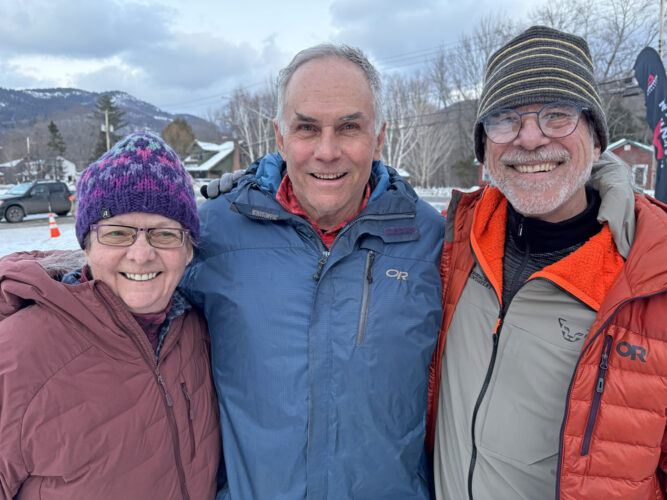
HISTORY IS COOL: 70 years ago
Aug. 3, 1951
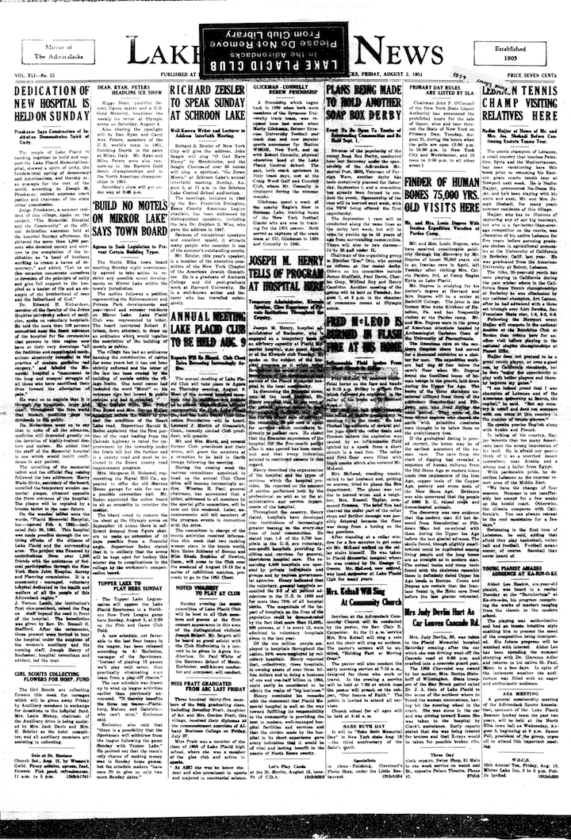
Hospital dedication
–
The people of Lake Placid in banding together to build and support the Lake Placid Memorial Hospital showed a spirit of unity, the fundamental spring of democracy and Americanism, and thereby set an example for the rest of the world, according to Joseph M. Proskauer, retired supreme court justice and chairman of the state crime commission.
Judge Proskauer, a summer resident of this village, spoke on the subject, “The Memorial Hospital and the Community,” at the official dedication exercises held at the hospital Sunday afternoon. He pictured the more than 1,300 people who donated money and services to the completion of the institution as a “band of brothers working to create a haven of democracy.”
The unveiling of the memorial tablet and the official flag raising followed the addresses. Harry Wade Hicks, secretary to the board, unveiled the temporary wooden memorial plaque, situated opposite the front entrance of the hospital. The plaque will be replaced by a bronze tablet in the near future.
The words on the wooden tablet began with, “Placid Memorial Hospital, Inc. — opened Feb. 4, 1951 — dedicated July 29, 1951.”
–
Stagecoach in Keene
–
(Editor’s note: This piece was written by Marjorie Lansing Porter, historian at the time for Essex and Clinton counties.)
Travelers on state highway 9N between Keene Valley and Keene might have thought they were “seeing things” one morning recently. An ancient Concord stagecoach was trundling along a route from which such gorgeous equipages had long since disappeared.
What may possibly be the last “run” of Kellogg’s coach, which with its six white horses was a well-known and welcome sight on the Westport-Elizabethtown road up to about 1904, wasn’t a sudden, made summer runaway of the extremely “well preserved” old lady but a dignified, pre-arranged journey from Keene Valley (home of the coach since 1919) to the Red Barn Museum on the outskirts of Keene. Towed by a Jeep, the old stagecoach was relieved of all responsibility en route, and appeared to thoroughly enjoy her return to society (traffic is heavy in the Adirondacks now) the well deserved attention she drew to her shapely figure, and the fine mountain view, swinging comfortably along atop her leather thoroughbraces, the work of some early craftsman.
Now, after her jaunt through a countryside famed for its beauty, the old stagecoach — unique along with the covered wooden bridge at Jay, in that they are about the only remaining objects of their kind in northern New York — hobnobs in the folk museum with such historic treasures as an ox cart and its accessories, ox yoke, ox goad (Ethan Allen’s no less) and ox shoe; century-old cheese press and butter-making equipment; ladder that took great-grandma and her youngsters to their log cabin loft; fanning mill and other early farm and household tools given and loaned by Essex County farm people in cooperation with the history department of their county.
Clinton County folks have a similar Red Barn Museum at Plattsburgh.
Columns
ON THE SCENE: Before there were trees
MARTHA SEZ: ‘This is what happens to the elderly brain, mine included’
Biff says he knew the war our country is now conducting with Iran didn’t surprise him one bit. It was in the ...
ON THE SCENE: Olympians on the Olympics
MARTHA SEZ: ‘Then there is the sad but true … story of the cow in the cemetery’
Every once in a while, I look back at columns I’ve written over the years and reminisce. There was the time, ...
LIONS CLUB LOG: Lions Club meets LPHS senior Joselyn Hernandez
The Lake Placid Lions Club has had a busy start to the 2025-26 seasons involving the Annual Radio Auction, ...