NORTH COUNTRY AT WORK: Exploring the ghost town of Griffin in southern Hamilton County
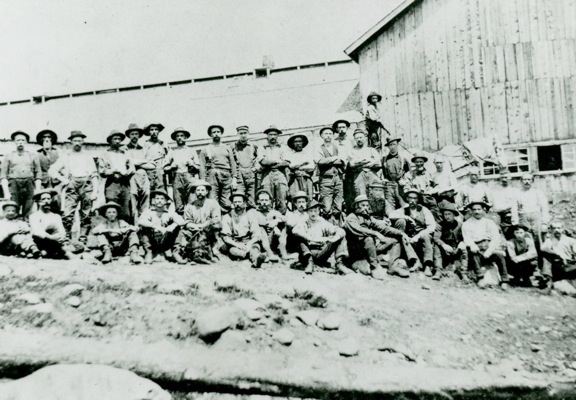
Tannery workers at the Rice Emery Company in Griffin, New York. The superintendent is Miles E. Darby, sixth from the right in the front row. Circa 1880s. Photo originally from Frank Girard. Courtesy of the Hamilton County Historian’s Office.
WELLS – If you wanted to visit the town of Griffin today, you’d have to head toward the town of Wells, located on the Sacandaga River in southern Hamilton County.
Travel down Route 8 (also called Griffin Road) and you’ll find empty foundations, old pipes, and one or two buildings.
But if you visited Griffin in the late 1800s, you’d find a huge tannery, sawmills, a school, a church, houses, farms, hotels, and a tavern – as Hamilton County Historian Eliza Darling jokes, while it had lumbermen, it had to have booze.
The settlement was driven by wood and water: its location on the eastern branch of the Sacondaga River was perfect for the Rice Emery Company tannery, as well as for powering the Morgan Lumber Company’s sawmills and moving the wood they processed. Darling says water is essential for tanneries:
“Tanneries are water hogs: they always, always need to be near fresh, running water. They’re usually located on a river and often will divert the stream right through them.”
Griffin also boasted one of the largest sugar bushes in the Adirondacks. It belonged to the Girard family, who were very prominent in town. Frank Girard wrote down a history of Griffin, and the photos we found come from him and his sister, Ouida.
The family owned a hotel called Girard House – Darling says local people refer to it as the Hacienda. It started out as a boarding house for the Morgan Lumber Company, so it served as housing for workers. That’s actually fairly common in histories of the Adirondacks. When the Girard family bought the building, they turned it into a hotel proper. As industry started to decline and the town turned to tourism, it was still popular with hunters for a long time afterwards.
Griffin was over by around the 1930s. The tannery died out from a combination of new technology, changes in the industry, and a string of bad financial decisions at the Rice Emery Company. The town was built around the tannery and the lumber company, and Darling says as they declined, so did the community.
“Like many Adirondack boom towns, it turned to tourism for a short time after that, but it didn’t last for very long in Griffin.”
Darling says the reason tourism didn’t work in Griffin is, again, all because of the water – while tanneries thrive on rivers, tourist economies rely instead on a central lake.
After the factories left, people moved away, and the buildings they left behind fell into disrepair. According to Darling, some of Griffin’s remains were probably recycled into Wells.
“It’s said, and I can’t prove it, that as Griffin died, the people of Wells would go up there and take stones form the rotting Griffin foundations to either build up new buildings in Wells or shore up their own foundations.”
Even though Griffin died about 80 years ago, some of the buildings are still there. You can see the pipes running through the tannery foundation, remains of small barns, and the Girard House where Ouida and Frank were born. That’s really all that’s left.
(This story comes to you from North Country Public Radio’s North Country at Work project, which explores the working lives and history of our region. To see all the stories, check out www.northcountryatwork.org/)
Columns
ON THE SCENE: Before there were trees
MARTHA SEZ: ‘This is what happens to the elderly brain, mine included’
Biff says he knew the war our country is now conducting with Iran didn’t surprise him one bit. It was in the ...

ON THE SCENE: Olympians on the Olympics
MARTHA SEZ: ‘Then there is the sad but true … story of the cow in the cemetery’
Every once in a while, I look back at columns I’ve written over the years and reminisce. There was the time, ...
LIONS CLUB LOG: Lions Club meets LPHS senior Joselyn Hernandez
The Lake Placid Lions Club has had a busy start to the 2025-26 seasons involving the Annual Radio Auction, ...