
Taking a stand for women in sports
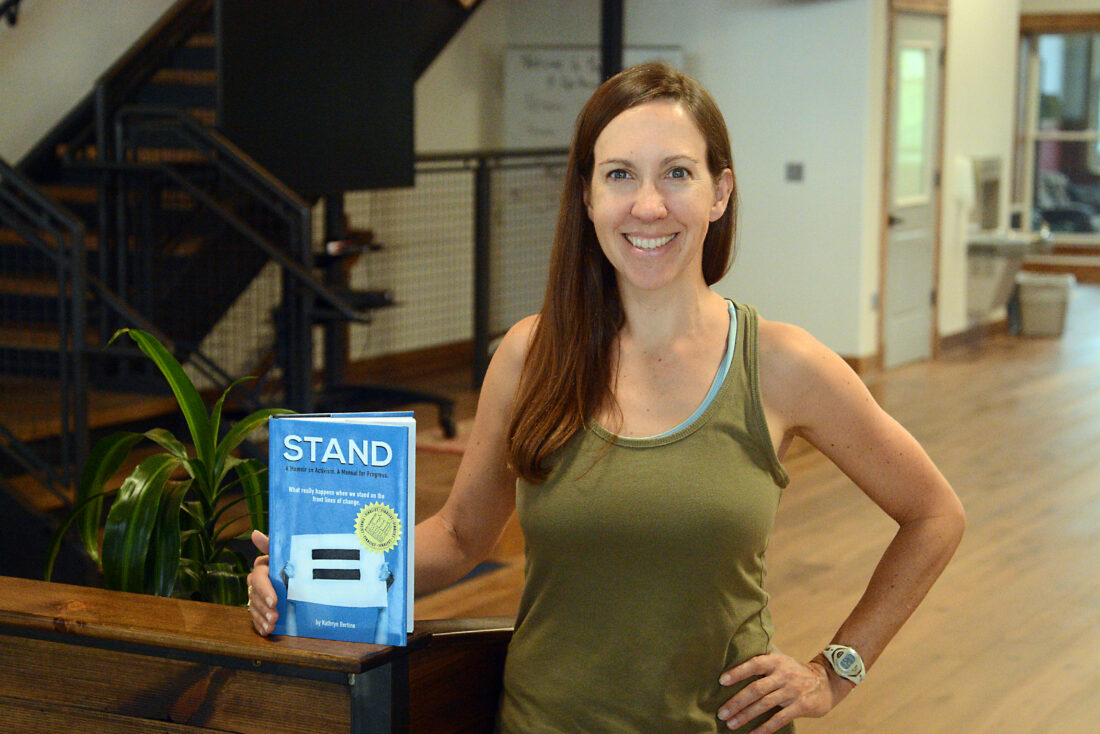
Kathryn Bertine(News Photo)
LAKE PLACID — Kathryn Bertine, an author, former professional cyclist and writer for ESPN, wants to take a stand for women in sports.
Bertine was at Northwood School’s Innovation Hub on Main Street in Lake Placid for a brief talk and book signing on Aug. 18. She showcased her latest book, “STAND: A memoir on activism. A manual for progress. What really happens when we stand on the front lines of change.”
The memoir, which was published on Jan. 28, is about Bertine’s decision to take a stand against gender discrimination within major corporations such as ESPN and the Tour de France.
–
Lake Placid roots
–
Bertine grew up in Yonkers and first came to Lake Placid around 1987, when she was about 12 years old. She came for an Ice Sports Industry figure skating competition.
During her time in Lake Placid, she was introduced to the idea of being able to figure skate during the summer.
“The rink I skated at in Yonkers closed down for the summer, it was just seasonal,” Bertine said. “So knowing that I could come up here and skate at the Olympic rinks was really amazing concept.”
She said that she skated for a total of six summers and fell in love with Lake Placid.
“The sense of community that we have as skaters clearly kept us bonded and I loved the town and I love the history,” Bertine said.
She continued to skate past her youth and even tried joining figure skating tours.
Officials at a traveling figure skating show, the Ice Capades, urged her to get a college degree before they would hire her as a professional figure skater, according to Bicycling magazine. She attended Colgate University, where she was recruited to run cross country.
While at Colgate, she didn’t get along with her coach and decided to join the rowing team. The Ice Capades eventually went out of business, so she joined Holiday on Ice, which toured around the world. Holiday on Ice became Hollywood on Ice, where she said she endured insulting mandatory weigh-ins, according to Bicycling magazine.
Once she retired from professional skating, she attended graduate school at the University of Arizona.
Bertine said that Arizona did not have a lot of ice or water, so she wanted to find a new sport to do. She said a rowing friend told her to get a bike because a lot of rowers and skaters transition well to bike racing.
“I started in triathlon and then it became apparent that my strongest discipline in triathlon was in cycling so I made the transition,” Bertine said.
With her cycling skill, she was a dominant triathlete. She completed two Ironmans in Lake Placid in 2001 and 2004. She also completed two half Ironmans in Lake Placid.
She became an elite level athlete, competing in competitions such as the World Duathlon Championship and more than 40 Olympic and sprint distance races combined, according to her book, “All the Sundays Yet to Come: A Skater’s Journey.”
–
Life as a writer
–
While starting her journey in cycling and triathlon, she studied writing at the University of Arizona.
“I researched that the University of Arizona had a pretty strong creative nonfiction, creative writing department,” Bertine said. “They also had a strong journalism school there. I was like, ‘This is where I want to go.’ I knew from an early age that I wanted to be a writer. Being on that path is what led me towards the world of journalism.”
After graduating from Arizona, she wrote her first book, “All the Sundays Yet to Come,” in 2003.
Three years later, she was hired by ESPN as a columnist. While continuing her professional cycling career, she created a series where she wrote about her quest to qualify for the 2008 Beijing Summer Olympics in cycling.
After her 18 month assignment, which resulted in her not qualifying for the Olympics, she left ESPN and would not come back until 2011, she said on a podcast with Alain Guillot. When she returned, she pitched a documentary film on inequity in women’s cycling.
Bertine said the network turned her pitch down and essentially told her that nobody would watch a film on women’s pro cycling.
–
Taking a stand
–
Bertine said that it was the guys in ESPN that were actually quite supportive of her ideas, and that it was at espnW, a section of ESPN that promotes women’s sports, where she ran into trouble. She said the women’s department was not as welcoming to some of the newer, edgier ideas in journalism.
“For me, it was a really interesting lesson learned,” Bertine said. “Keep in mind I’m in my mid-thirties so I think, like, ‘Okay, I’m grown up I think I know how things work a little bit,’ and I was not prepared to come up against this idea that not all women support women. So when my boss at the time said no, I’m not gonna entertain this idea of a documentary on women’s pro cycling, I was pretty blown away at that time, and it really flipped that eternal switch.”
She said it made no sense because ESPN had the financial ability to make the film and it would only broaden their audience and viewership.
“When (her boss) said no, we are not doing this, it turned the switch to like, ‘Fine, if you’re not gonna do it, I’m gonna do it,’ which was terrifying,” Bertine said. “I actually said that out loud at one point, so I had to do it.”
She said that she remembers thinking she knew there was an audience for this out there, and that she would prove to ESPN that this was a mistake on their part to say no to her idea.
When she started to make the film, she was living in Tucson, working part-time as a waitress trying to fund her pro-cycling dreams and goals. She interviewed a lot of local people, because she believes change starts at a local level.
Eventually, the film gained more financial backing, and it gave her the ability to do things like fly out and interview a European Olympic gold medalist. Some of the best footage from the entire film, she said, came from interviewing local Tucson people.
Her documentary, “Half The Road,” was released in 2014 and won five film festivals awards. It debuted in 16 nations and scored international distribution, according to Bertine’s website.
“After it was out there and the world started responding to it, that is how I knew it was the right choice,” Bertine said. “Keep in mind when I saw the world had responded to this, and they were renting and they were viewing and buying tickets, that doesn’t make a documentary filmmaker a millionaire, it’s not like it changed a whole lot for me.
“What really, truly did change was the idea that women’s cycling was powerful, interesting and marketable,” she added. “That was what made it a paradigm shift in the sport itself. For me, that was a huge win, we were extremely successful that way.”
Bertine continued her activism for women’s professional cycling. She started Le Tour Entier, a social activism movement, in an effort to bring parity to women’s professional road cycling. The group started with the Tour de France, according to Bertine’s website.
The group created an online petition in 2013 to challenge the parent company of the Tour de France, Amaury Sport Organization, to allow women to participate in the race. The petition closed with 96,422 signatures.
Earlier this year, it was announced that women would finally get to have their own race, the Tour de France Femmes.
“I think that we can and should start small, that’s where the seed is planted,” Bertine said. “Here I am, living in Tucson, challenging ASO, the parent company of Tour de France. At first, they were listening, and eventually, they did. If I’m able to make that change happen from Tucson, I’m like, ‘Okay, we all have that ability, we just need to start from where we are.'”
She said that even though she wanted to prove to ESPN and the Tour de France that they were wrong, her biggest motivator was to prove that women belong there. She said she felt that both ESPN and the Tour de France were these powers that thought that they got the ultimate say, and they shouldn’t be able to have that final decision if they do not listen to their audience.
Bertine said she’ll continue to stand up for what she believes in and wants others to do the same. In fact, her book was even rejected by publishers multiple times, so she decided to independently release the book.
“I would say to young girls that you have the power to make change happen,” Bertine said. “Don’t let anyone tell you otherwise, whether that is men or women. And to young boys, support the sisterhood, when you see strong, awesome girls and women that are doing something cool, get them support mentally, financially, emotionally, show them that you are in their corner.”
Local Sports

Youth hockey champions

Hundreds cheer on USA hockey at Olympic Center
Section VII takes on Nordic skiing state championship
The Saranac Lake girls Nordic ski team is the state champion for the first time in school history. The Red ...
Meyers Taylor wins Olympic monobob title
US finishes 5th in Olympic luge team relay
Fisherman is Jamaica’s new bobsled pilot
CORTINA D’AMPEZZO, Italy — Monday, Feb. 16 would have been a fantastic day for fishing in Jamaica. The weather ...