ON THE SCENE: ‘Snow on Demand’ for winter sports
- Tom Mason looks at an exhibit. (Provided photo — Naj Wikoff)
- Dave Jones and Nancy Beattie (Provided photo — Naj Wikoff)
- Courtney Bastian, Lake Placid Olympic Museum director, with board Chair John Becker (Provided photo — Naj Wikoff)
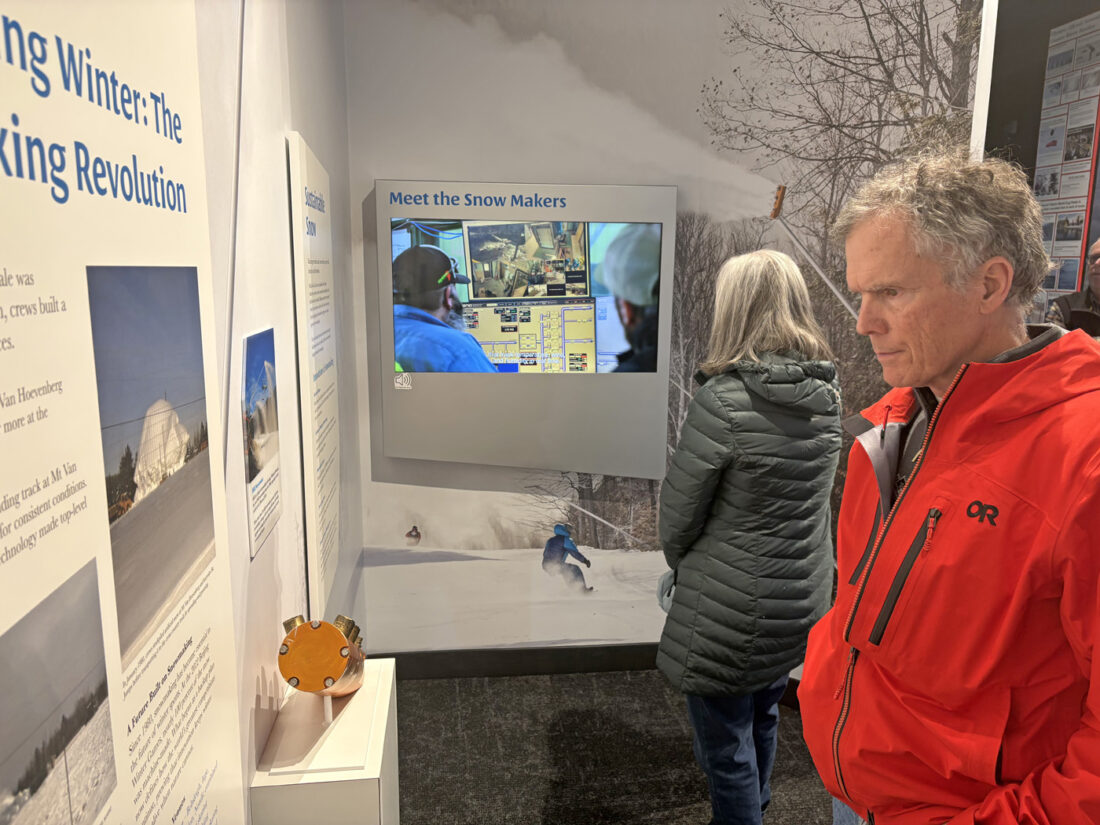
Tom Mason looks at an exhibit. (Provided photo — Naj Wikoff)
Lake Placid’s culture is intertwined with the wondrous Adirondack natural environment and sport, particularly winter sports, though summer events such as the horse show, Ironman, lacrosse and rugby have grown in stature. These two fundamental assets are being significantly impacted by climate change, as highlighted by a new interactive exhibit at the Lake Placid Olympic Museum located in the Olympic Center.
On Wednesday evening, Feb. 4, the museum showcased its new exhibition, “Snow on Demand,” that featured a variety of interactive displays that illustrate the growing impact that warming temperatures and severe weather are having on winter sports, and the evolving technologies that are being developed and put to the test at Olympic Regional Development Authority venues as a means of providing athletes and recreational enthusiasts a quality experience.
The display also provides insights into how a wide variety of wildlife adapt to changing weather, techniques that we humans have adapted to enable us to have a positive outdoor experience, no matter the weather.
Highlighted at the beginning is the prediction, backed by research, that by 2050, only four former Winter Olympic host communities will have reliable winters: Lake Placid; Lillehammer and Oslo, Norway; and Sapporo, Japan. Consider that on Feb. 4, as it has been for much of the winter, it was too warm to make snow in Park City, Utah, as temperatures have been 15 to 20 degrees above normal.
While this year we in the East have been enjoying a banner snow and cold weather season, it is far warmer and less snowy than people who have lived up and through the 1960s have experienced.
Dave Jones and Nancy Beattie (Provided photo — Naj Wikoff)
“Throughout my life, every winter is different,” said Dave Jones, of Lake Placid. “It’s been 60 degrees and 40 below on Christmas day. You never know, but I remember tunneling in the snowbanks in front of our house on Greenwood Street as a child. Today, some days there are no snowbanks. The exhibit’s incredible, phenomenal. They’ve done a beautiful job.”
“The exhibit goes into a lot of things, starting with what climate change is,” ORDA Communications Manager Jaime Collins said. “What stood out for me was learning about the innovations in snowmaking, along with using drones at Whiteface to determine which area of the mountain needs snow and which has enough; they can pinpoint where snow is needed.”
At Whiteface, as is true at all other venues, the goal is to crank out more snow at a higher quality and less cost, while making the most efficient use of energy and water. A terrific example is taking place at the ski center, where the venue continually upgrades and modifies the system, thereby improving customer satisfaction.
Morgan Langey, now in his 25th year on the hill, is the snowmaking supervisor at Whiteface. He leads a large dedicated team, many of whom work through the night in at times brutal conditions, to create an enjoyable ski experience with a well-packed, deep, covered surface. In the area set aside for training and athletic competition, they create their desired harder “boiler plate” surface vital for providing consistency over a race.
While Whiteface has slopes for all skiing abilities, overall, it’s one of the steepest resorts in the east, which makes it especially challenging for crews to cover and groom. What’s required is about 75 miles of air and water piping across the mountain, and five major pumping stations to lift the massive amounts of water from the Ausable River to the highest ski slopes in the East, all the while seeking to dissipate heat generated by compressing the air needed to spray fine droplets of water into the air to create snow.
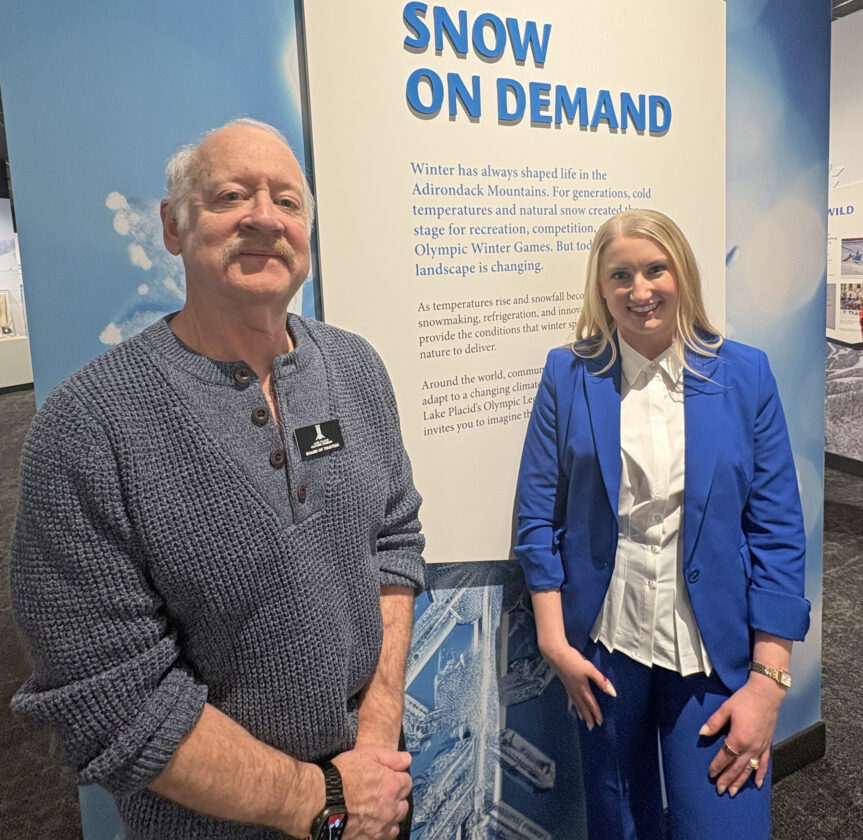
Courtney Bastian, Lake Placid Olympic Museum director, with board Chair John Becker (Provided photo — Naj Wikoff)
“Since COVID, we’ve redone the majority of our snowmaking infrastructure,” Langey said. “Snowmaking is now job security. The planet is changing. Without practical snowmaking on this mountain, we wouldn’t have much of a season. Having the investment and crew we’ve had over the past couple of years has enabled us to do amazing things.”
Langey said that the new energy-efficient guns outshine anything they’ve had before. However, the snow they make can contain more water, thus they create huge piles that they let sit so the excess water can leach out, leaving drier snow for the crews to spread over the trails and groom into the surface treasured by skiers.
At the peak of the season, Langey had 40 people working 12-hour shifts, many through the night, in often brutal conditions on the steepest mountain in the East, to provide skiers with a quality experience. Now the crew is down to less than half that number.
The process begins with high volume low pressure 250 horse power pumps that can draw 2,000 gallons of water a minute each for a maximum of 6,000 allowable out of the West Branch of the AuSable River, water that is initially screened and filtered before sent on to the first wave of high-pressure pumps that push water up to succeeding pumps spread out over the mountain. Aside from screening out twigs, branches, and fish, a vexing problem can be slush, which can overwhelm the system unless physically removed.
On average, 350 million gallons of water are used each year, with well over 90% eventually returning to the river. Their work and enhanced snow-making techniques are being appreciated by the skiers.
“We often ski out West in the Cascades, because our son lives there, but this year we are not because our son said don’t come, the snow and the snow making is not good,” Mauricio Gonzales said.
“I’ve been skiing at Whiteface full time since the early 1990s,” Bob Dickie said. “At a place like Whiteface, snowmaking is very important. Even with all the natural snow we’ve received, the Whiteface crew has made a ton of snow. They have been getting better and better at making snow. Decades ago, it probably earned its nickname as ‘Ice Face,’ but that term is totally unjustified these days. In fact, I was skiing at Gore this morning. I was amazed by how much better the conditions are here. From the snowmaking and quality of the grooming, Whiteface has done so much better.”
Courtney Bastian, Lake Placid Olympic Museum director, said that the exhibit came out of a desire to provide an experience that focused on climate change and science, and on their impact and importance on winter sports and winter recreation.
“The exhibit is fantastic,” Tom Mason said, a longtime ski instructor at Whiteface. “It also tells how we were the first-ever Winter Olympics host to use manmade snow, which has been used ever since.”
Mason also encourages people to take in the simulated bobsled ride, located next to the “Snow on Demand” exhibit, where one can experience riding down Lake Placid’s refrigerated track, and the all-natural Cresta Run near St Moritz, Switzerland, a track that will no longer be possible to build or use in the near future.
“The exhibit underscores the reality that we all face, especially in what we consider to be a climate resilient ecosystem,” said Adirondack Council Executive Director Raul “Rocci” Aguirre. “Climate change is having an impact, the exhibit highlights that very well. I don’t think you get a real sense of what exists until you see the visuals that illustrate the impact and change. You see that here.”
The Lake Placid Olympic Museum is open daily from 9:30 a.m. to 5 p.m. Learn more at lakeplacidolympicmuseum.org.
(Naj Wikoff lives in Keene Valley and has been writing his column for the Lake Placid News since 2005.)
Columns

ON THE SCENE: Before there were trees
MARTHA SEZ: ‘This is what happens to the elderly brain, mine included’
Biff says he knew the war our country is now conducting with Iran didn’t surprise him one bit. It was in the ...

ON THE SCENE: Olympians on the Olympics
MARTHA SEZ: ‘Then there is the sad but true … story of the cow in the cemetery’
Every once in a while, I look back at columns I’ve written over the years and reminisce. There was the time, ...
LIONS CLUB LOG: Lions Club meets LPHS senior Joselyn Hernandez
The Lake Placid Lions Club has had a busy start to the 2025-26 seasons involving the Annual Radio Auction, ...