ON THE SCENE: A third Winter Olympics in Lake Placid?
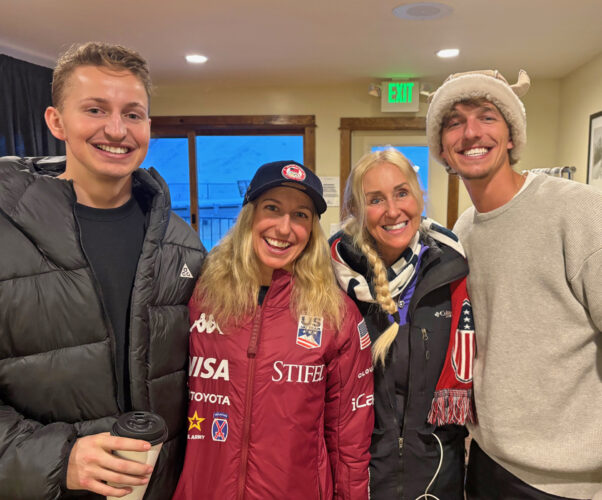
- Andrew Weibrecht and Robert Carroll (Provided photo by Naj Wikoff)
- Ashley Walden, Marc Galvin and Tim Burke (Provided photos by Naj Wikoff)
- John Morgan and Billy Jones (Provided photos by Naj Wikoff)
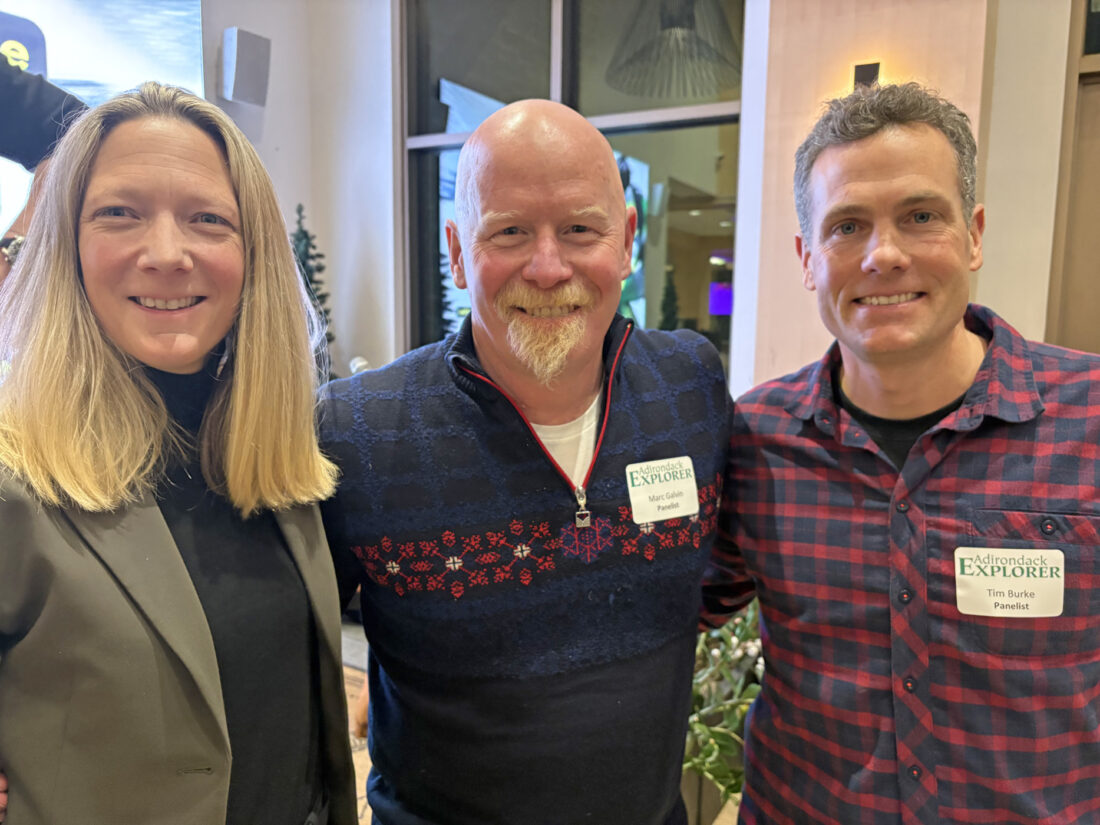
Ashley Walden, Marc Galvin and Tim Burke (Provided photos by Naj Wikoff)
Should (or could) Lake Placid host another Olympics?
Not alone, but worth exploring was the consensus of the well-attended panel discussion held at the Mount Van Hoevenberg base lodge on Thursday, Jan. 22. Organized by the Adirondack Explorer, sponsored by the Adirondack Council and hosted by the state Olympic Regional Development Authority, the panel featured three Olympians — U.S. biathlon coach Tim Burke, ORDA CEO and former USA Luge athlete Ashley Walden and two-time Olympic Alpine ski medalist and Mirror Lake Inn Resort and Spa Operations Manager/Vice President Andrew Weibrecht — state Assemblyman Robert Carroll, NPR reporter Brian Mann and Marc Galvin, co-owner of the Bookstore Plus and Lake Placid village board member. Over 150 attended, and Adirondack Explorer reporter Zachary Matson moderated the panel.
Lake Placid has hosted two Winter Olympics (1932 and 1980), two winter FISU World University Games (1972 and 2023) — second only in size to the Olympics — and numerous World Cup and World Championships across several disciplines. As an outcome of the significant investment by New York state for the 2023 FISU University Games, most of ORDA’s venues meet or exceed the highest international standards, except for the lack of a covered speedskating oval and an Alpine downhill course, which Weibrecht said is being addressed and tested this winter.
Even so, for Lake Placid to host another Olympics, it would need an urban partner like New York City or possibly Montreal to stage all skating and curling events, as well as the opening and closing ceremonies. Gore and Belleayre could possibly hold some of the skiing events. The distance between Lake Placid and New York City is similar to that between Milan and Cortina, and Beijing and the Yanqing and Zhangjiakou districts, where its Alpine, cross-country and sliding races were held.
Most likely, 2042 or 2046 are Lake Placid’s best chances as Switzerland is in discussion with the International Olympic Committee for 2038, though climate change could put a crimp in those desires as well as Salt Lake City’s in 2034 as the weather out West this year is illustrating as many resorts have been too warm to even make snow (Lake Placid picked up a Freestyle World Cup final event as a result).

Andrew Weibrecht and Robert Carroll (Provided photo by Naj Wikoff)
Salt Lake City’s other, and possibly greater, challenge is the growing threat of air pollution. Great Salt Lake has shrunk dramatically in size (it has lost 60% of its surface area), and as it does, winds across the toxic, dried lake beds are adding dangerous pollutants to the air, which is already stressed by increased traffic-related pollution.
As a result of overall increased temperatures, an increasing population with water needs, and historically low snow pack this winter, scientists are warning of the lake possibly disappearing in the near future, posing serious health risks for humans, and, of course, athletes.
One of Matson’s opening questions went to Mann, the former North Country Public Radio reporter and now an NPR representative, who is soon heading to Italy to cover the Games. Mann praised ORDA’s high ethical standards in comparison to the corruption he often witnessed in Albany for NCPR, yet he highlighted the ongoing significant investment by the state and questioned its sustainability and value.
“ORDA does astonishing things,” said Mann. “There are amazing events that occur here. We have athletes whose careers have been significantly shaped by ORDA’s efforts. A lot of that happens off the ledger; it’s hard to quantify the benefits to the region, the state, and individuals. But there is also a pattern, as ORDA has transformed itself over the last decade; fundamentally, it’s a different organization that used to operate in the millions and occasionally tens of millions of dollars, that now operates in the hundreds of millions of dollars.”
Mann said there are some important questions that need to be asked: what is the return on the investment, what’s the management structure, and are we getting the best return on an investment of this scale? He believes ORDA’s new normal is an annual state investment of 80 million, and at times more. He feels that with that kind of taxpayer investment, it’s important to dig into those numbers and not let the aspirations or the hosting of a new event get in the way of asking the questions.
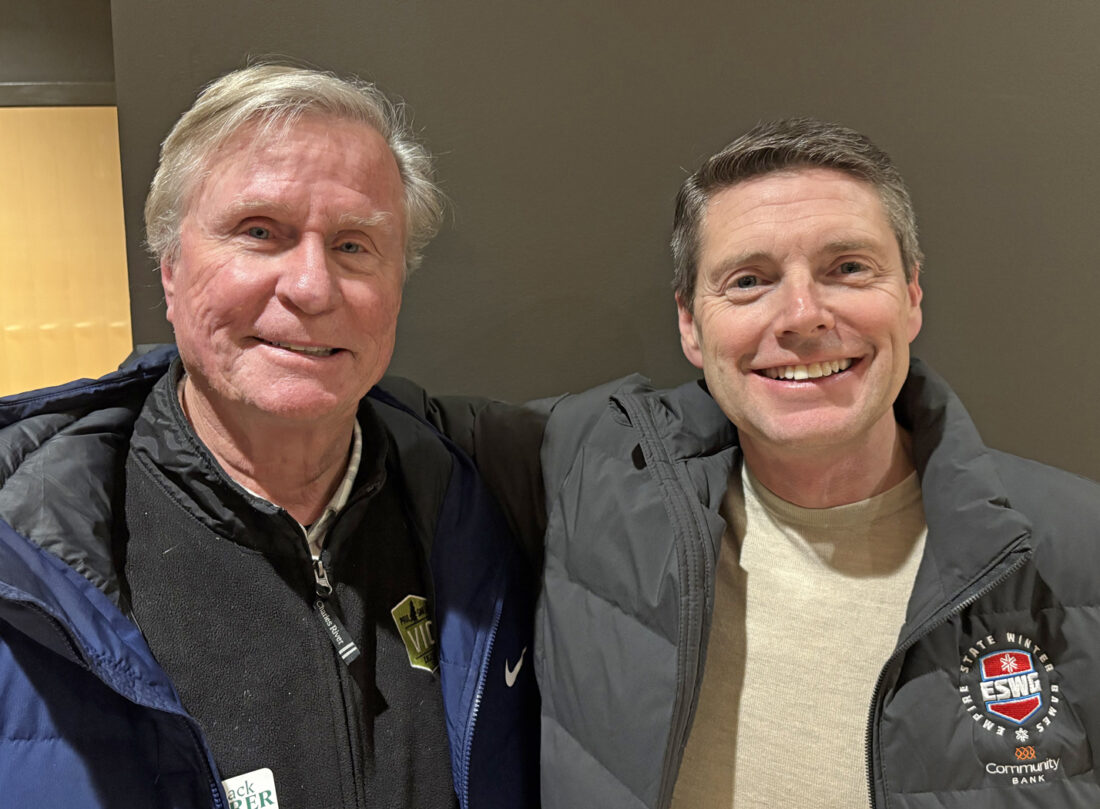
John Morgan and Billy Jones (Provided photos by Naj Wikoff)
Galvin and Weibrecht countered with two salient points. Galvin said we should not measure the economic benefits of a major sporting event by short-term gains, and Weibrecht said Lake Placid and the region’s economy have significantly increased, and that he has learned that most of the Inn’s new visitors are initially attracted by ORDA events and venues.
“From a Main Street perspective, we’re in it for the long haul,” said Galvin. “It’s not about how much you make during an event, but through making sure visitors have a great time, people will come back year after year. I know that there was a lot of talk about how flat business was during the University Games, but we got a six-hundred-million-dollar investment in the venues, which has secured our spot as a winter destination, and brought in lots of people and investment year after year.”
Weibrecht said that recent economic data research covers the period from 2012 to 2023, a time that overlaps with the venues being upgraded.
“Essex County has grown in tax dollars revenue from tourism by 159%,” he said. “It is now the largest tourism-generating area in all of northern New York state. It’s passed Warren and Saratogac counties and is closing in on a billion dollars a year. I think what we need to talk about, when we think of the venues, is that there are a lot of beautiful places in the Adirondacks, and people have a lot of choices. What does this region have that nobody else has? You can look at the investment the state has put into the venues, and the usage of the venues, and say, yes, they are having an incredible impact on local business.”
When discussing their takeaways from participating in the Olympic Games, Weibrecht stressed the challenges posed by logistics, security, and transportation, noting that, compared with many other host villages, Lake Placid is better positioned than most and that a partnership with New York City would bring many assets.
Walden said preparation and adaptability are key; it’s important to plan, but surprises happen. She said that in the Olympics or organizing a FISU Games, there are a lot of moving pieces. Another takeaway for her was how incredibly valuable our venues are, and following the University Games, ORDA now receives far more requests to stage events than they can accept.
Both Burke and Weibrecht pointed out that growing up in a region where former Olympians and fabulous venues abound results in kids viewing becoming an Olympian as achievable (if these normal people did it, I have a chance), coupled with learning how to skate, ski, and slide alongside members of national teams.
Assemblyman Carroll, who represents a Brooklyn district, stated flatly that Lake Placid cannot host the Olympics by itself, but in partnership with New York City, it’s a distinct possibility, as both communities have amazing venues that, combined, would result in an exceptional Games. Carroll feels that what’s needed is an exploratory committee that includes representatives of both communities, to be established now to examine the potential, benefits, risks, challenges, and opportunities.
“I think there is a real shot of hosting the games in 2042, 16 years away,” said Carroll. “The IOC now chooses the venue more than 10 years out. I think a Lake Placid-New York City Olympics would be of extreme value to our whole state. There is too much of a divide between upstate and downstate New York. I believe these Olympics will bring our state together. I think that it would be an immense civic project that would supersede any large civic project that our state has undertaken since the Erie Canal.”
“If the state and community desired to host an Olympics, we’d ready the facilities for that,” said Walden. “Obviously, in fifteen to 20 years, we’d continue to improve them. We see that need as race standards change all the time, as athletes get better, we’re continually having to adapt and change, which we need to do if there will be an Olympics or not.”
Responding to Mann’s concerns about labor shortages and housing, Walden said these are concerns they share with local and state leaders and that they are working to improve efficiencies as they collaborate with others to address these critical issues.
“We have insured assets of over $600 million,” said Walden. “Replacement of these assets is probably double or triple that. What we are looking at is how to extend the benefit of those investments. We want to centralize things, bring the venues together, and not just maintain those assets but extend their life as much as possible. That’s a conversation we’re having at the board level.”
“I thought that it was a wonderful conversation,” said Nick Politi, who is an associate real estate broker and owner of Merrill L. Thomas, Inc. in Lake Placid. “We need to continue the legacy here in Lake Placid for our kids and, thanks to the upgrades of the venues, we have the capabilities to do this.”
“I think the whole premise is, as my former colleague Robert Carroll said, to have the conversation,” said former North Country Assemblyman Billy Jones. “We need to have people in the room who are thoughtful and can measure out the pros and the cons. Yes, it’s a big dream, but we’ve always gone after big dreams. We’re not going to tear down these assets, the venues down, we need to keep them operating at a world-class level.”
“I’ll bet in 1932 and 1980 we didn’t have an assemblyman from Brooklyn beating our drum,” said local sportscaster John Morgan.
“The only way to make a dream come true is to pursue it,” said ORDA Board Chair Joe Martens.
(Naj Wikoff lives in Keene Valley and has been writing his column for the Lake Placid News since 2005.)
Columns
LIBRARY NEWS: AARP volunteer tax help begins at Lake Placid Public Library
The Lake Placid Public Library offers support for many new years’ needs, including tax preparation, wellness ...
‘I kept texting Woody snow videos. He sent no reply. Not even an emoji.’
How much snow did you get? A winter storm that meteorologists are calling potentially historic started in the ...
MARTHA SEZ: ‘Have you ever looked at your reflection in the funhouse mirror?’
January. The beginning of the New Year! In November 2025, we celebrated Thanksgiving and then, in December, the ...
ON THE SCENE: Recapturing the Miracle on Ice
MARTHA SEZ: ‘Earth’s longest living creatures reside far down in the briny deep’
“Now this is the Law of the Jungle — as old and as true as the sky; And the Wolf that shall keep it may ...