ON THE SCENE: FIS Freestyle athletes overcome fear and weather
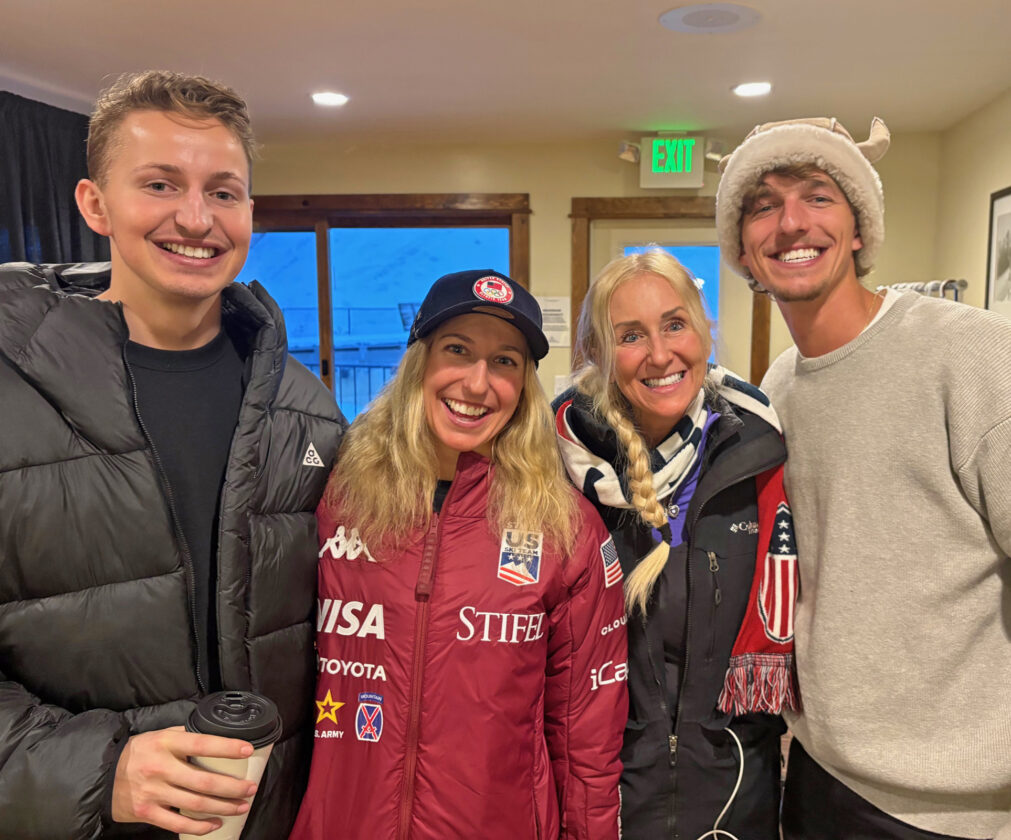
Pictured are, from left, Magnum (brother) Winter Vinecki, Dawn(mother), brother Ruger (with horns). All the family members will be traveling to Italy supporting their athletes. (News Photo - Naj Wikoff)
The FIS Freestyle World Cup individual finals were moved from Deer Valley, Utah, to Lake Placid and held in conjunction with the Stifel Lake Placid Freestyle Cup, a previously scheduled FIS World Cup planned for the weekend of Jan. 11-12. The outcome was Lake Placid hosted back-to-back World Cups, and the awarding of the Crystal Globes.
The reason for the change was the lack of snow out west; 70-degree temperatures in Denver have been the norm until late. But, as in ancient Greece, the gods can be cruel and seem to delight in harassing we mere mortals, especially Zeus, Aeolus, and Boreas, the gods of storms (rain), wind and winter. These gods went all out two weekends ago, blasting Mount Van Hoevenberg with a tropical storm featuring 60 mph gusts that ripped away several sections of track coverings, heavy rain, and downed trees, causing power outages and road closures.
Pulling off its own Miracle on Ice, the Mount Van Hoevenberg track crew, supported by colleagues from the ski jumps and Whiteface, brought the track back to international standards, enabling the Luge World Cup to be successfully held. Having succeeded in driving mortals crazy that weekend, it seemed as if the FIS Freestyle World Cup was too delicious an opportunity for the gods to ignore. Once again, wind and rain whacked another venue, but sensing that possibility, Olympic Ski Jumps assistant general manager Kyle Penny was prepared.
“We bought some concrete curing blankets that contain an insulation liner that we will use to insulate the jumps and protect them from rain,” said Penny. “Protecting the jumps is the most important challenge, as rebuilding them can take from half a day to a full day. Two of the jumps have full-wood encasements, which we built this fall following recent changes to the guidelines. We will be testing both systems now through the next several weeks of the Olympic camp to determine which performs better.”
“The rain that happened last night is a much bigger concern for our coaches and for the venue staff than us,” said US team member Chris Lillis. “If you look around, the site is extremely manicured. Each degree of the jump going down has to be specific, and that’s achieved because the coaches and staff were out here at six or earlier in the morning rebuilding the jumps and getting them ready to go. If we get more rain tonight, guess what, they’ll have to get up even earlier and get it ready again for us. So, a big shout-out to them for making the jumps ready for us to compete safely.”
Penny said he feels an aspect of their support is a result of the decades of experience by members of the venue’s crew, naming Brad Preston and Chip Draper, assisted by former Canadian aerialist Brad Suey and augmented by U.S. Team ski coaches helping finalise and shape the in-run, jumps, and landing hill.
“This past summer, we upgraded aspects of our snowmaking, which included running a waterline around the backside of the freestyle site,” said Penny. “That allowed us to add two new fan guns, which makes covering the hill easier. With the fan guns, we don’t need to turn the big compressor on; with the touch of a button, we can rebuild the in-run quickly if needed.”
Most of the athletes got into the sport fairly young. Quinn Dehlinger started doing slopestyle when he was ten, and later, at a big air competition, he was recruited by one of his current teammates’ sisters and another skier to join an elite hill program. After making that team, he, like Chris Lillis and Kaila Kuhn, lived and trained in Lake Placid for three years, which eventually led all of them to advance to the US Team.
All the athletes said that fear is a constant aspect of their sport. “We try to make it as simple as possible,” said Dehlinger. “It’s easy to get ahead of yourself and think, ‘Oh, I have to do this twist in this amount of time, and then that.’ It’s best to focus on your takeoff. You can’t do a good jump without a good takeoff. From there, you focus on the cues you’ve built up through years of training and rely on all the hours you’ve put in. When you’re looking down the ramp for the first time in a season, it can be hesitating, but once you head down the ramp, you know that you can do it because you’ve done it a thousand times.”
“It would be a lie if any of us told you that we weren’t scared,” said Kaila Kuhn. “It’s about managing fear, and we all have different ways of doing that. Sometimes it’s breath work, or meditation, or speaking with sports psychs.”
“It’s been a long time since I’ve questioned whether I was going to go,” said Lillis. “I don’t know whether the jump’s going to work out or not, or if I’m going to land on my feet. I’ve definitely taken a lot of hard crashes over the years, but I know that I’m going to turn my skis. Knowing that gives a certain amount of certainty to it that allows me to focus on all the small things you need to do to have success.”
“Visualising is key,” said Vinecki. “Making sure I have it in my head before I turn my skis, and then it’s about finding that confidence, whether from the jump before that I did good or remembering a jump that I did good several months ago. It’s all about defining a couple of key things that will help make it simpler. We rely on muscle memory from the thousands upon thousands of previous decisions.”
All said that the support of their family and friends is critical, as is being in a supportive community like Lake Placid, where people they meet in town or work at the jumps know why they are here and what it takes to compete at a high level.
“The athlete and the Olympian are not you,” said Lillis. “You have to love yourself regardless of how things go in the competition. You have to remember that you are more important than any one event or day. I remind myself that there is Chris the person and Chris the athlete – I try not to get the two confused.”
Columns
ON THE SCENE: Olympians on the Olympics
MARTHA SEZ: ‘Then there is the sad but true … story of the cow in the cemetery’
Every once in a while, I look back at columns I’ve written over the years and reminisce. There was the time, ...
LIONS CLUB LOG: Lions Club meets LPHS senior Joselyn Hernandez
The Lake Placid Lions Club has had a busy start to the 2025-26 seasons involving the Annual Radio Auction, ...
ON THE SCENE: Mountainfest magic in town of Keene
MARTHA SEZ: ‘You were born in a Pig year, but don’t think of yourself as a pig’
Yippee-ki-o-ki-yay, galloping all the way, here comes Year of the Horse! My apologies to Hanna-Barbera Animation ...