ON THE SCENE: Hoevenberg’s team restores sliding track in brutal weather
- Brett West and son, USA Luge athlete Tucker West (Provided photo by Naj Wikoff)
- Chris Gill, Ricky Friedrick and Gunner Sheffield at Mount Van Hoevenberg (Provided photo by Naj Wikoff)
- Shaving the ice (Provided photo by Naj Wikoff)
- Luge official Rob Doorack and Mark Grimmette, USA Luge sports program director Provided photo by Naj Wikoff)
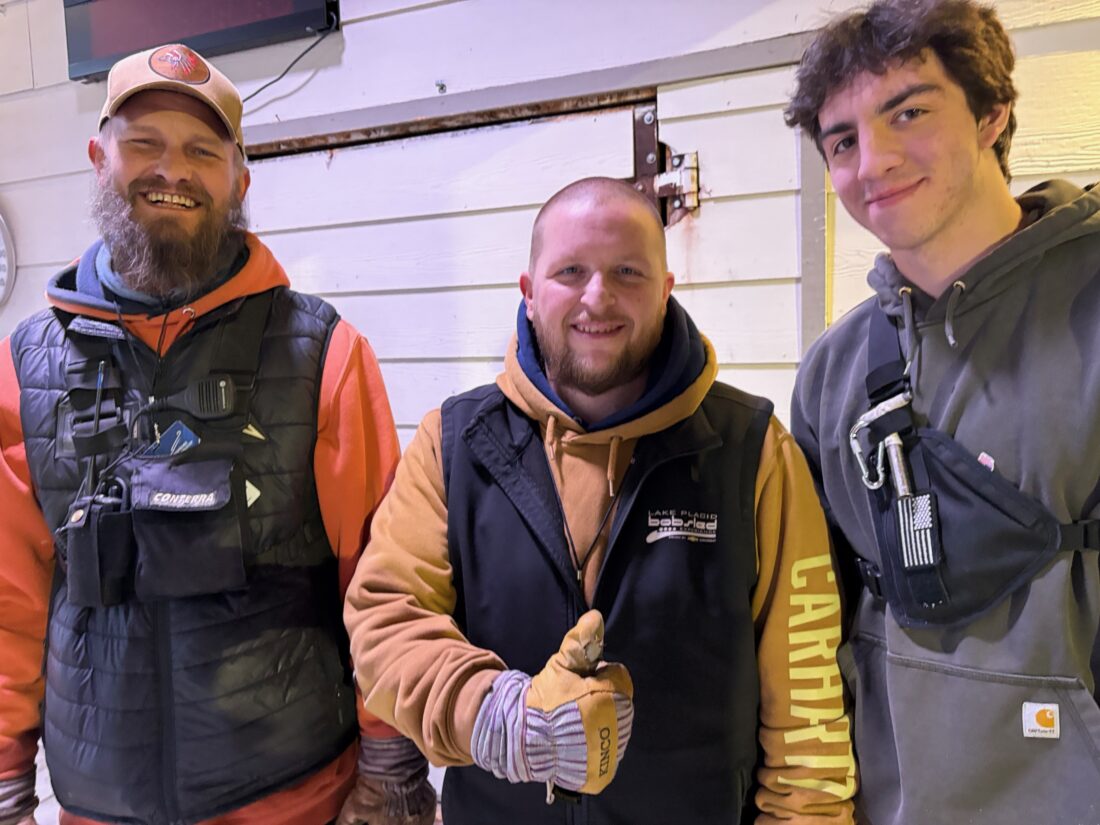
Chris Gill, Ricky Friedrick and Gunner Sheffield at Mount Van Hoevenberg (Provided photo by Naj Wikoff)
The FIL Luge World Cup, scheduled for Dec. 18 to 20, was much more than an Olympic trial for the athletes; it was its own kind of trial for the track crew at Mount Van Hoevenberg, which faced daunting odds caused by a brutal weather system that arrived on day two of the race.
Few people would have imagined that the serpentine sliding track would have re-opened Saturday, much less that evening, following two waves of 60 mph wind gusts, heavy rain, power outages and temperatures in the low 50s. That it did was the result of a full-court press by the Mount Van Hoevenberg staff, seasonal temp workers, German ice meisters, staff from the ski jumps and Whiteface Mountrain, along with Gilbane and other contract workers.
When venue manager Ric Preston and lead Hoevenberg ice meister Ricky Friedrick arrived early Saturday morning, they faced trees fallen over in the drive in from state Route 73, and along the service roads that led up to the top of the track. Porto-johns were blown over, marketing materials and several track shades ripped away, along with branches and other debris in the track, plus it was raining hard.
Normally, prepping a track is a time-consuming process. This year, as a result of major investment in the run to upgrade its refrigeration system and make the track more viewer-friendly, the track crew got a late start, the ice was thin a couple of weeks out, which took a considerable effort to get it back to international standards.
Track crews’ typical work day starts at 3 a.m. Breaking into three groups, each assigned to a third of the track, they start by walking down the track looking for bumps, jumps — anything that needs roller chiseling, using a sharpened planner blade set in a 4-inch-wide metal frame attached with a flexible joint to a long handle to shave off protrusions in the ice. The roller chisel allows them to smooth out the curved ice in the track, four inches at a time. Any holes are filled and smoothed in with a thick slush.
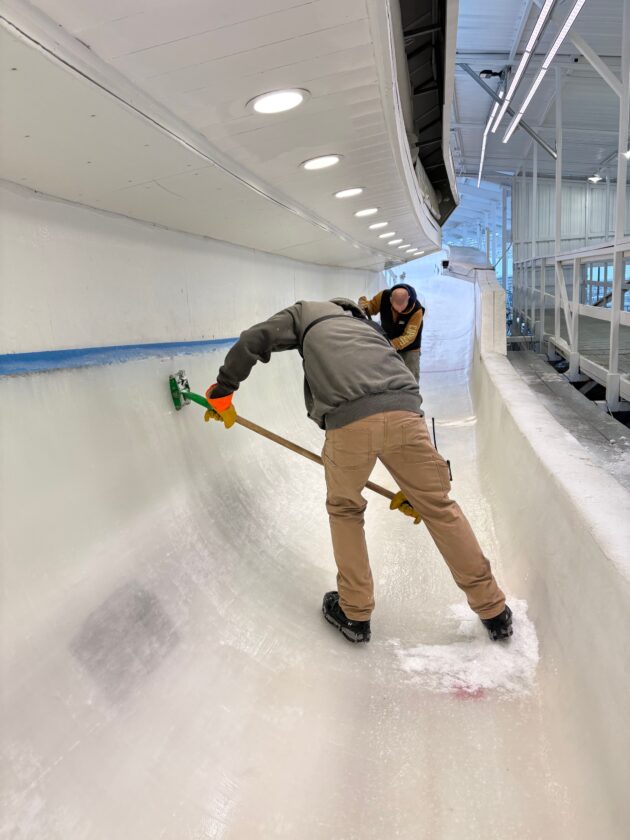
Shaving the ice (Provided photo by Naj Wikoff)
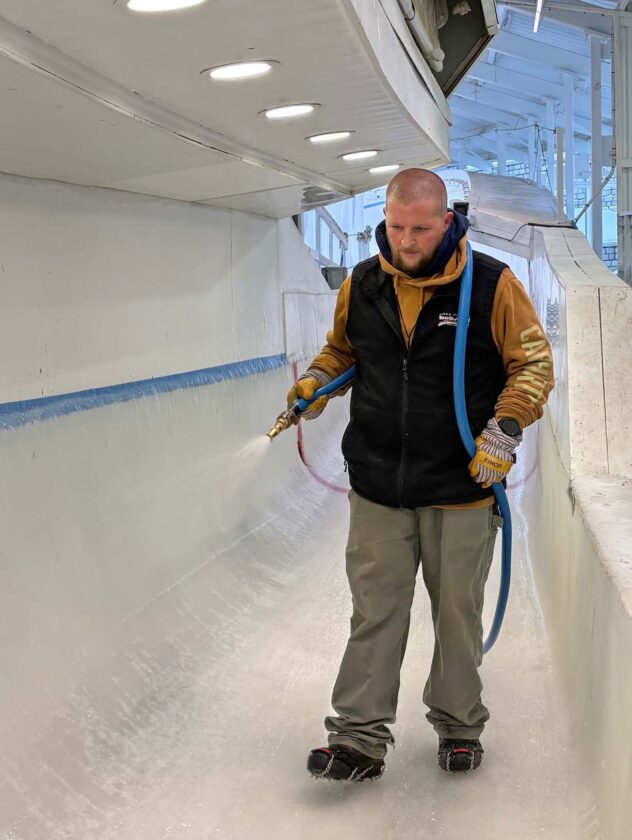
“Our job is to provide sliders with world-class ice,” said Friedrick, the crew chief. “We do a mile 4 inches at a time, usually shaving the ice 2 millimeters at a time. We build out the ice by spraying water on the track; it takes a lot of watering. We try to get ten coats on per shift. In season, we often work 10 hours or more a day. When it’s challenging, some do 15.”
“Our biggest challenge is wind and warm weather,” said Chris Gill.
On Friday, they were hit by extreme winds, very warm weather, heavy rain, power outages, and debris in the middle of a World Cup featuring the top sliders from 16 nations.
“When I arrived, it was already 50 degrees out; a lot of rain, wind, but we got lucky when the rain stopped,” said sliding sport operations manager Brian Berghorn. “Things started to cool off a little bit, and we were able to scrape the frost off the track. Then we got wind and rain again, and trees went down everywhere, taking down power lines, causing us to lose refrigeration. Then it started to snow, and we were facing a flash freeze on the hill.”
“Our maintenance guys did a great job of clearing the paths and roadways, making it safe for everyone driving up and down the hill and walking on the pedestrian paths, and cleaning the debris out of the track. They were cleaning snow and debris out as fast as it was coming in.”
Several sections of the track shades were blown out. Gilbrane crew members managed to replace or wrestle the shades back into place despite the heavy winds that had them bouncing around in their swaying buckets, an achievement that enabled the maintenance crews to get ahead of incoming snow and branches and the track crews to start patching and rebuilding the ice.
“The fact that we were racing at the end of the day on Friday was a bit of a miracle,” said Berghorn.
That miracle was made possible by the help provided by the ski jump and Whiteface maintenance crews, the assistance of a German track crew, Hoevenberg’s track crew, suplimented by seasonal employees from Central and South America, and Lake Placid Municipal Electric and NYSEG teams repairing transmission lines and removing downed trees.
“We struggled a lot with curve four,” said Berghorn. “We have pump stations all the way up the track, and even with the power back on, those higher up were struggling to get back online. On Friday evening, Markus Aschauer and the German team, stationed in cure four, initially had to patch the ice after every sled. The falling temperatures helped make the Friday evening race possible.”
“I was extremely impressed with the amazing job that the track crew did to get the track ready to hold races,” said luge racing judge Rem Davis. “I can’t say enough about the track crew. They brought it back to international race standards, making it possible for the athletes to compete. Hoevenberg’s track crew doesn’t get a lot of credit they deserve for the amount of work they put in to make this track competition ready.”
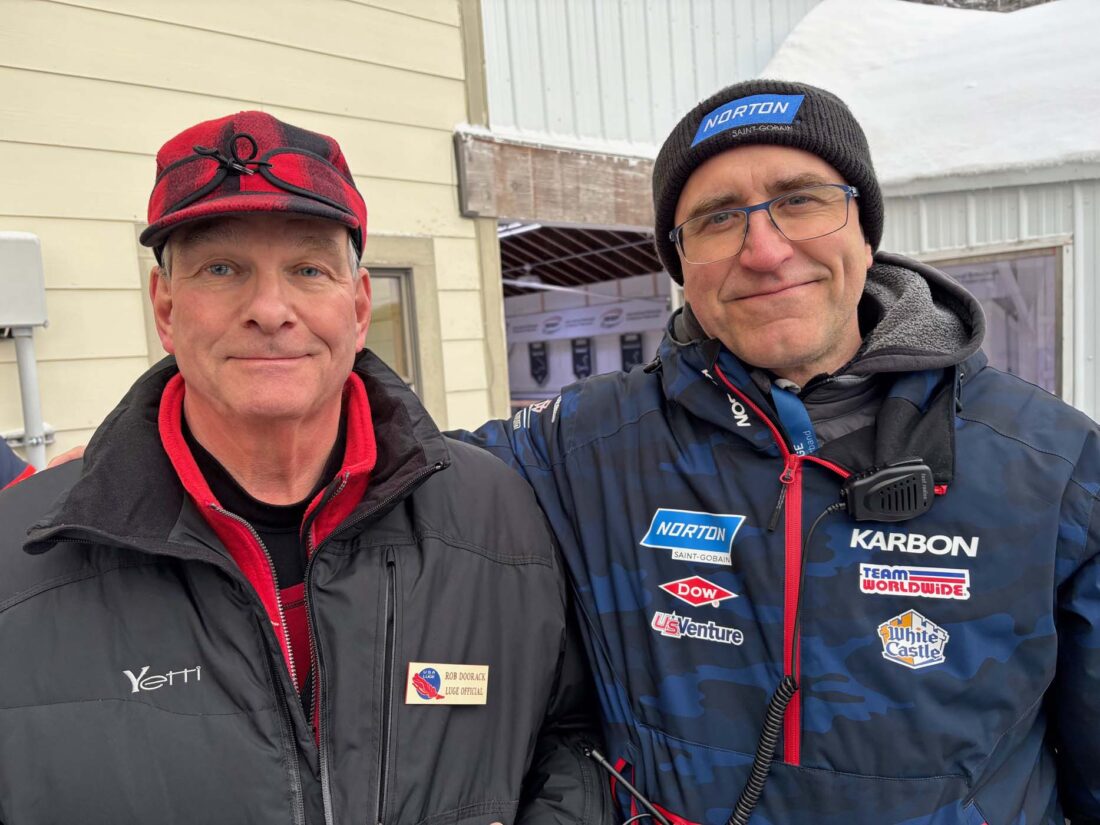
Luge official Rob Doorack and Mark Grimmette, USA Luge sports program director Provided photo by Naj Wikoff)
USA Luge sports program director Mark Grimmette said that Friday’s weather was crazy, going from heavy downpours, then ice crystals in the rain, to snow, all coupled with heavy warm winds, and power outages. He praised the maintenance and track crew for their ability to get the track back to competition standards under such conditions.
“They did a great job,” said Grimmette.
“The worst combination for a track is warm wind and rain,” said USA Luge team member Ashley Farquharson. “The track crew definitely had to work hard to get it slidable for us in the evening. We suffered a bit from snow patches, and it was a bit bumpier than normal, but they did a great job for us. I love a home race. Racing in the U.S. is just amazing because we get so much support.”
“It’s always tough to have a change in the race schedule,” said USA Luge slider Tucker West. “Your first thought is, can the track survive this storm when you see a 70-mph warm wind and rain. But we’ve slid on this track in every condition possible, so whatever condition the track would end up being, we’ve experienced before, so we could probably slide down. But the track crew did a great job of getting it back to racing standards, it ended up being fun racing.”
(Naj Wikoff lives in Keene Valley and has been writing his column for the Lake Placid News since 2005.)

Brett West and son, USA Luge athlete Tucker West (Provided photo by Naj Wikoff)
Columns

ON THE SCENE: Olympians on the Olympics
MARTHA SEZ: ‘Then there is the sad but true … story of the cow in the cemetery’
Every once in a while, I look back at columns I’ve written over the years and reminisce. There was the time, ...
LIONS CLUB LOG: Lions Club meets LPHS senior Joselyn Hernandez
The Lake Placid Lions Club has had a busy start to the 2025-26 seasons involving the Annual Radio Auction, ...
ON THE SCENE: Mountainfest magic in town of Keene
MARTHA SEZ: ‘You were born in a Pig year, but don’t think of yourself as a pig’
Yippee-ki-o-ki-yay, galloping all the way, here comes Year of the Horse! My apologies to Hanna-Barbera Animation ...