ON THE SCENE: Do you feel loved by our country?
- Alexis Adamkowski interviews Mac MacDevitt. (Provided photo by Naj Wikoff)
- Shown here at Heaven Hill Farm in Lake Placid on Dec. 6 are Blake Gendebien, back; Martha Swan and Amy Mountcastle, middle; and in the front, Anika Brown, Alexis Adamkowski and Mrudangi Trivedi. (Provided photo by Naj Wikoff)
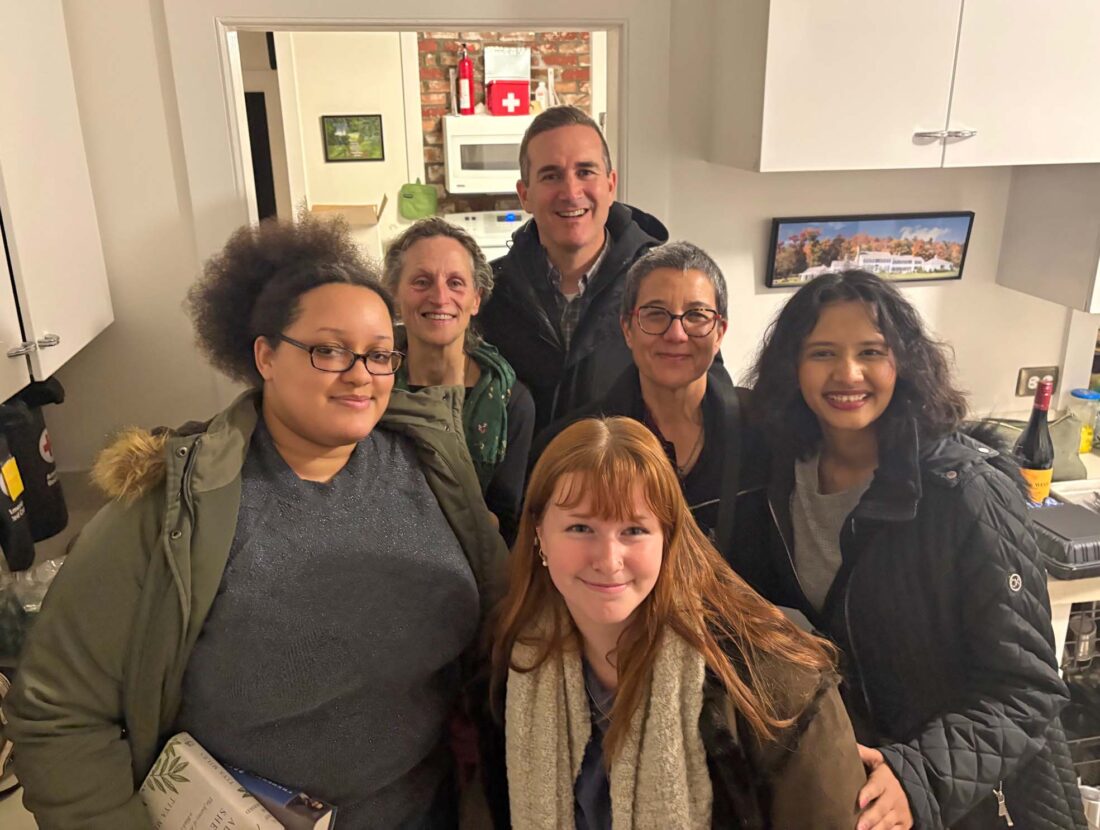
Shown here at Heaven Hill Farm in Lake Placid on Dec. 6 are Blake Gendebien, back; Martha Swan and Amy Mountcastle, middle; and in the front, Anika Brown, Alexis Adamkowski and Mrudangi Trivedi. (Provided photo by Naj Wikoff)
Do you feel loved by our country? If so, why so; if not, why not, and what would it take to feel loved by our country? Such are the questions being asked by SUNY Plattsburgh and University of Rochester students of their classmates, teachers, and community members through a listening program launched this past spring by John Brown Lives!.
Titled Loving our Country, the program was developed to deepen understanding of how federal policies are affecting people, businesses, and nonprofits across the North Country, particularly in New York’s 21st Congressional District. Martha Swan, founding director of John Brown Lives!, plans to compile and share the results with local leaders throughout the region, which includes those seeking to replace Congresswoman Elise Stefanik as the region’s representative in Congress.
The program was stimulated last February, when Swan, on a ZOOM call on an unrelated topic, heard a person from the Hudson Valley say that many people of color, be they citizens, having a green card, or a work permit, were afraid to leave their homes in case they might be picked up by United States Immigration and Customs Enforcement, and were seeking legal advice as to the kind of documentation they needed to carry with them to prove they had a right to live and work in the country.
Shortly after, the Adirondack Community Foundation sent a request to local agencies to determine whether they had been affected by cuts in federal funding. Those two events prompted Swan to create a program to learn how people from all walks of life are affected by federal policies. Launched during John Brown Lives! annual spring celebration of the birth of abolitionist John Brown, the program is based on one-on-one listening sessions between a person willing to share their story and a listener armed with just a notepad.
“Loving our Country is an old-fashioned, face-to-face, one-on-one moment to listen to what someone entrusts us to hear. How they’re being impacted, what their fears are, what the consequences are of federal cuts and this barrage of policies that are raining down on us,” said Swan.
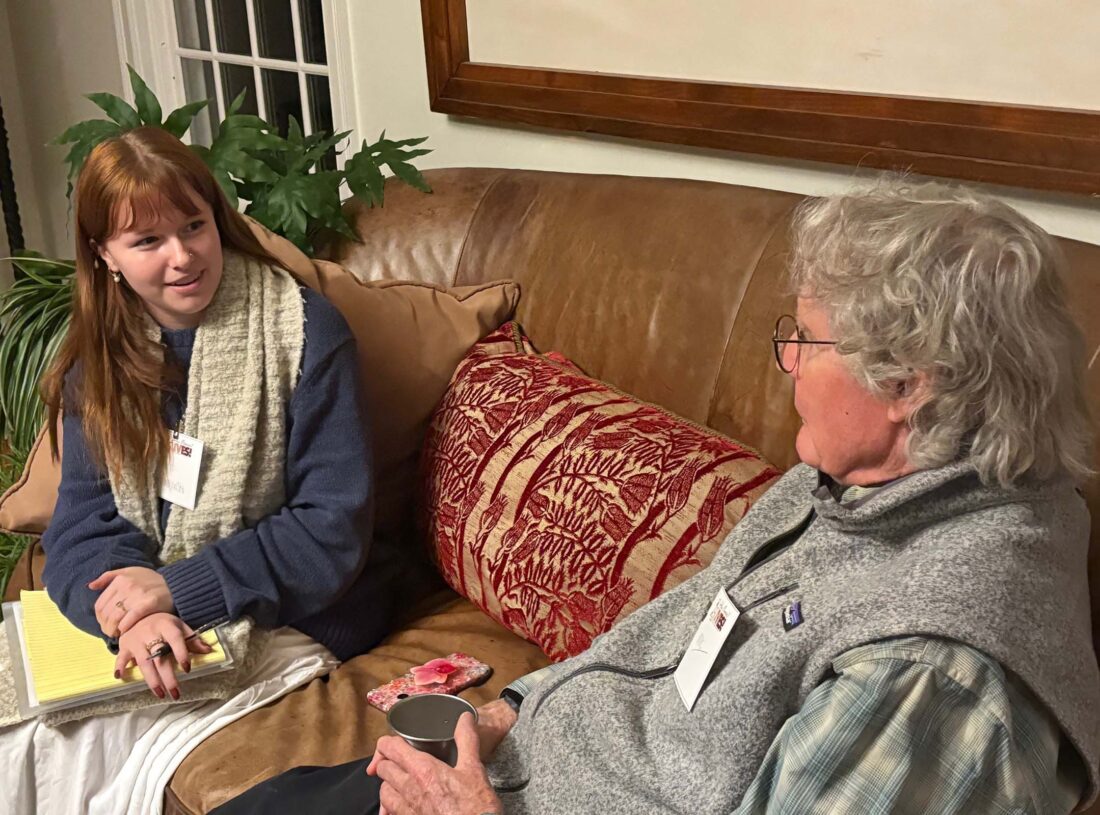
Alexis Adamkowski interviews Mac MacDevitt. (Provided photo by Naj Wikoff)
The student program, though, is a bit different in that the questions asked are not, “How have federal cuts and programs impacted you?” but rather, “Do you feel loved by our country?” If so, how so? If not, why not, and what would it take to feel loved? Beginning with SUNY Plattsburgh and the University of Rochester, Swan’s goal is to establish student listening teams on all 21 college and university campuses across the 21st District, and hopes that other colleges throughout the country will do the same.
“There’s a song that the Argentine singer, Mercedes Sosa, the voice of Latin America, used to sing, I want to love my country,” said Swan. “Her song captured for me, as a young person, what I so desired — to love my country, but my country makes it so hard, historically and today. Loving our Country is a call to action to create a country that we can all proudly say, I am loved by my country.”
Swan feels the key to that goal is to provide opportunities for people from all walks of life to share their feelings about where we are, their joys and pain points, and what could make the country work better. Doing so could help people and their leaders better understand our country, the challenges and opportunities we face, and encourage more people to work across divides and towards achieving common goals.
On Saturday, Dec. 6, John Brown Lives! hosted a listening session at Heaven Hill Farm in Lake Placid for attendees with five students from SUNY professor of anthropology Dr. Amy Mountcastle’s Doing Cultural Research class. Afterward, the students shared what they heard from the participants and through leading such sessions this fall with the SUNY Plattsburgh greater community. Two seeking to be the Democratic representative for NY-21, Pickled Pig owner Stuart Amoriell and farmer Blake Gendebien, attended.
“This project caught my eye because it gave us the opportunity to not just practice anthropological research methods, but to put them into action,” said SUNY student Olivia Davis. “This project gave us the opportunity to do that with college students who rarely feel heard, and with adults.”
Anika Brown said that through speaking with adults, she heard a wide variety of opinions and discovered that she shared many similar views, more than she expected. Alexis Adamkowski shared that, especially post-COVID, young people spend so much time online that they are losing their sense of community, and that this project helped her deepen her relationships with classmates and people of different ages.
“I found myself being a conduit for people’s stories, who they love, what they care about, and to represent that to the best of my abilities,” said Adamkowski.
“Everyone I interviewed had a lot of broad and diverse opinions about policies in America,” said Ben Anderson. “I don’t think I got one answer that was the same, yet everyone I interviewed had a deep appreciation and love for their community and the people of America. One thing they didn’t feel loved by was the policies and the politicians; they felt disconnected from them. All they wanted was for America to come together and be for the people so they can have a country they could love and cherish.”
Mac MacDevitt loved the opportunity to share his thoughts with the students and said the hardest question to answer was what it would take to feel loved by his country. Another said he felt good about being listened to for a couple of minutes without feeling he had to be careful or that he was being judged.
“People defined their sense of country in very different ways,” said Davis. “For some, it was the people in the country, for some, the government, some, the land, and for some, people nearby or the founding community. Many who felt it was the people felt loved by the people, loved by their communities. People wanted more community support, more empathy between people, and more reciprocation amongst people.”
“Even though everyone’s answers were completely different, there was a universal faith in the people of America, and a faith that if we work together, we can overcome the divisions in the country,” said Anderson.
“People believe in the core values that America was built on in the beginning,” said Adamkowski.”
(Naj Wikoff lives in Keene Valley and has been writing his column for the Lake Placid News since 2005.)
Columns
ON THE SCENE: ‘Snow on Demand’ for winter sports
MARTHA SEZ: ‘Artificial intelligence is coming out ahead’
By MARTHA SEZ I watched Bad Bunny’s Super Bowl halftime show on YouTube, but not until this morning because I ...
ON THE SCENE: 1980 Olympic hockey coach Herb Brooks honored
MARTHA SEZ: ‘Groundhog Day is, after all, a very minor holiday’
As I write this, Groundhog Day has just come and gone, leaving many in the North Country confused and slightly ...
LIBRARY NEWS: AARP volunteer tax help begins at Lake Placid Public Library
The Lake Placid Public Library offers support for many new years’ needs, including tax preparation, wellness ...