Oh, to be as old and steady as a tree
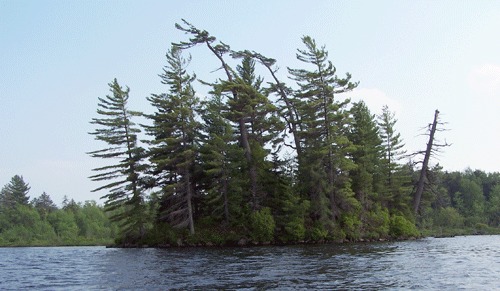
A white pine’s leaning trunk typically indicates the direction of the prevailing winds. Bannered limbs almost always point toward the east. Photo — Joe Hackett
As I enter my sixth decade on this planet, I’ve become increasingly interested in the past. Although I’ve always been a fan of human history, I’ve recently become enthralled with the region’s natural history, particularly as it relates to a place that is as old as dirt.
My ever-growing concerns of growing old are somewhat tempered when I consider the fact that the Adirondack shield is composed of anorthite, which is one of the oldest rocks on the planet.
Appropriately, anorthite is also found in the lunar highlands on the moon, which may explain the notion of lunar sightings that were focused on the “Old Man on the Moon.” Although it’s unlikely that I’ll ever visit the moon, it is comforting to know what the lunar surface looks like. Evidence of the lunar landscape is readily available to anyone who is willing to take a short hike to a local peak, or a stroll along the rocky shorelines of our local lakes.
While the ancient bedrock remains rather static, the earth’s crust still shifts occasionally under the weight of the soaring Adirondacks. The resulting minor tremors are known as a “rebound earthquake.” Although we rarely experience the type of earth-shattering quakes common to California, the Adirondack region remains one of the most seismically active regions in the country.
In the process of investigating old stuff, I recently took a road trip to the Pack Forest near Warrensburg to visit the Grandmother Tree. The towering white pine is one of the most renowned virgin pines in the park, and it has been protected for years.
While many of the virgin pines that once defined the landscape of the region fell to the lumberman’s ax more than a century ago, there are still some very impressive stands of old growth timber to be found throughout the rest of the North Woods, especially in the Five Ponds Wilderness near Cranberry Lake. One of my favorite virgin stands is located near Tomar Landing at the far western end of Lows Lake.
There are also some impressive stands of old growth timber located on private lands.
While researching old growth forests a bit closer to home, I recently paid a visit to the Elder’s Grove, which is also known as the 1675 Grove. This small stand of tall trees is located a short distance from Easy Street, just down the road from Gabriels.
The towering pines, which date back to 1675 are impressive specimens, and the surrounding landscape bears evidence of the lingering shade these monoliths have provided over the centuries. The easy 20-minute hike will take visitors to a different time, and a different place.
It is a primitive scene despite the small metal tags that have been used to mark each tree. Even though it is possible to hear the road noise, the scene instantly transports visitors to a different time and a wilder place. As you step into the shade of the assembled giant white pines, you’ll feel as if you’ve been captured in a time warp.
Similar stands of old growth pine can also be found on the Tongue, a long peninsula of land that parallels the St. Regis River as it flows out of the Lower St. Regis Lake. Other stands of old growth include several located along Forest Home Road, and others to be found throughout the St. Regis Canoe Area and the McKenzie Mountain Wilderness area located between Lake Placid and Saranac Lake.
Over the years, I’ve stumbled upon a number of these virgins. They are often evident as they tower significantly over the rest of the forest.
Unfortunately, once the tall trees grow above the safety of the surrounding woods, they are susceptible to being flagged or bannered by the prevailing winds.
Sometimes it’s worse, and the trees are totally top-lopped by a burst of wind or spiral fractured from a lightning strike. Such wounds may eventually prove mortal if they provide access to boring insects, rot or further fractures.
However, the bannered or compass pines are still very useful, as their limbs readily reveal the direction of the prevailing winds that always blow in from the west to east. The stunted limbs will be located on the eastern side of the trees, while the limbs located on the western side of the trees will be elongated.
It is easy to forget that trees are one of the oldest living organisms on the planet. Until 2013, the oldest individual tree in the world was Methuselah, a 4,845 year old Great Basin bristlecone pine tree located in the White Mountains of California.
The world’s oldest known living tree, a conifer that first took root at the end of the last Ice Age, was discovered in Sweden. The visible portion of the 13-foot-tall “Christmas tree” isn’t ancient, but its root system has been growing for 9,550 years, according to a team from the Umea University’s Department of Ecology and Environmental Science.
Discovered in 2004, the lone Norway spruce, a species that has traditionally been used to decorate homes during Christmas, represents the planet’s longest-lived identified plant. Researchers found the shrubby mountain survivor at an altitude of 2,985 feet.
Spruce stems have a lifespan of around 600 years, but as soon as a stem dies, a new one emerges from the same root stock. As a result, spruce have an extremely long life expectancy. Ancient spruces in Sweden have been dated between 5,000 and 6,000 years in age.
While Adirondack spruce and pine are not so long lived, they still rank among the oldest tree species in the region. For aficionados of old growth trees, there are very few species that can compare with the grandeur of a towering white pine matriarch, leaning to the east along the shoreline of a quiet Adirondack lake.
Outdoors
VISITING LAKE PLACID : A different world: A winter climb up Mount Colden
KEENE — My heart pounded, not from the 2,500 or so feet we had ascended over the last couple of hours, but for ...
Forest ranger recalls saving hiker lost for two days in Dix Range
Snowshoer found dead in lean-to in Pharaoh Lakes Wilderness
SCHROON — A Florida man was found dead in a lean-to in the 44,400-acre Pharaoh Lakes Wilderness in southern Essex ...

DEC proposes changes to coolwater sportfish regulations
State Police release name, cause of death for Marcy hiker