Leaf season kicks off under dry weather
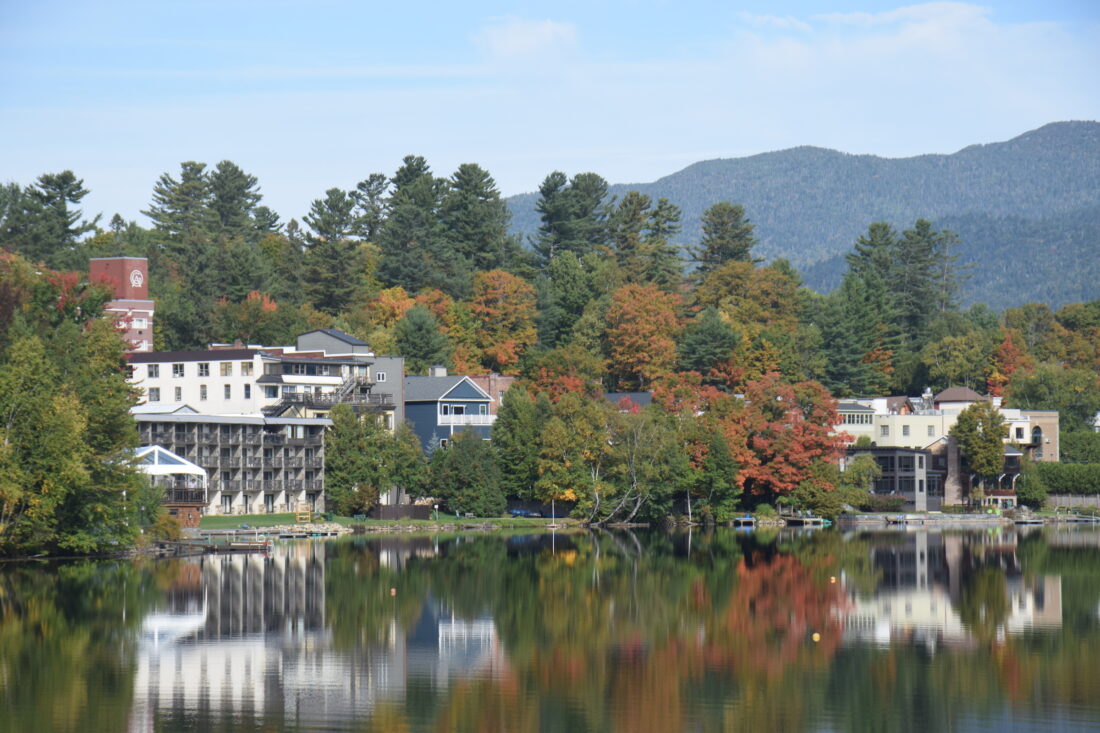
Early signs of fall foliage are seen in Lake Placid on Wednesday, Sept. 17. (News photo — Chris Gaige)
LAKE PLACID — It’s early yet, but make no mistake: the leaves, they are a-changin’.
This year, some deciduous trees throughout the Tri-Lakes region are changing color a bit earlier than usual. This is being driven, in part, by drought conditions over the past couple of months. It’s not a one-size-fits-all explanation, though. Fall foliage displays are driven by a myriad of weather and environmental factors — and how they interplay with each other, noted Justin Waskiewicz, a forestry professor at Paul Smith’s College.
“So drought can induce an earlier color change, but it will be different than a ‘normal’ year because different species, as well as different topographic locations, have different responses to drought, different sensitivities,” he wrote.
–
Why does drought hasten leaf drop?
–
Drought conditions can induce trees to act like winter is coming, Waskiewicz added. That’s because in some ways winter is a ‘drought’ — from the tree’s perspective. That’s because, regardless of how much precipitation falls during the cold months, trees can’t make use of it when they are frozen. Furthermore, the real enemy isn’t the cold, Waskiewicz noted, but the more aggressive loss of moisture that can come during the cold weather.
“‘Evergreen’ trees are proof that it is physiologically possible to create leaves that can survive sub-zero temperatures,” he wrote. “There’s a variety of tricks to it, but the real enemy (for trees) isn’t freezing, it’s freeze-drying. In winter, the dry, windy air and also ice crystals forming outside of living cells will both draw moisture out of living cells, just like a steak in your freezer for too many weeks.”
The thick, waxy coating of evergreen needles, combined with their relatively small surface area — compared to larger and more flimsy deciduous leaves — helps to minimize this winter freeze-drying effect. The tradeoff, Waskiewicz noted, is that evergreen needles are less efficient at producing energy for the tree during the summer.
The Adirondacks are sort of a middleground, with its climate allowing both sorts of trees to survive. Waskiewicz explained that further north, it becomes less efficient for trees to have deciduous leaves as the frost-free period of the year is so short, often making evergreens the dominant forest tree species. On the other hand, regions closer to the equator have longer, and in some cases constant, frost-free seasons, making the larger deciduous leaves a more efficient strategy, as the trees aren’t impacted as much or at all by the winter freeze-drying effect.
Besides causing some trees to drop their leaves earlier, drought can also have an indirect impact on leaves. Waskiewicz said that drought-stressed leaves can also face a different slate of insects and diseases than in a normal or wet year. Though variable by species and its immediate environmental surroundings, these can impact a leaf’s appearance, causing it to look brown or splotchy as the leaf is eaten away or killed off at the micro-level by these organisms.
–
Leaf drop
–
Waskiewicz explained that leaf change in deciduous trees is a controlled and complex process with numerous steps, all designed for the tree to minimize energy loss.
“(T)he tree retrieves what resources it can from the senescing leaves (e.g., mobile nutrients like nitrogen) before ‘cutting them off’ from the resources that they take from the tree (e.g. water), forming a barrier called an ‘abscission layer’ and dropping them in more or less orderly fashion,” he wrote.
It’s a complex signaling process unique to the fall. For instance, Waskiewicz pointed out that when leaves or a branch are suddenly killed, they don’t go through this process there is no color. Instead, they just turn brown.
Trees that are extra sensitive to drought, such as birch and beech, may start withering before the orderly leaf drop process gets going, resulting in brown leaves sans color, Waskiewicz noted. He added that this extends to trees in environments that accelerate the drying process, such as steep or rocky hill sides, where water is quicker to drain.
–
The science
–
Fall leaf colors come from two basic sources, Waskiewicz noted. One is the pigments that are present in the leaf all throughout the summer, but are typically masked by green chlorophyll. The other is the pigments that are specifically generated in the fall when sugars in the leaf are no longer taken in by the tree.
Chlorophyll is responsible for the leaves’ green color throughout much of the summer. It allows plants to produce energy from the sun through photosynthesis.
Carotenoids are another pigment in the leaves throughout the summer. They produce orange, yellow, and brown colors, notably in things such as carrots or bananas. Like chlorophyll, trees rely on the pigment to help absorb light for energy production, even as they cannot be seen by the human eye, as long as chlorophyll is present in the leaves.
Carotenoids take longer to break down than chlorophyll, as it is a more stable compound, according to the U.S. Forest Service. Waskiewicz explained how this comes into play in the fall.
“As the green chlorophyll gets broken down and its components get reabsorbed, you see a yellow. That’s carotenoids,” he said in an interview last fall. “Those are also going to get broken down but it takes longer (than the chlorophyll), so they sort of linger there and all else equal, you get this period of the leaf appearing yellow.”
Yellow from carotenoids serves as the base color, in a sense. Anthocyanin is then added to complete the palette. Waskiewicz detailed that aspect of the autumn colors process.
“Anthocyanins are the reds. Mixed with the carotenoids, you get the orange color,” he said in an interview last year. “Those are created while the lingering chlorophyll that hasn’t yet been broken down is still photosynthesizing and still producing sugars. The anthocyanins are sort of a byproduct of that. But because the tree is starting to cut the leaf off, the chlorophyll that is still waiting to be disassembled is still producing these sugars, but then those sugars are not being respired because it is cold, or they’re not being exported back into the tree because the tree is starting that process of cutting the leaf off.”
The more anthocyanins are in a leaf, the redder — or even purple in high enough concentrations — it appears. The less of it, the more orange or yellow the leaf looks. While weather impacts this color spectrum each year to a degree, much of the palette is pre-determined by the tree species’ genetics.
It’s why some trees, such as red maples, regularly turn brilliantly red, while other species tend to produce less anthocyanin and appear only predominantly yellow before falling.
–
Short-term weather
–
Although the long-term dry weather could lead to some dullness, now is not the time for rain when it comes to bolstering color vibrance. It’s a bit of a paradox, but sunny days and clear nights in the few weeks right before foliage tend to produce the more vibrant colors than cloudy skies and rainy weather, according to Waskiewicz.
“Rainy weather will leach out and wash away sugars and ‘dampen’ the colors (besides which the pounding raindrops and associated wind will knock down leaves prematurely),” he wrote. “Warm nights and cool, cloudy days will lead to less color development.”
Sunny days allow for the sugars to build up in the leaves, while the cool nights — which are helped by clear skies that make it easier for the temperature to drop as less heat is retained by the clouds — help to prevent the sugars flowing from the leaves into the tree. The more sugar that gets trapped in the leaves, the more colorful they tend to be.
Fortunately for leaf peepers, the upcoming forecast points to plenty of warm, sunny days and cool, clear nights, according to the National Weather Service’s Burlington, Vermont office, which serves the Tri-Lakes region.
NWS Burlington Meteorologist Adrianna Kremer said that persistent high pressure should help keep precipitation away for at least the next week.
“We’re … going to be dry for at least another week or so,” she said. “There’s low pressure to our south and that’s going to be keeping the high (pressure) centered over the Northeast. It’s been pretty stationary over us.”
Local News
VISITING LAKE PLACID : A different world: A winter climb up Mount Colden
KEENE — My heart pounded, not from the 2,500 or so feet we had ascended over the last couple of hours, but for ...
Forest ranger recalls saving hiker lost for two days in Dix Range
Snowshoer found dead in lean-to in Pharaoh Lakes Wilderness
SCHROON — A Florida man was found dead in a lean-to in the 44,400-acre Pharaoh Lakes Wilderness in southern Essex ...

Ad’k Life announces photography contest winners
Some see Olympic blueprint for a 3rd Lake Placid games
CORTINA D’AMPEZZO, Italy — Imagine: A sprawling world-class city and a small mountain village with a rich ...