Connecting the past to the present
Lake Placid Elementary School fourth-graders present artifact research at History Fair
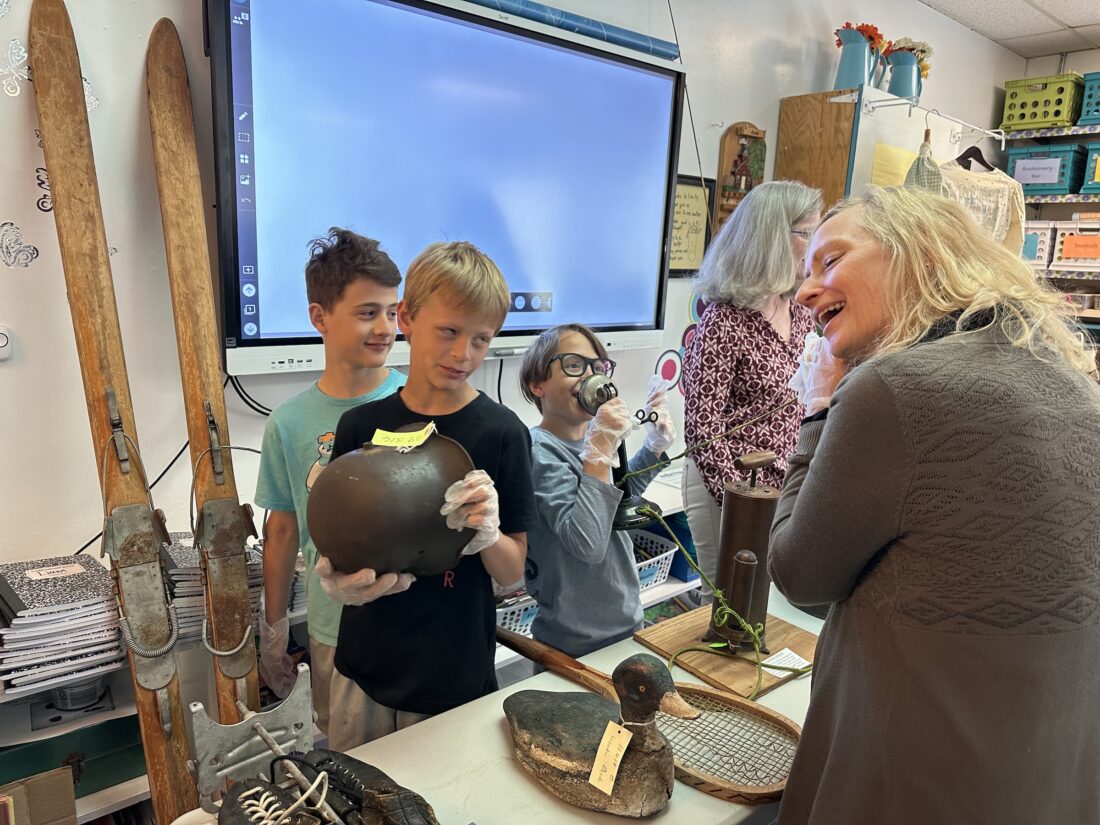
Lake Placid Elementary School students Noah and Graysen watch Cooper and fourth-grade teacher Allison Smith play with a candlestick telephone on June 5 during their History Fair preparations. (News photo — Andy Flynn)
LAKE PLACID — The assignment was simple. Pick an artifact, research its history and tell its story.
It’s a task I’ve been practicing for more than 20 years. From 2003 to early 2009, I wrote a newspaper column, — “Adirondack Attic” — for publications across the North Country, from Glens Falls to Plattsburgh, including the Lake Placid News. Every week, I explored the history of an object in the collection of the Adirondack Museum in Blue Mountain Lake. And from 2010 to 2017, I did the same every month at museums around the region for my “Adirondack Attic” program on North Country Public Radio.
I turned each year’s newspaper columns into a book, the “Adirondack Attic” series in six volumes.
So I was right at home when asked to be part of Allison Smith’s fourth-grade History Fair last week at the Lake Placid Elementary School. Her students — about 45 in all — worked with educators at the Lake Placid-North Elba Historical Society and Wilmington Historical Society to pick an artifact, research its history and tell its story. They ended the week with a day’s worth of presentations and a pizza party for the entire fourth grade.
The goal of the History Fair was to create and present an exhibit about the history of the Lake Placid/North Elba and Wilmington region. It’s part of the students’ local history education.
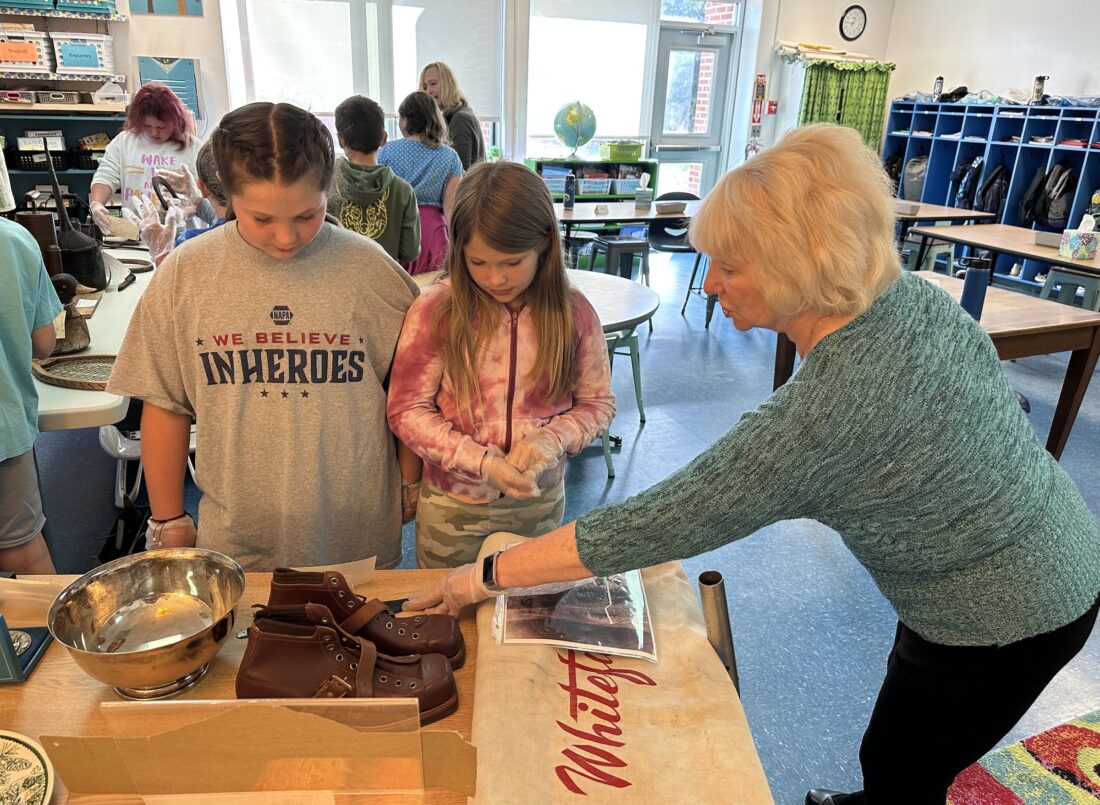
Wilmington Historical Society President Karen Peters on June 5 shows Ava and Emma, Lake Placid Elementary School students in Allison Smith's fourth-grade class, some artifacts from Wilmington. (News photo — Andy Flynn)
Once the research was done, students could tell their stories in one of three ways: on a poster, in a newspaper story or in a skit. Only one student chose the skit Cooper was the only student to perform a skit; the rest created poster boards. He researched the candlestick telephone.
“Telephones,” Cooper said. “You might have one. These are the ones without Facebook or Snapchat.”
History Fair was a week-long project, starting on Friday, June 2 and ending on Friday, June 9.
Mrs. Smith handed over the history tasks to three former teachers: Wilmington Historical Society President Karen Peters and Lake Placid-North Elba Historical Society Director Sophie Morelli and Trustee Margie Gallagher.
“I’m a teacher, so I love teaching,” Peters said. “It brings together my love of history together with kids. They get to learn about history in a different way by studying the objects of their local area. … It makes it more meaningful to them if it’s local, but it relates to the larger world.”
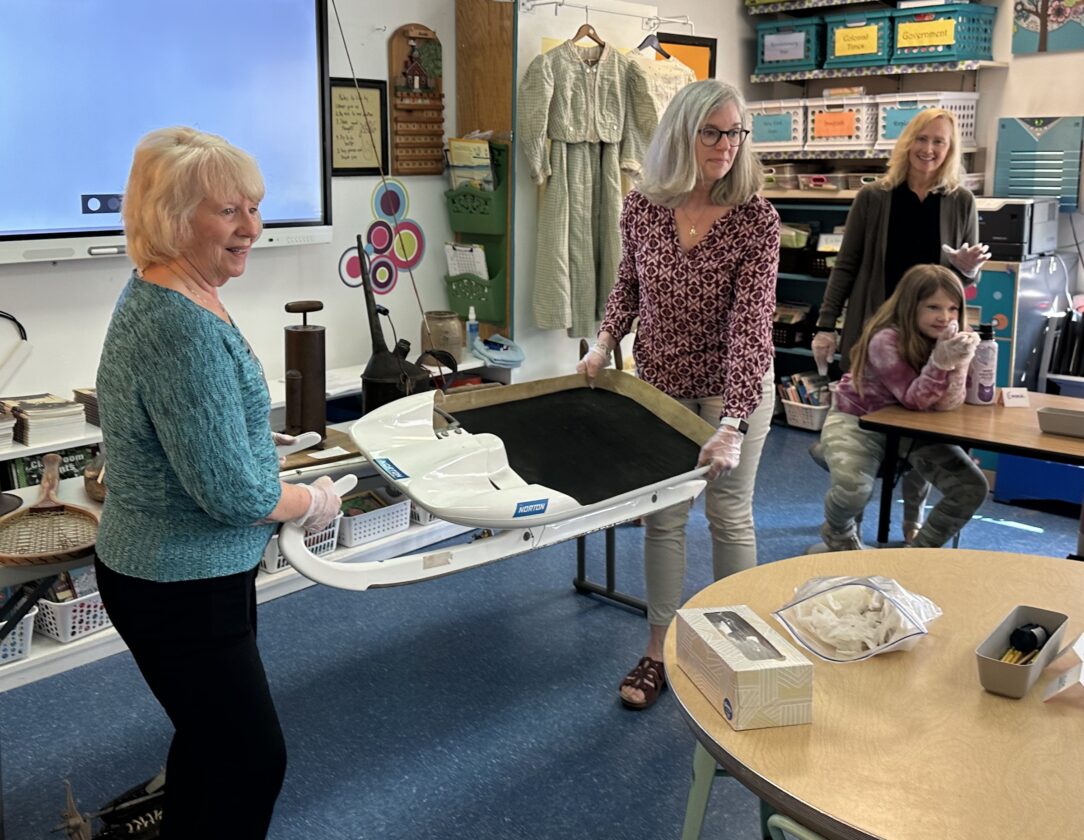
Wilmington Historical Society President Karen Peters, left, and Lake Placid-North Elba Historical Society Trustee Margie Gallagher show students a luge sled on June 5 in Allison Smith's Lake Placid Elementary School fourth-grade classroom. They were presenting a small collection of artifacts so the students can choose one to research for the June 9 History Fair. (News photo — Andy Flynn)
First, students had to learn about a History Fair. Day 1 was spent on its definition, viewing a video on the history of North Elba and learning the time periods associated with our local history — Early Settlement (1800-1900), Grand Hotels (1880-1945) and Attractions & Events (1932 to present). Students also tried to guess the mystery artifact. Three students guessed correctly; it was a mold for making candles.
Day 2 was spent planning. Students looked at the artifacts brought to the classroom from the historical societies, learned how to handle them (with gloves), selected a partner or decided to complete the project solo and began planning their projects.
The artifacts on display included a duck decoy, a German helmet from World War II, a pair of wooden skis, a pair of 1950s ski boots, a candlestick telephone, a luge sled, medals won by Olympic speedskater Jeanne Ashworth in her youth, a bell from the Haselton School, a 1964 Whiteface Sports Car Championship bowl, a T-bar from Mount Whitney, a stereoscope with slides, a pair of dresses, a tennis racket, ice tongs, an oil can for trains, a steamer whistle and a winter hat made with ermine fur.
“Does history play a role in what we are doing today?” Peters asked the students.
“It shows us how they lived back then,” one student answered. “And then we can use that to like find stuff and sell it and be rich.”
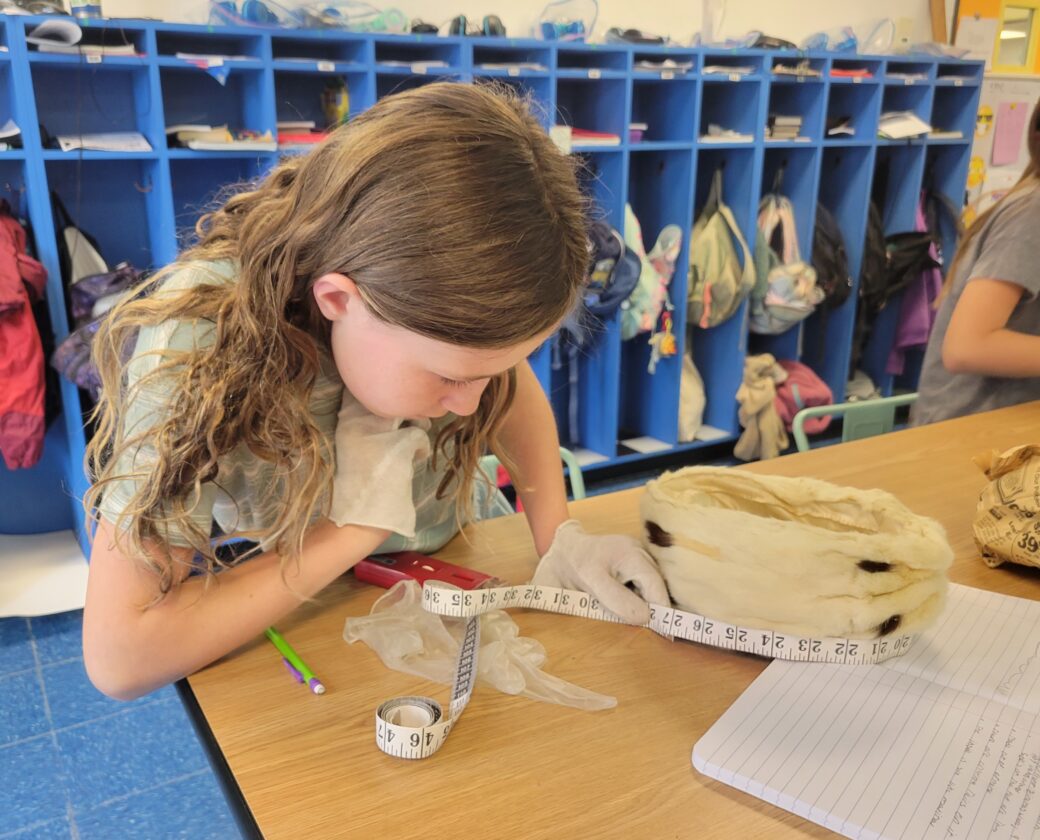
Fourth-grade student Zoe on June 6 researches a winter hat made from ermine fur for the Lake Placid Elementary School's History Fair. (Provided photo — Karen Peters)
“Like ‘Antiques Roadshow,'” Peters responded with a laugh.
“There’s our entrepreneur in the class,” Gallagher added.
Peters persisted with her question.
“Does history help us with the present or the future?”
“Yes, it does,” one student said.
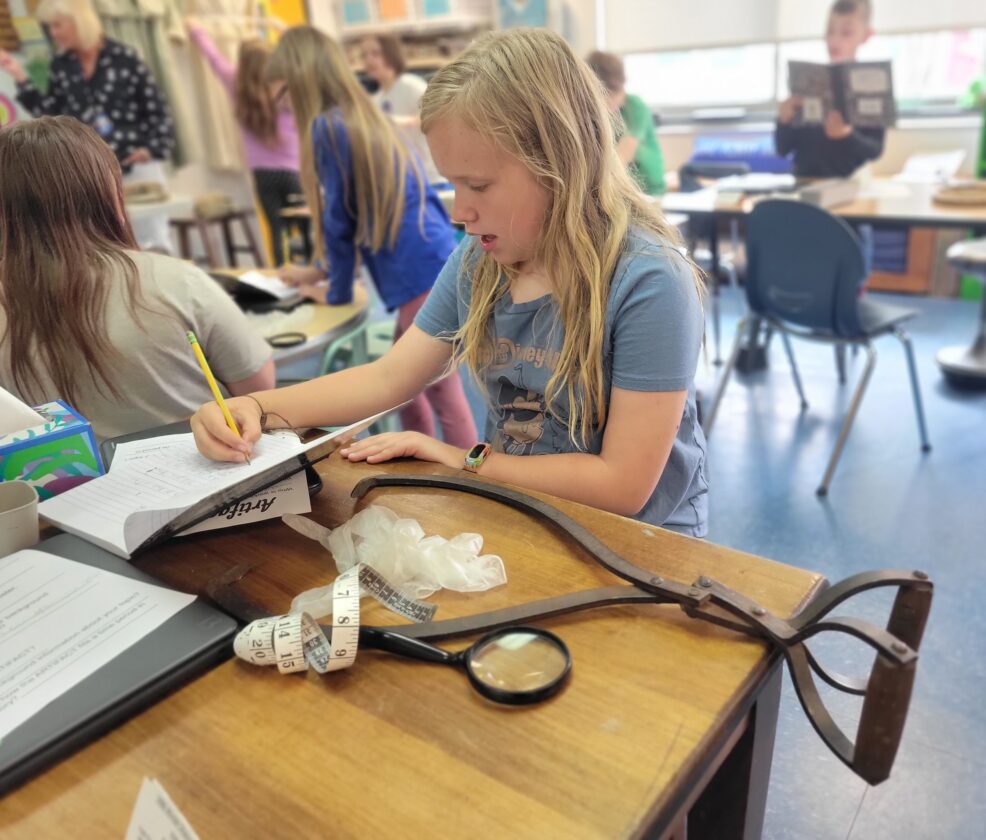
Fourth-grade student Sadie on June 6 researches a pair of ice tongs for the Lake Placid Elementary School's History Fair. (Provided photo — Karen Peters)
“In what way?” Peters asked.
“Before we invented the wheel, there was no wheel,” the student said. “So basically having something from the past can define the future because even when we didn’t have the wheel, someone made it and now we have even better wheels. So having something right now means that it will probably get better.”
“And now we have an inventor,” Gallagher said.
“I think you hit the nail right on the head. Exactly. Exactly,” Peters added. “You often hear the phrase, ‘If you study the past, it helps you with the future.'”
Days 3 and 4 were work days. Students wrote descriptions for their artifacts, completed research on the internet, wrote text, printed photos, and began building their posters: either a trifold that could stand on a table or a flat poster that had to be hung on a wall.
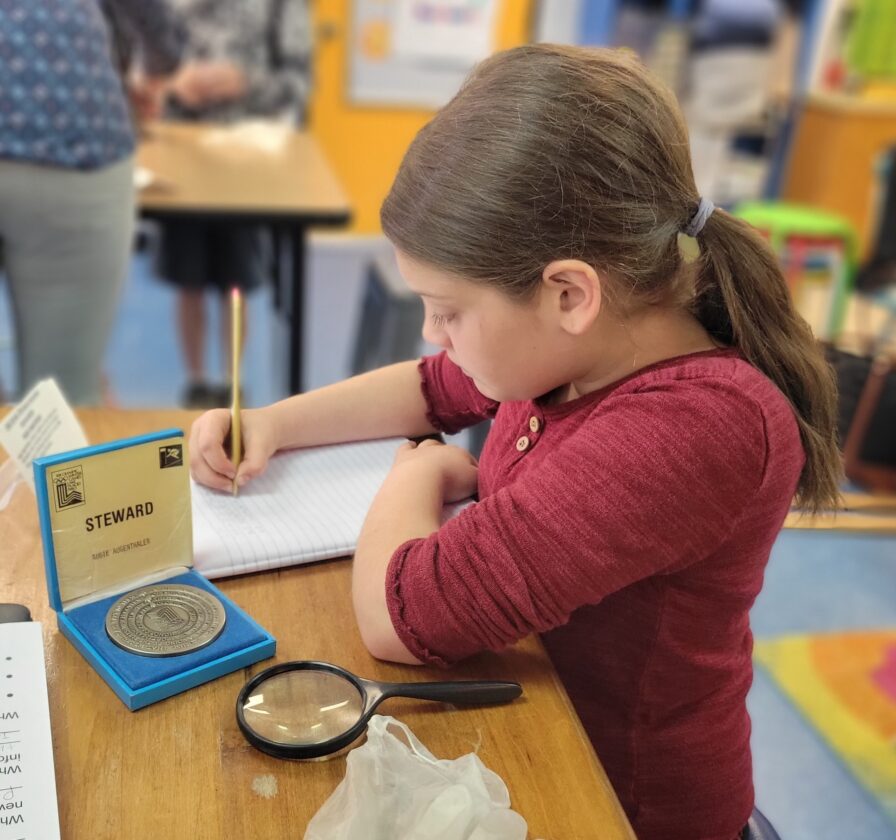
Fourth-grade student Lilah on June 6 researches a volunteer medal from the 1980 Olympic Winter Games for the Lake Placid Elementary School's History Fair. (Provided photo — Karen Peters)
Day 5 was dedicated to finishing the students’ posters.
And Day 6 was the History Fair. Each class — two in the morning and one in the afternoon — was filled with presentations.
At the begininning of each class, students practiced their presentations, with the adults offering constructive criticism.
“Practicing is really important so that you know what part you’re going to say, what your partner’s going to say,” Mrs. Smith said.
Once practice time was over, about four students presented at a time. Students stood in front of their colorful posters, with the artifacts near them, and read the scripted material pasted on the posters.
“The students who are not presenting will be the audience going to different presentations,” Mrs. Smith explained to the students. “And then we switch roles.”
Lake Placid-North Elba Historical Society Trustee Peter Roland Jr. visited Mrs. Smith’s classroom on June 9 to see the presentations, like the one Liliana and Ava did about the duck decoy.
“I like the objects, and I like the connection that these students make with the objects,” Roland said. “Like, they have a duck decoy, and I said, ‘We still use duck decoys.’ And she said, ‘As a matter of fact, my family remembers the Ducks Unlimited.’ So there’s a connection with the past, and that’s important.”
Students who listened to the presentations were encouraged to give positive feedback.
At the end of each class, all the students received a Wilmington bicentennial pin and a certificate of achievement. Gallagher reinforced the positive aspects of each presentation:
– “Owen and Lemmy were stereoscope viewers, and they were some pretty good detectives.”
– “Lauren and Lillie did the anatomy of a duck, including its bill. It was very cool.”
– “Lena and Liam. They did the school bell, and they learned some new mathamatical words including how to measure circumference. Excellent.”
– “Lilah had the volunteer medal. She asked excellent questions and had beautiful eye contact for her presentation.”
At noon, the entire fourth grade gathered in Mrs. Smith’s classroom, where I gave each student a signed copy of two books, “Adirondack Attic” volumes 2 and 4. And then the students went to their homerooms to eat pizza from Mr. Mike’s.
Morelli was struck by the students’ curiosity and dedication to their projects.
“I think they’re so interested and really engaged with the artifacts in a way that some people would be surprised by,” she said. “There’s always a little bit of a worry that ‘It’s all this old stuff. How are we going to get them to care?’ But they are so interested, and they really dive into the research. I feel like they just look so proud when they are presenting, and at the end they learn all this new stuff and they get to tell all of their friends. I just think it’s really great. They really get so deep into it for such a short amount of time.”
The posters will be on display at the Lake Placid-North Elba Historical Society’s Heritage Fair, which will be held on Saturday, Aug. 12 at the History Museum in the train station.
–
Mystery artifact
–
On Friday, June 2, all the fourth-grade students were invited to guess the mystery artifact. Here are the guesses:
– Something off a train (Liam C.)
– Ammo pack (Connor)
– Chimney (Liliana)
– Candle making mold (Sean, Lena and Emma)
– Smoke pot (Reid)
– Cage (Georgi and Axton)
– Heater (Zoe, Mav, Annalyse, Lemmy, Jack and Quinn)
– Water pipes (Bently)
– Musical instrument (Ava V.)
– Bird feeder (Sadie)
– Crusher (Joseph)
– Mold to make stone (Aydin)
– Stove/fire for warmth (Senita)
– Fish trap (Hannah)
– Sifter (Isabella)
– Part of an old car (Ryan)
– Gun powder holder (Lilah)
– Something that makes iron bars (Owen and Riley)
– Bullet holder (Lauren, Emina)
– Ice cream machine (Lillie)
– Pipes to carry water (Ember)
– Camping grill (Seid)
– Furnace (Charlie)
– Filter (Lily)
– Trap (Noah K.)
– Mini jail cell (Graysen)
– Radiator (Cooper)
– Communication device (Ava P.)
“I think you guys were really really clever with what your were thinking and putting together,” Gallagher said before the reveal. “The correct answer is a candle mold. Wax would go down in there, and you would let it cool. It’s tapered on the ends.”
Those who guessed correctly — Sean of Mrs. Smith’s class, Lena of Mrs. Stratford’s class and Emma of Mrs. Kramer’s class — were given a Hershey’s milk chocolate candy bar as a prize.
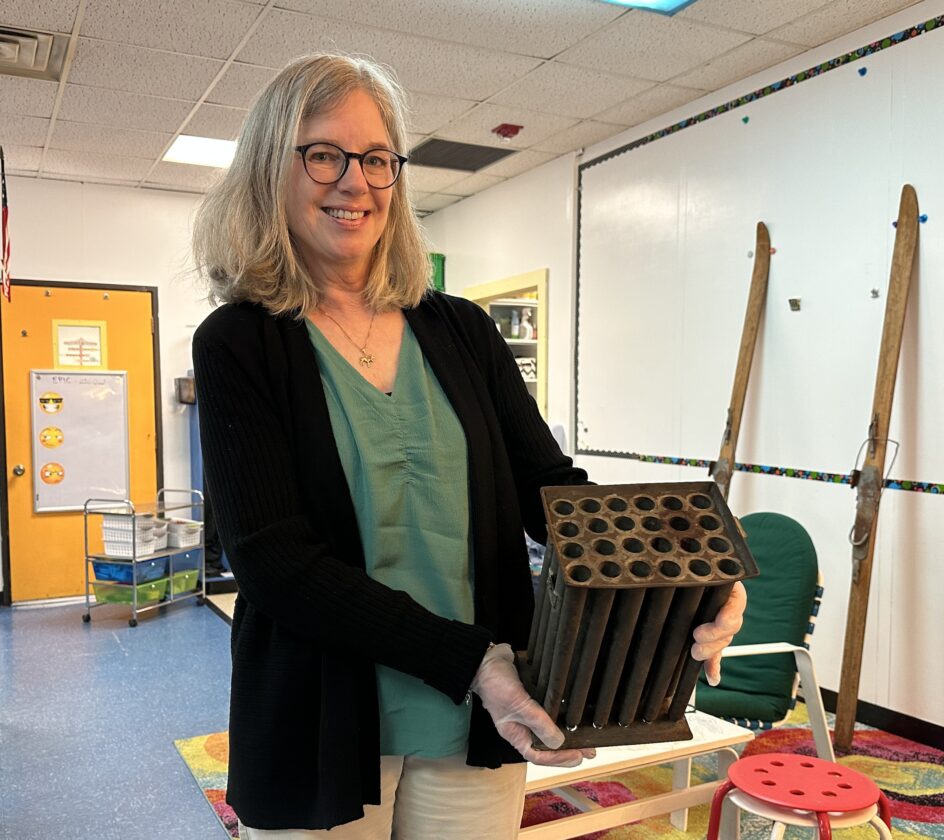
Lake Placid-North Elba Historical Society Trustee Margie Gallagher shows the mystery artifact during the Lake Placid Elementary School fourth-grade History Fair. It is a candle mold. (News photo — Andy Flynn)
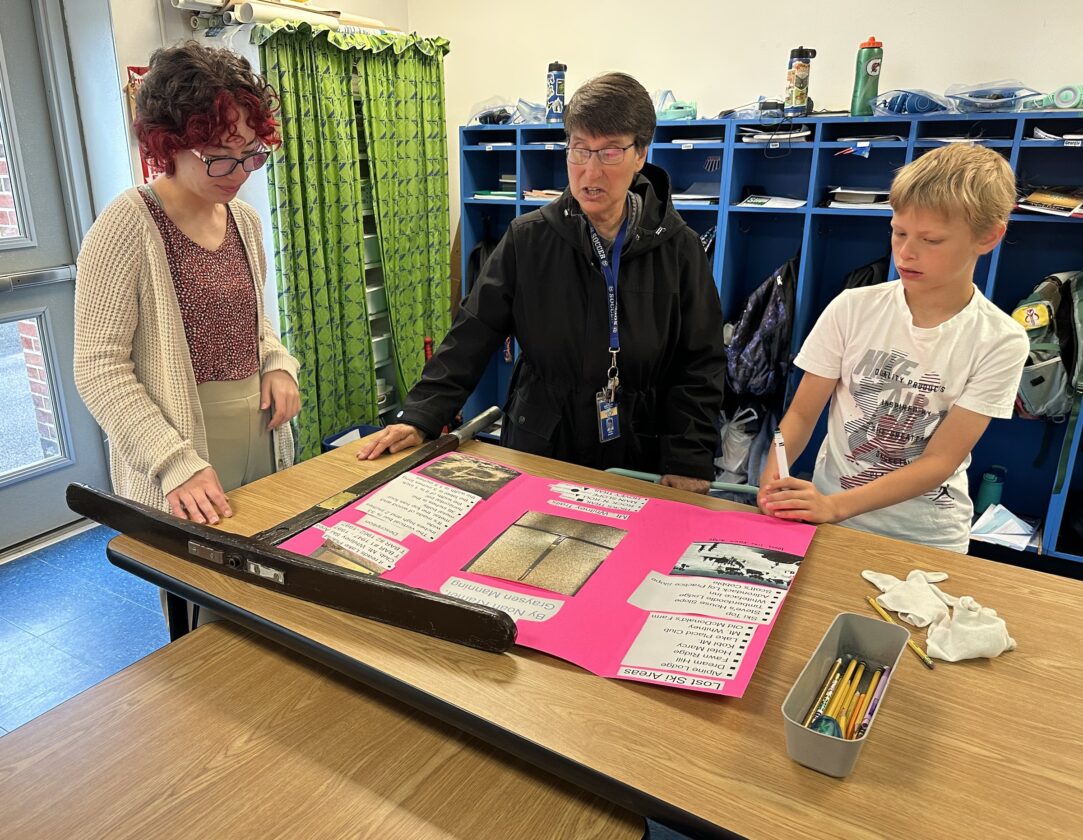
Lake Placid-North Elba Historical Society Director Sophie Morelli, left, and Lake Placid Elementary School Teaching Assistant Alicia Brandes help Noah, a student in Allison Smith's fourth-grade class, practice his History Fair presentation about a Mount Whitney T-bar on June 9. (News photo — Andy Flynn)
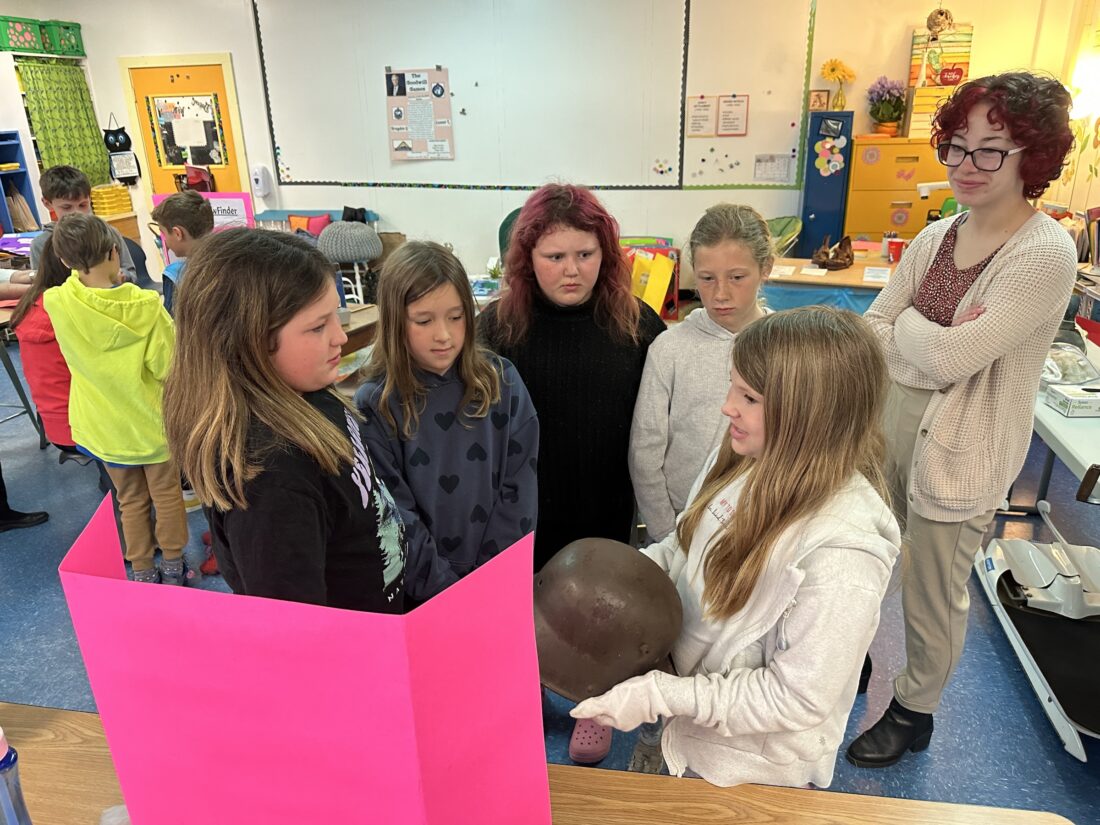
Lake Placid-North Elba Historical Society Director Sophie Morelli watches Emma present the history of a World War II helmet while Ava, Lily, Tatum and Estelle listen on June 9 in Allison Smith's Lake Placid Elementary School fourth-grade class. (News photo — Andy Flynn)
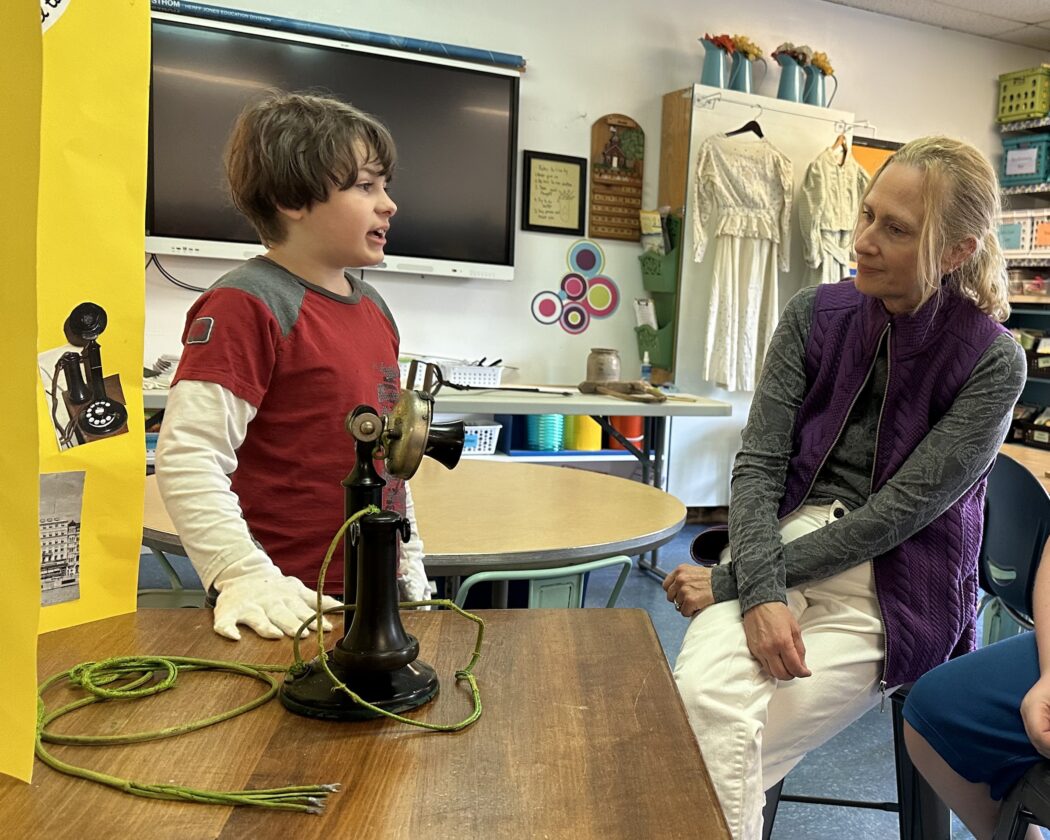
Fourth-grade teacher Allison Smith watches Bently give a History Fair presentation on June 9 in her Lake Placid Elementary School class. (News photo — Andy Flynn)
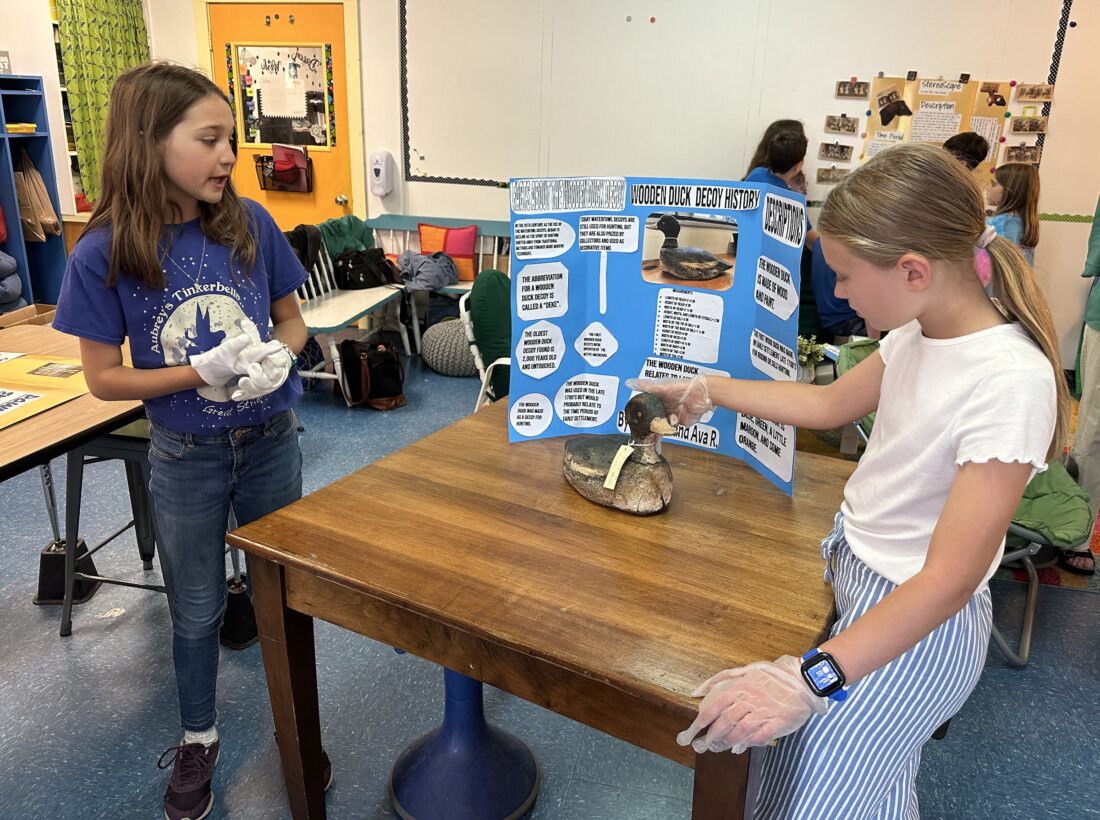
Fourth-grade students Liliana and Ava give a History Fair presentation about a duck decoy on June 9 in Allison Smith's Lake Placid Elementary School class. (News photo — Andy Flynn)
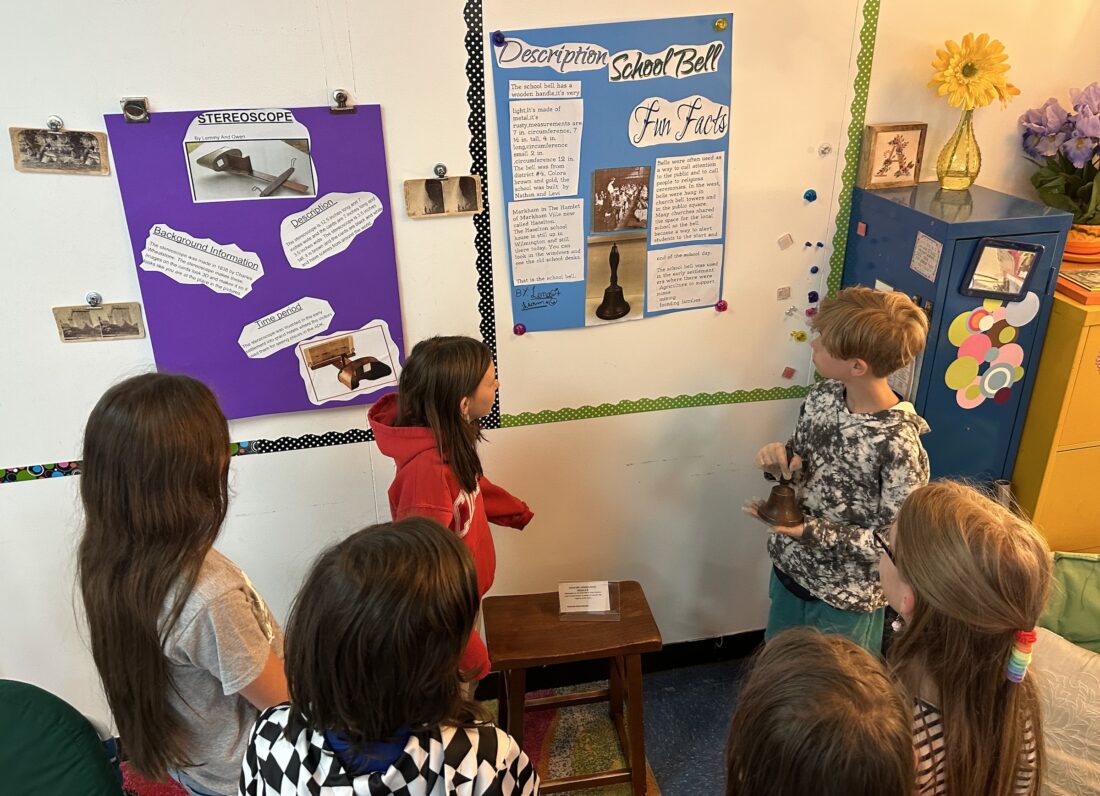
Fourth-grade students Lena and Liam give a History Fair presentation about a Haselton School bell on June 9 in Allison Smith's Lake Placid Elementary School class. (News photo — Andy Flynn)
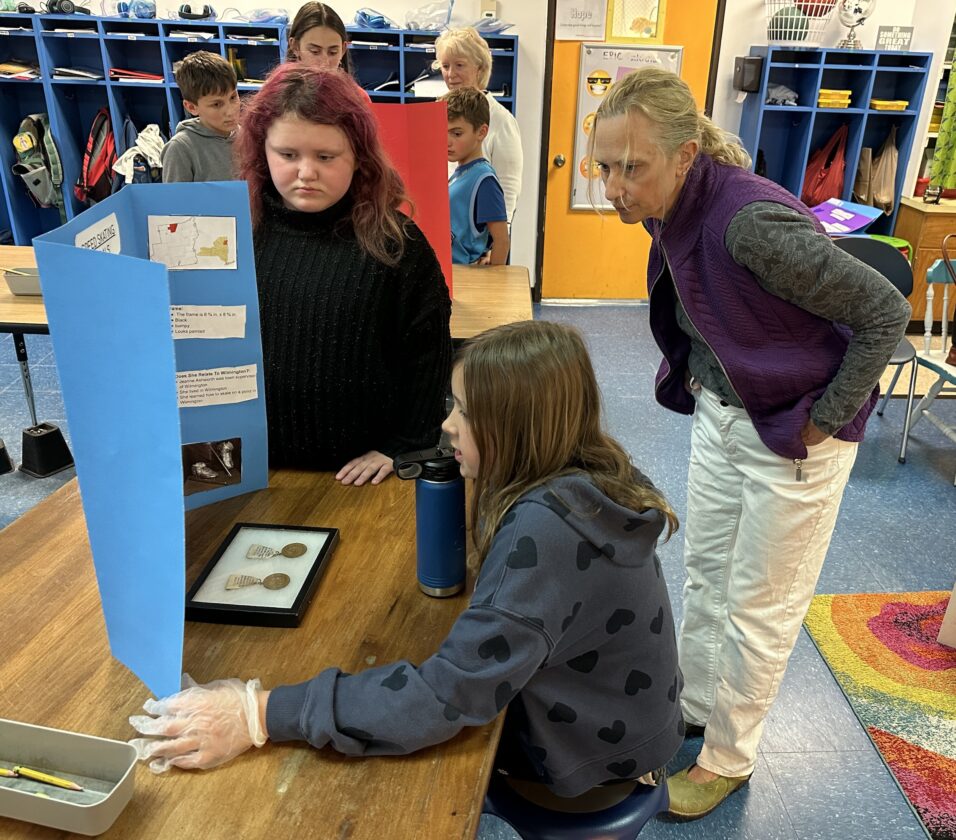
Fourth-grade student Tatum and Lake Placid Elementary School teacher Allison Smith watch Lily give a presentation on Olympic speedskater Jeanne Ashworth's childhood medals during the History Fair on June 9. (News photo — Andy Flynn)
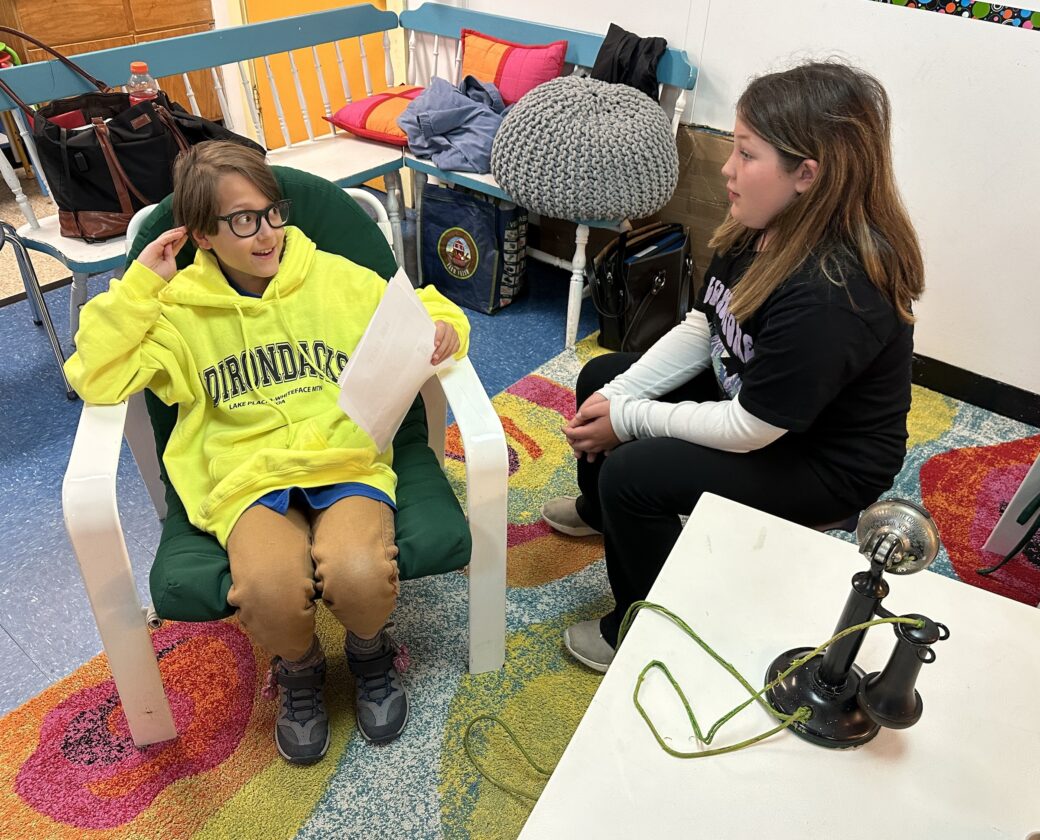
Ava listens to Cooper present the history of a candlestick telephone during the History Fair on June 9 in Allison Smith's Lake Placid Elementary School fourth-grade class. (News photo — Andy Flynn)
Local News
VISITING LAKE PLACID : A different world: A winter climb up Mount Colden
KEENE — My heart pounded, not from the 2,500 or so feet we had ascended over the last couple of hours, but for ...
Forest ranger recalls saving hiker lost for two days in Dix Range
Snowshoer found dead in lean-to in Pharaoh Lakes Wilderness
SCHROON — A Florida man was found dead in a lean-to in the 44,400-acre Pharaoh Lakes Wilderness in southern Essex ...
Ad’k Life announces photography contest winners
Some see Olympic blueprint for a 3rd Lake Placid games
CORTINA D’AMPEZZO, Italy — Imagine: A sprawling world-class city and a small mountain village with a rich ...