DEC: Avoid muddy high-elevation trails
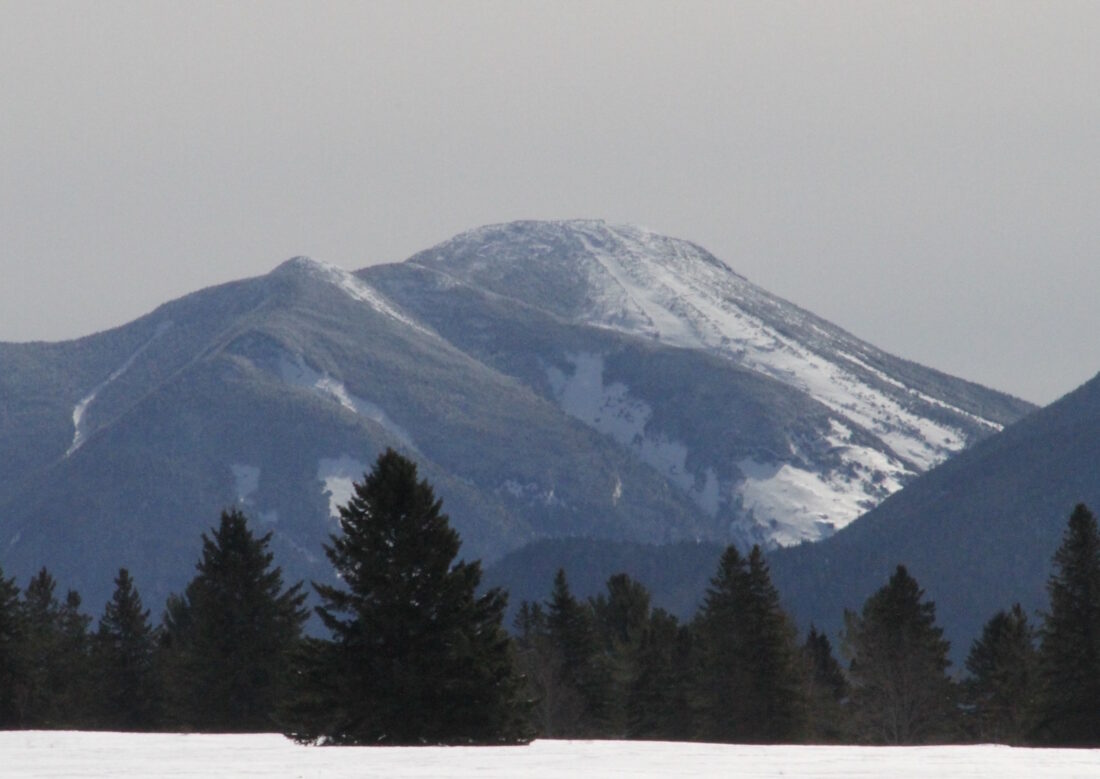
Mount Colden in the High Peaks Wilderness Area of New York's Adirondack Park is seen in March 2023. (News photo — Andy Flynn)
ALBANY — The state Department of Environmental Conservation on Thursday, April 6 urged hikers to postpone hikes on Adirondack trails above 2,500 feet until high elevation trails have dried and hardened.
Despite the warm weather, high elevation trails above 2,500 feet are still covered in slowly melting ice and snow.
These steep trails feature thin soils that become a mix of ice and mud as winter conditions melt and frost leaves the ground. The remaining compacted ice and snow on trails is rotten, slippery, and will not reliably support weight.
“Monorails,” narrow strips of ice and compacted snow at the center of trails, are difficult to hike and the adjacent rotten snow is particularly prone to “post-holing” — leaving deep footprints in the snow — which makes trails more difficult and hazardous for others to use.
Hikers are advised to avoid high elevation trails for the duration of the muddy trail advisory for several reasons: Sliding boots destroy trail tread, can damage surrounding vegetation and erode thin soils causing washouts; rotten snow and monorails are a safety hazard even with proper equipment; and high elevation and alpine vegetation are extremely fragile in spring months as they start their regrowth after winter.
Hikers should avoid the following high elevation trails until trail conditions have dried and hardened: — High Peaks Wilderness: All trails above 2,500 feet, specifically Algonquin, Colden, Feldspar, Gothics, Indian Pass, Lake Arnold Cross-Over, Marcy, Marcy Dam — Avalanche — Lake Colden, which is extremely wet, Phelps Trail above Johns Brook Lodge, Range Trail, Skylight, Wright, all “trail-less” peaks, and all trails above Elk Lake and Round Pond in the former Dix Mountain Area — Giant Mountain Wilderness: All trails above Giant’s Washbowl, “the Cobbles,” and Owl Head Lookout — McKenzie Mountain Wilderness: All trails above 2,500 feet, specifically Whiteface, Esther, Moose and McKenzie mountains — Sentinel Range Wilderness: All trails above 2,500 feet, specifically Pitchoff Mountain — Jay Mountain Wilderness: Specifically Jay Mountain.
Until conditions improve, hikers are encouraged to responsibly explore low elevation trails or enjoy other forms of recreation.
–
Low elevation and other trails
–
Mud and variable conditions are prevalent across all trails in the Adirondacks. Hikers can encounter thick mud, flooding, ice, and deep slushy snow even on low elevation trails.
Hikers should be prepared to encounter these conditions and know how to reduce their impacts to protect the surrounding natural resources.
Hikers are advised to walk through the mud, slush, or water and down the center of the trail. This helps to reduce erosion and trail widening and minimizes damage to trailside vegetation. Waterproof boots, gators and trekking poles are recommended to safely and comfortably traverse these variable trail conditions.
–
Cold water advisory
–
Water temperatures are freezing and falling in can lead to immediate hypothermia. Hikers are advised to never attempt to cross high, fast-moving water, especially following rain or significant snowmelt. If there is precipitation forecast during the day, hikers should be mindful of how water crossings might swell between their first crossing and return trip.
Hikers should use extreme caution in areas of moving water, such as inlets, outlets, and streams. Banks will be icy and currents are swift.
The muddy trail advisory for high elevation trails may last into June as it sometimes takes that long for trails to dry and harden, while in lower elevations.
The advisory may be lifted as soon as May for lower elevation trails.
Local News
VISITING LAKE PLACID : A different world: A winter climb up Mount Colden
KEENE — My heart pounded, not from the 2,500 or so feet we had ascended over the last couple of hours, but for ...
Forest ranger recalls saving hiker lost for two days in Dix Range
Snowshoer found dead in lean-to in Pharaoh Lakes Wilderness
SCHROON — A Florida man was found dead in a lean-to in the 44,400-acre Pharaoh Lakes Wilderness in southern Essex ...

Ad’k Life announces photography contest winners
Some see Olympic blueprint for a 3rd Lake Placid games
CORTINA D’AMPEZZO, Italy — Imagine: A sprawling world-class city and a small mountain village with a rich ...