COMMUNITY CONNECTIONS: ARTA plays friends group role as rail trail is constructed

Adirondack Rail Trail Association Executive Director Brian Woods poses at the Lake Placid train station on March 20, 2023. (News photo — Andy Flynn)
LAKE PLACID — As winter slowly loses its grip on the Adirondacks, with robins and other migratory birds returning, recreational opportunities on the Adirondack Rail Trail are fading away as the snow melts.
To be clear, the 34-mile multi-use recreation path from Lake Placid to Tupper Lake is not constructed yet, but people have been using it in a variety of ways now that the rails have been removed.
While the Department of Environmental Conservation is in charge of the state-owned trail corridor, its partners and stakeholders — local governments, businesses and nonprofit organizations — are also working hard to create a vibrant rail trail. The main goal is to make something unique — a different way of interacting with the Adirondacks — in order to benefit residents and visitors.
–
Enter ARTA
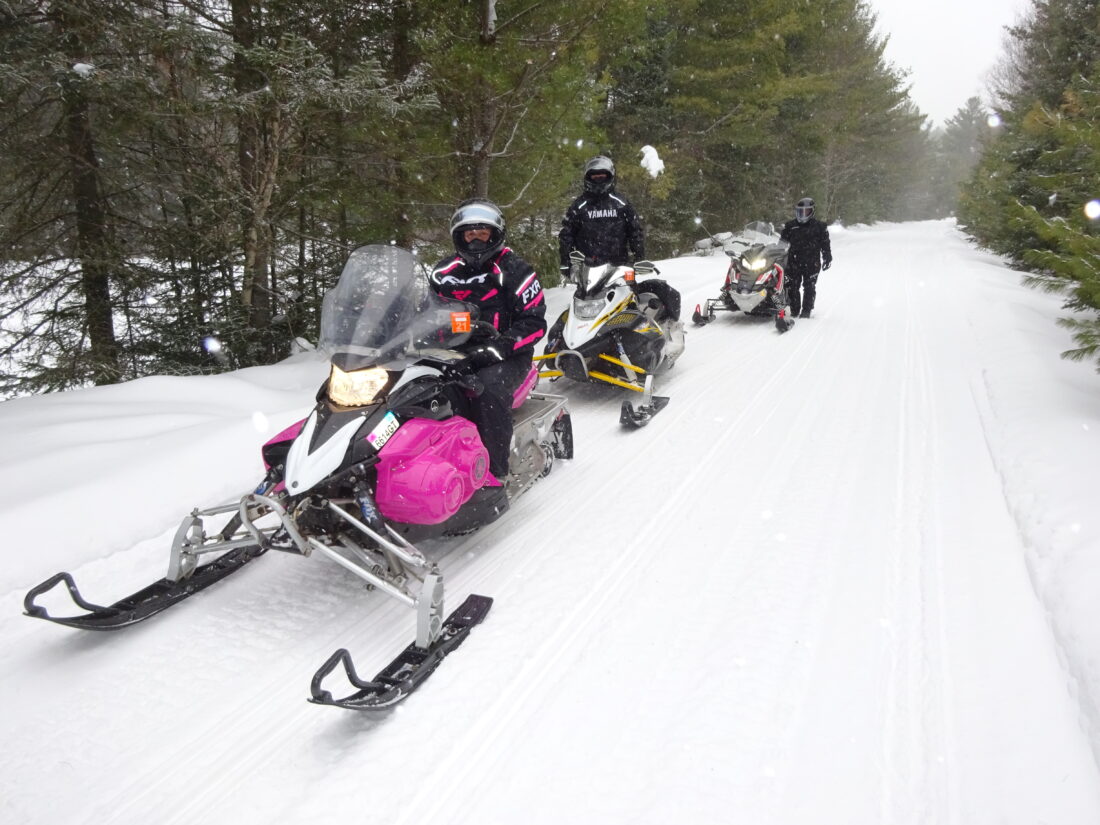
Adirondack Rail Trail users (Photo provided)
–
When the idea of removing the rails between Old Forge and Lake Placid gained traction more than a dozen years ago, it was the Adirondack Recreational Trail Advocates leading the charge. At the time, the Adirondack Railway Preservation Society was operating scenic tourist trains between Lake Placid and Saranac Lake and out of Utica and Thendara (near Old Forge).
Then, after former Gov. Andrew Cuomo announced in May 2016 to split the difference — keeping the rails between Old Forge and Tupper Lake and removing them between Tupper Lake and Lake Placid for a rail trail — the Adirondack Recreational Trail Advocates changed its name. Now it’s the Adirondack Rail Trail Association.
“The same acronym. We’re just going to swap out some letters,” said ARTA Executive Director Brian Woods. “We love our acronyms.”
ARTA is considered the friends group of the Adirondack Rail Trail, working with the DEC, local governments and businesses to help promote the attraction; establish consistency as it travels from Tupper Lake to Lake Clear, Saranac Lake, Ray Brook and Lake Placid; and ensure that the rail trail is the “best version of itself.”
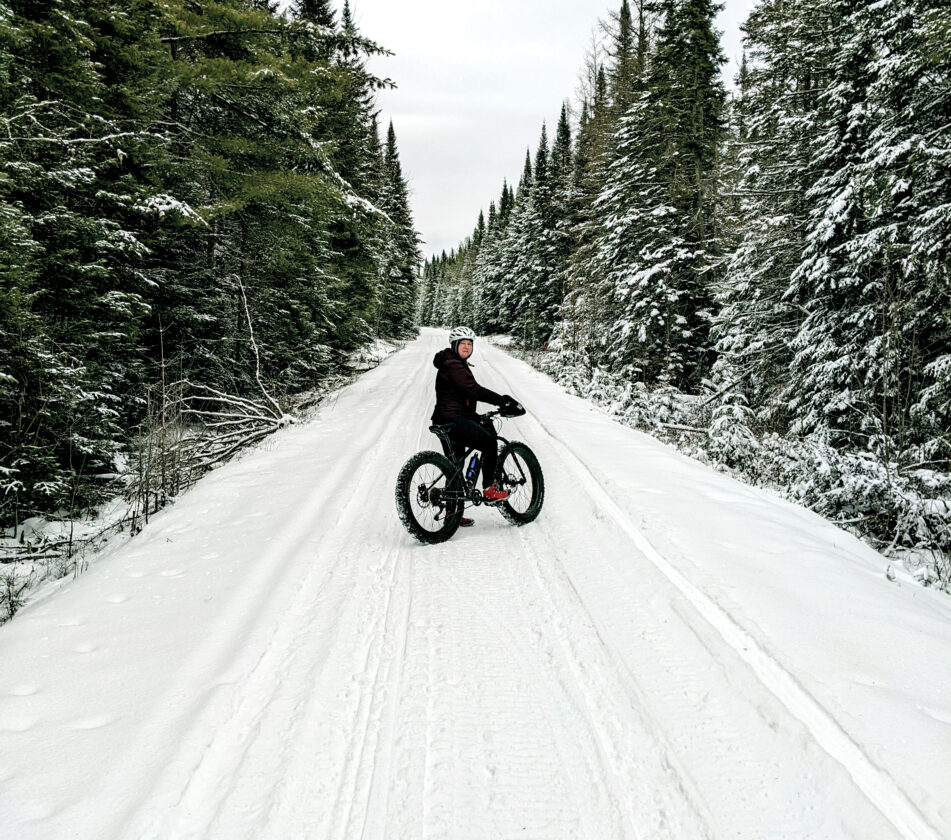
Adirondack Rail Trail user (Photo provided)
The Adirondack Rail Trail is modeled after the Virginia Creeper National Recreation Trail, a 34.3-mile rail-to-recreation trail established in 1987 that traverses through two counties from Abingdon, Virginia, through Damascus, ending just past Whitetop Station in the Mount Rogers National Recreation Area at the Virginia-North Carolina border. The friends group there is the Virginia Creeper Trail Conservancy, a nonprofit volunteer organization that helps promote, maintain and preserve the Creeper Trail corridor.
–
Trail construction
–
The rails along the Adirondack Rail Trail were removed in 2021. The DEC and Office of General Services awarded Kubricky Construction Corp. of Wilton, Saratoga County, the $7.9 million contract for the first phase of construction, which began in the fall of 2022. The contract is funded by NY Works, with an additional $225,000 supported by the Environmental Protection Fund for construction oversight and inspections.
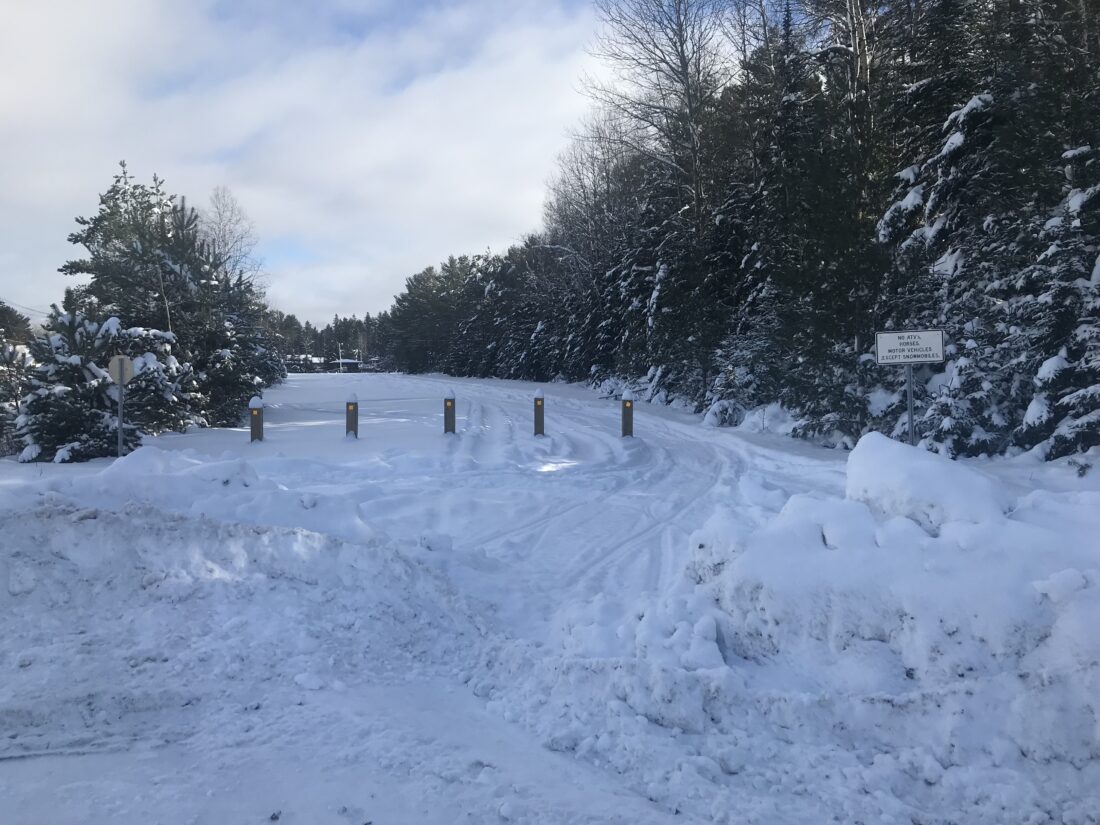
Here is the land off Station Street in Lake Placid where the Adirondack Rail Trail begins. The Open Space Institute plans on buying the land and turning into a trailhead a parking area for users of the trail. (News photo — Andy Flynn)
Phase 1 starts in Lake Placid, a short distance from the train station on Station Street, to Aubuchon Hardware in Saranac Lake. That’s just over 9 miles. Construction is expected to be complete by September of this year. During the construction season, the trail will be closed to recreational users.
“If individuals in the summer of 2023 are interested in getting out and riding the trail, great,” Woods said. “I’d say get out to Saranac Lake, get out to Tupper Lake, get out to Floodwood or Lake Clear and jump on the trail and enjoy it. But construction won’t be done, so don’t think this is the final product.”
The contract for Phase 2 of construction — from Aubuchon Hardware to Floodwood Road — is out to bid right now. It is expected to begin in the fall of this year and be finished in the fall of 2024.
Phase 3 of construction — from Floodwood to the Tupper Lake train station — is expected to start in the fall 2024 and finish in the fall 2025.
The trail corridor is 34 miles long by 100 feet wide, with a 2.5-foot shoulder on both sides.
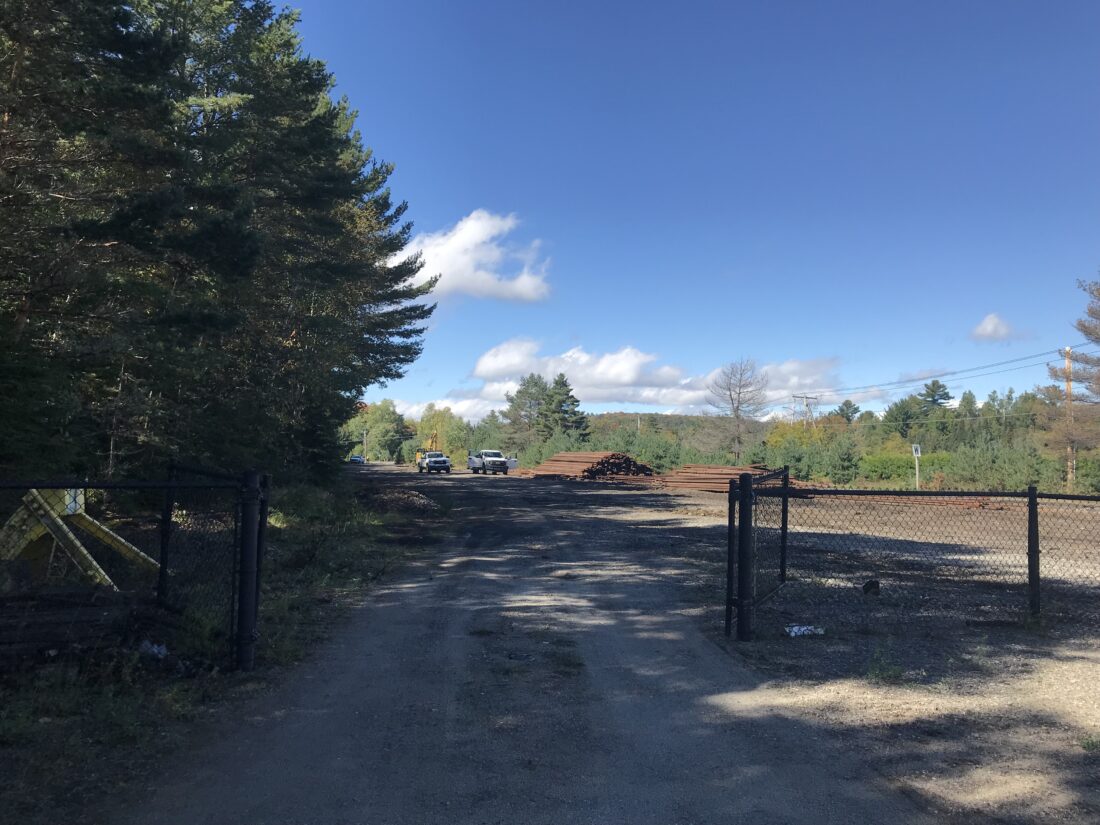
Here is the land near the Lake Placid train station, looking toward Station Street, where the Adirondack Rail Trail begins. The Open Space Institute plans on buying the land and turning into a trailhead a parking area for users of the trail. This photo was taken in September 2021 as rails that were being removed were piled up. (News photo — Andy Flynn)
“They’re altering the surface so that the grade of the trail is no more than 2%,” Woods said about the trail. “That helps with accessibility. That helps with runoff.”
The trail — with the exception of a paved section in the village of Saranac Lake — will have a packed gravel stone dust surface. Construction will include re-leveling, re-surfacing, creating a defined shoulder and trail signage (mile markers and way-finding signs).
When the rail trail is complete, summer users will be able to use it for running, walking and biking — including class 1 ebikes.
“On the surface that we’ll see on the trail, you (will be able to) take a road bike on it,” Wood said. “It will be rideable to hybrids, mountain bikes, recumbents and fat-tire bikes.”
–

Adirondack Rail Trail user (Photo provided)
Trail use
–
The Adirondack Rail Trail is being designed for people of all ages and abilities.
“If you’re someone who utilizes a wheelchair, this trail will work for you,” Woods said. “If you’re someone who enjoys cycling, but you need a recumbent cycle, this trail will work for you.”
Woods sees the rail trail as a space for Tri-Lakes residents and visitors to use in different ways, “whether it’s for recreation, for sightseeing, they want to go fishing by themselves, with kids, with a friend, you can do that. You can go for a walk. You can have a picnic. You can watch the sunset in certain spots. It’s a different way of interacting with the Adirondacks.”
This past winter, the section between Lake Placid and Saranac Lake was open for recreational users, and Woods said he was glad to see a variety of people using the trail, including heavy use by snowmobilers.
“The first significant snowfall, I went out on my cross-country skis, I saw a snowmobiler,” he said. “I saw a skier. I saw someone on a fat tire bike. That was great to see. I had a concern that we were only going to see one form of transportation on the trail, and I think the reality is that there has been true multi-use. I think that as the word gets out and conditions improve on the trail, as the surface changes, it will only increase the number of people we see on it in the wintertime — on their bicycles, on snowshoes, on skis.”
–
Lake Placid trailhead
–
In Lake Placid, work has begun on establishing a terminus for rail trail users. Officials at the Open Space Institute are raising money to build a trailhead and parking lot near the train station, on land that is currently owned by the Lake Placid-North Elba Historical Society.
OSI Senior Vice President for Communications Eileen Larrabee told the News in February that the group was in “active conversations” with the historical society to buy the land. With a recent focus on making land more accessible, in addition to conserving it, Larrabee said the Lake Placid rail trail work is an “extension” of their conservation projects.
“We always say, ‘Bring people to the land and make them fall in love with it so then, ultimately, they, too, will care for the land and want to protect it,'” Larrabee said.
Gov. Kathy Hochul’s executive budget proposal, through the state Environmental Protection Fund, included $300,000 to purchase the land. If approved by legislators and signed by the governor, Larrabee said the OSI would then leverage that to raise $700,000 in private donations from individuals and foundations.
In December, OSI received a $500,000 grant in a round of Regional Economic Development Council awards to design and construct the trailhead and parking area. The preliminary plans include a 43-space parking lot area with three EV charging stations and two accessible parking spots, public restrooms, bike repair stations, a pavilion, picnic tables, interpretive signage, a brick paver plaza and green spaces such as a place to park snowmobiles in the winter. There would also be a pick-up and drop-off space for the village’s Placid XPRSS public transportation trolley.
“It’s a mini welcome center,” Woods said of the OSI’s plans for the Lake Placid trailhead.
This year, ARTA received a $49,183.61 grant from the town of North Elba’s Local Enhancement and Advancement Fund (LEAF) to install bike racks and portable toilets at the Lake Placid trailhead, and this past November it was awarded a $25,000 LEAF grant for local marketing.
–
Friends group
–
As the friends group of the Adirondack Rail Trail, ARTA works with the DEC in ways that are similar to the way John Brown Lives! — a nonprofit friends group — works with the manager at the John Brown Farm State Historic Site. It’s a public-private partnership.
“The presence of the state ensures that there is consistent governance and funding for certain levels of the trail,” Woods said. “It ensures that the enforcement that is necessary on the trail is in place. But the presence of a formal nonprofit entity, like ARTA … we have access to funding that the DEC doesn’t have access to.”
ARTA’s work consists of being a steward of the rail trail — helping with monitoring and maintenance — plus raising funds for those efforts and working with the municipalities to ensure they have the services they need for the trail. Yet the DEC still has jurisdiction over the trail corridor.
“Once you step off of that 100-feet wide corridor, each municipality is left to their own device,” Woods said, “so without ARTA in place, Lake Placid can make decisions for signage, for bike racks, for bike-repair stations that is different from what Saranac Lake decides to do and is different from what Tupper Lake decides to do — because there isn’t one entity in place working with all of them to help fundraise, to help write grants and to help install this.”
The goal is consistency among the villages and uniformity.
“You want to think of what works best for that community, but you also want to think about the experience of the trail user, so they understand it’s one trail,” Woods said. “We really kind of see ourselves as synthesizing all of the best of each municipality, the concerns of each municipality, the strengths, bringing them together to address what goes on off the trail in relation to the trail but also to be partners to the DEC to make sure that the trail has everything that it needs to be successful. That they have everything they need to be responsible for this trail.”
During their annual meeting on March 20 in Saranac Lake, ARTA officials appointed new board members, mainly from local government and business stakeholders: Brad Hathaway, Department of Public Works superintendent, village of Lake Placid; Jimmy Williams, mayor, village of Saranac Lake; Jordanna Mallach, supervisor, town of Harrietstown; Pete Edwards, code enforcement officer, village of Tupper Lake; Rick Donah, town councilor, town of Tupper Lake; North Elba town Supervisor Derek Doty and Councilor Emily Politi (shared seat); Chris Keniston, business representative, Tupper Lake; Chrissie Wais, business representative, town of Harrietstown; John Brockway, business representative, town of Harrietstown; Matt Delaney, business representative, town of North Elba; and Rachel Karp, Saranac Lake Area Chamber of Commerce. Two more business representatives, one from Tupper Lake and one from North Elba, will be added to the board. Nominations can be submitted to info@adirondackrailtrail.org.
Going forward, ARTA officials will soon roll out a membership program, and they are working on a survey to assess the economic impact of the trail once the section between Lake Placid and Saranac Lake is complete.
“The midpoint numbers from Rails-to-Trails Conservancy’s study indicate that we can expect $20 million in new spending as a result of the trail — and those figures were calculated in 2012 — the spending total for today’s dollar should be higher,” Woods said. “Additionally, that figure doesn’t include the spending of local permanent residents.”
When the Adirondack Rail Trail is finished, Woods said it will be possible for people to create one-of-a-kind itineraries for an all-day adventure.
“My wife did the trail last summer with her cousin and biked from Lake Placid, climbed up Scarface, came back down, biked down the trail, ran up Baker, ran back down, and then I met them at Donnelly’s,” Woods said. “A perfect day. And I think that each person is going to find a dozen different ways to make use of this trail, whether it’s recreation, physical fitness, spending time with family, friends, or transportation. I think that one of the things we don’t talk about is the number of cars on the road in the Adirondacks. And I think it has the potential in certain areas to reduce the numbers.”
Learn more at www.adirondackrailtrail.org.
–
(Correction: An earlier version of this story stated incorrect information about the class of ebikes that will be allowed on the Adirondack Rail Trail when it is complete. The trail will only allow Class 1 ebikes. Class 2 and 3 are the categories not allowed as they have a throttle and don’t require pedal assist. Class 1 is only pedal assist to 20mph. Also, town of Tupper Lake Councilor Rick Donah was added to the ARTA board in March. The News regrets the errors.)
Local News
VISITING LAKE PLACID : A different world: A winter climb up Mount Colden
KEENE — My heart pounded, not from the 2,500 or so feet we had ascended over the last couple of hours, but for ...
Forest ranger recalls saving hiker lost for two days in Dix Range
Snowshoer found dead in lean-to in Pharaoh Lakes Wilderness
SCHROON — A Florida man was found dead in a lean-to in the 44,400-acre Pharaoh Lakes Wilderness in southern Essex ...
Ad’k Life announces photography contest winners
Some see Olympic blueprint for a 3rd Lake Placid games
CORTINA D’AMPEZZO, Italy — Imagine: A sprawling world-class city and a small mountain village with a rich ...