Bird groups counting on citizen scientists this coming weekend
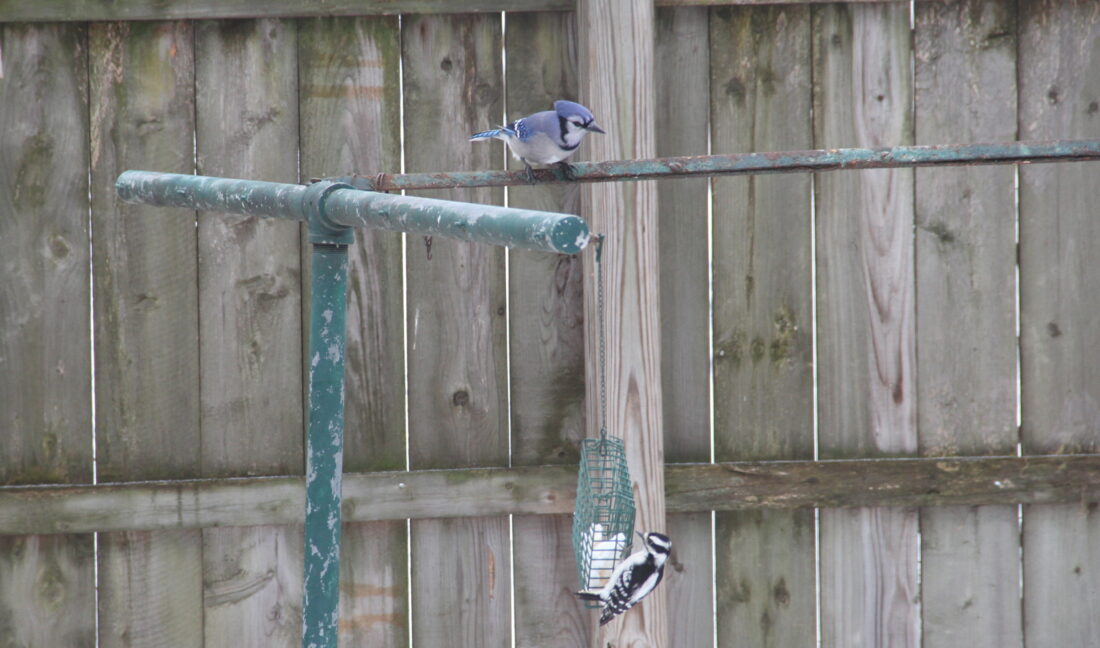
Photo of blue jay and downy woodpecker by Andy Flynn
SARANAC LAKE — Bird groups are looking for all types of birders — casual ones, hardcore ones, even beginners — to help count birds this weekend around the world during the 26th annual Great Backyard Bird Count.
Taking place from Friday, Feb. 17, to Monday, Feb. 20, the GBBC is a citizen science project of the Cornell Lab of Ornithology, National Audubon Society and Birds Canada with support by founding sponsor Wild Birds Unlimited.
“Based on the recently released State of the Birds report, we know that half the bird species in the United States and Canada are decreasing,” said David Bonter, co-director of the Center for Engagement in Science and Nature at the Cornell Lab of Ornithology. “We absolutely need the eyes and ears of birdwatchers to give us the big picture when it comes to shifting bird populations.”
The GBBC and other bird count events, such as Audubon’s Christmas Bird Count, give scientists a clearer picture of how birds are doing. Are individual species declining, increasing or holding steady?
“We only ask for 15 minutes of your time at the minimum,” said Becca Rodomsky-Bish, Cornell Lab of Ornithology’s project leader of the GBBC. “If you want to spend an hour watching, if you want to watch every day for more than an hour, that is wonderful.”
Rodomsky-Bish was a panelist for the “Get Ready for the Great Backyard Bird Count Q&A webinar” on Wednesday, Feb. 15, which is archived on the Cornell Lab’s YouTube page. More than 2,700 people from around the world attended the webinar.
Birders are simply asked to watch, count and share the birds around them.
“And it’s not just for those that you see,” Rodomsky-Bish said. “Some of us are hearing birds, so we also welcome people who are recording bird sounds and hearing birds to tell us what birds they are hearing and seeing.”
And people aren’t limited to their backyards.
“You can be in your front yard. You can be at your church. You can be at a school. You can be at a local park. You can be out on a walk,” Rodomsky-Bish said.
What birds should people count?
Kerrie Wilcox, manager of Project FeederWatch at Birds Canada, said people should record every bird they see and hear.
“That includes a flock of geese that are flying overhead,” she said. “Or if you hear a black-capped chickadee but don’t see it, we want you to count that, too. So if you’re going for just a short walk for the Great Backyard Bird Count and you see three chickadees at the start of your walk, count that. And then if you see five a little later, it’s a running tally. So now you have eight chickadees. And we want you to do that for every species during your count, and then enter your checklist for each location you do a count and each time you go out.”
Those new to the event can find out all they need to know at www.birdcount.org. People of all ages and skill levels are welcome.
“If you are a beginner, you should definitely feel encouraged to join our Great Backyard Bird Count efforts,” Chad Witko, National Audubon Society’s senior coordinator for avian biology, said during the webinar. “Every count matters. The more data we get in, the more powerful the analyses and sciences on the back side of these counts.”
Most beginning birders know more about local birds than they might realize, according to Witko, especially the backyard birds they’re feeding for a long time.
“And for what you don’t know, there are a lot of tools out there that really help with your identification process, whether it be field guides, online resources or apps like Audubon’s field guide or Merlin Bird ID,” Witko said. “And if you feel stuck after that, it’s OK sometimes to leave the birds unidentified. Even the best birders aren’t able to identify every bird that they see.”
What happens if people just cannot identify a bird?
“It’s really just mostly important that you record the birds that you can identify,” Kathy Dale, National Audubon Society’s director of citizen science, said during the webinar.
If there’s a bird that people can’t completely identify — but they know, for example, that its some type or hawk or duck — there is a way to record that they’ve seen a type of hawk or duck.
“It’s also fine to not record it at all,” Dale added.
Last year, an estimated 385,000 people participated during the GBBC, which is held every February. They reported more than 7,000 species from 192 countries.
“The Great Backyard Bird Count is a stepping stone towards bird conservation,” Birds Canada President Patrick Nadeau said in a press release. “Taking this step in February launches a journey of discovery whether you’re just beginning to learn about the birds around you or an experienced birder watching out for new feathered friends.”
The GBBC website has tools and information to help birdwatching newbies and veterans participate in the count. That include’s step-by-step instructions for entering the GBBC bird lists on three apps:
¯ Merlin Bird ID app: https://www.birdcount.org/merlin-bird-id-app
¯ eBird Mobile app: https://www.birdcount.org/ebird-mobile-app
¯ eBird on a computer: https://www.birdcount.org/ebird-on-computer
In order to participate, birdwatchers can take three easy steps:
Step 1: Decide where you will watch birds.
Step 2: Watch birds for 15 minutes or more, at least once over the four days, Feb. 17 to 20.
Step 3: Identify all the birds you see or hear within your planned time/location and use the best tool for sharing your bird sightings.
Learn more about the Great Backyard Bird Count at www.birdcount.org.
Local News
VISITING LAKE PLACID : A different world: A winter climb up Mount Colden
KEENE — My heart pounded, not from the 2,500 or so feet we had ascended over the last couple of hours, but for ...
Forest ranger recalls saving hiker lost for two days in Dix Range
Snowshoer found dead in lean-to in Pharaoh Lakes Wilderness
SCHROON — A Florida man was found dead in a lean-to in the 44,400-acre Pharaoh Lakes Wilderness in southern Essex ...
Ad’k Life announces photography contest winners
Some see Olympic blueprint for a 3rd Lake Placid games
CORTINA D’AMPEZZO, Italy — Imagine: A sprawling world-class city and a small mountain village with a rich ...