Standing with Ukrainians … literally
Dmitry Feld returns home to Ukraine with Dr. Cogar to help pets in need
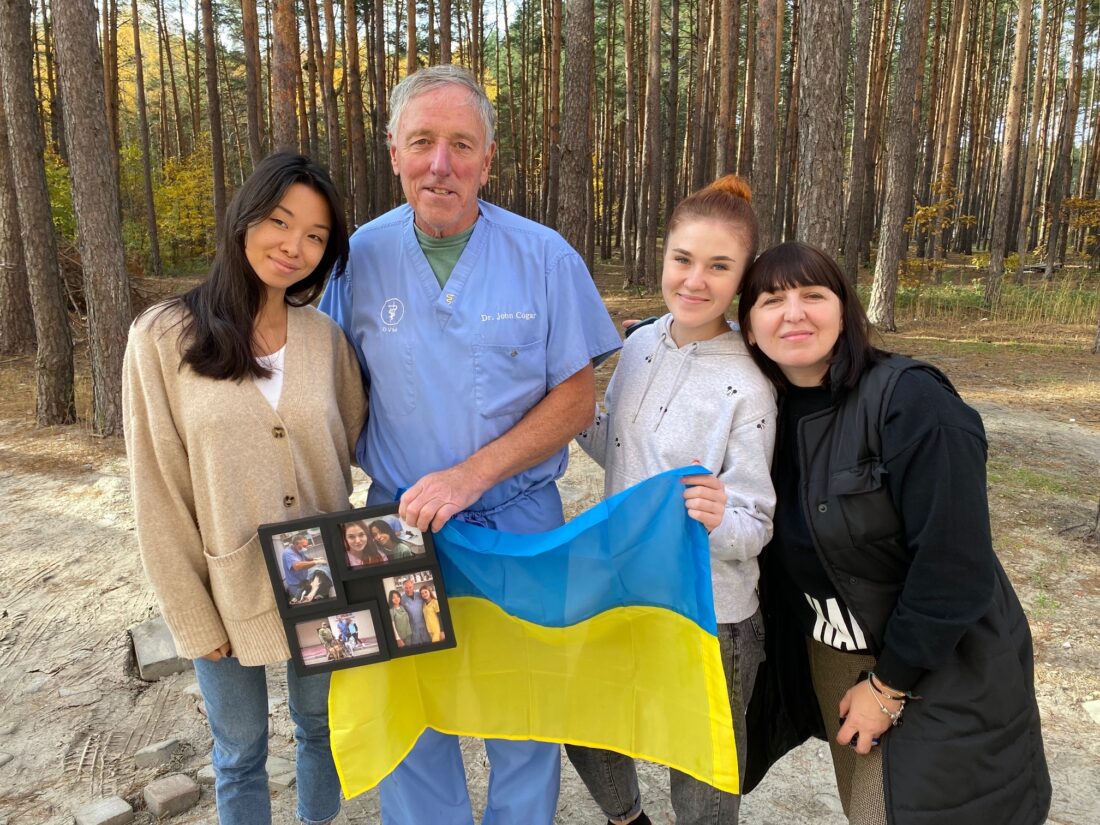
Dr. John Cogar, a veterinarian from Saranac Lake, poses with staff from the veterinary clinic where he volunteered recently, helping dogs and cats, in the city of Irpin, Ukraine, near the capital of Kyiv. They presented him with a flag to take home. He traveled with Lake Placid’s Dmitry Feld, who grew up in Kyiv and was Cogar’s translator. (Photo provided — John Cogar)
LAKE PLACID — When Dmitry Feld and Dr. John Cogar arrived at the train station in Ukraine’s capital city of Kyiv three weeks ago, they were met by soldiers, who were told to look out for a man in shorts. That was Feld.
The duo hadn’t had any sleep for about 36 hours. Cogar, a well-known veterinarian from Saranac Lake, and Feld, the marketing manager for USA Luge in Lake Placid, had left the Adirondack Regional Airport in Lake Clear on Oct. 18. Their mission — to help dogs and cats in a war zone for more than a week. They were volunteers.
Before boarding the Cape Air Cessna 402C, they sent two small, black plastic boxes — packed with surveillance drones — through the TSA checkpoint. They were gifts for the Ukrainian military, which has been fighting Russian forces since they invaded Ukraine on Feb. 24.
“We get off at the train station with our drones, and these military guys — marines — they swarmed Dmitry and me,” Cogar said. “And they hugged us, greeted us and then they ripped their brigade patches off their shoulders and gave them to us. And that was a tearjerker moment.”
“And one of the drones went right to the front line,” Feld added.
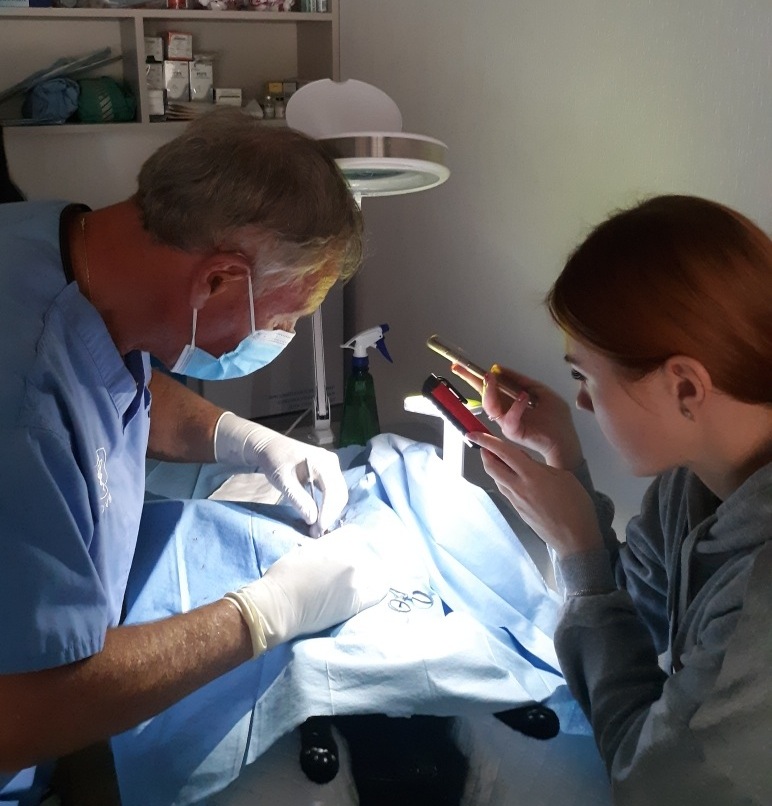
Dr. John Cogar, a veterinarian from Saranac Lake, performs surgery at a veterinary clinic in Irpin, Ukraine, in October. (Photo provided — John Cogar)
“This is life-saving stuff for them, these drones,” Cogar said.
Feld, who moved to the U.S. from Ukraine in the late 1970s, grew up in Kyiv, and he was Cogar’s translator while the vet helped local pets — mostly spaying and neutering, but office visits as well. Out of eight days volunteering for a veterinary clinic in the city of Irpin, northwest of Kyiv, Cogar had one day off, a Sunday. And he spent half of that day as a guest at the military drone school in Kyiv.
“They let him actually fly one of those drones,” Feld said.
Irpin was in the news during the earliest days of the war. It was the scene of heavy fighting from Feb. 27 to March 28 — Russian forces captured half of Irpin by March 14, and Ukrainian forces recaptured the city on March 28. Vestiges of that fighting are still visible — including burned-out Russian tanks — and made an impression on Cogar.
–
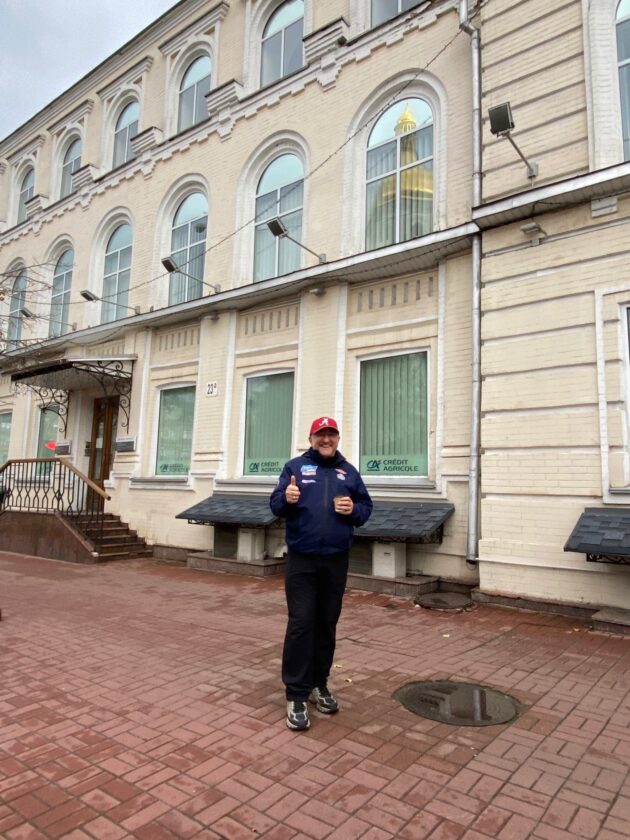
Dmitry Feld, of Lake Placid, poses outside the building where he grew up in Kyiv, Ukraine, during a trip in October. (Provided photo)
Not quite normal
–
“It was very surreal,” Cogar said.
About 200 feet away from the modern building that houses the veterinary clinic is a building the Russians used as a torture chamber during their occupation — just seven months earlier.
“So if you can wrap your brain around that, and then a block over this way is a playground with kids playing … going up and down the teeter-totters and the slides,” Cogar said.
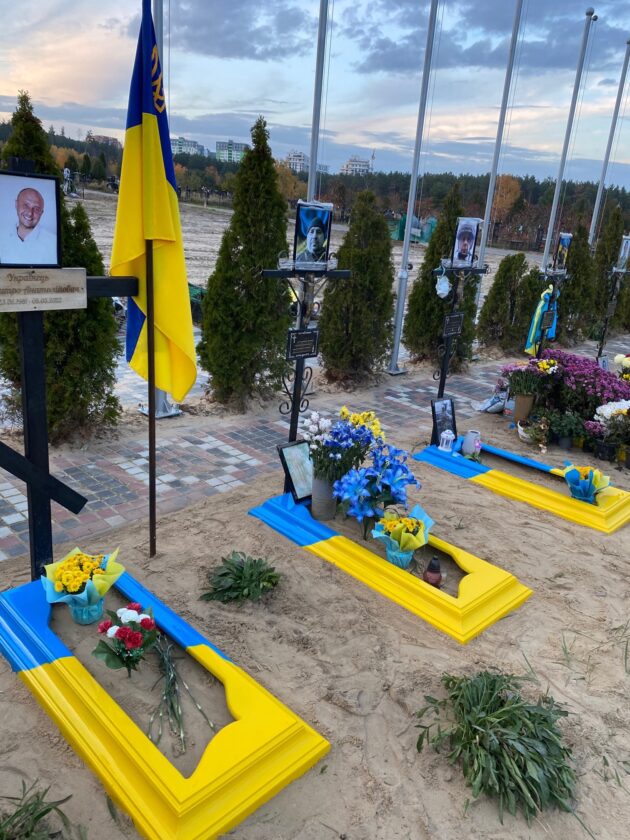
Graves of Ukrainian soldiers in the city of Irpin (Provided photo)
“Yeah, surreal,” Feld said.
“And next to that is a car with a thousand machine gun bullet holes in it,” Cogar said. “You’re trying to grasp this, and they’re going on with their lives. … These people go on day in and day out with their lives like everything is normal. And it’s not normal.”
One morning, a women informed Cogar that the Ukraine military had shot a Russian-sent attack drone out of the sky a few hours earlier — two blocks away.
“And my eyes are getting as big as saucers,” Cogar said. “And the woman telling us the story goes, ‘Yeah, our military is good.'”
One night, while Feld and Cogar were having a candlelight dinner (the power was out), they looked out the window toward a nearby park and saw more than a dozen people wearing headlamps and gathering for an outdoor social event.
“They have guitars, making shish kebabs, dogs hanging out, and they just get along with their lives, even with no electricity,” Feld said. “Their spirit is so high and it just blew my mind.”
–
The work
–
But Cogar was there for the cats and the dogs.
“They don’t have veterinarians,” Feld said. “Most veterinarians left. It’s a war. Either they’re on the front lines or they left for other countries.”
Their visit was set up by the Ukrainian Red Cross for Animals, which planned Cogar’s schedule.
“They allocated each day to different groups,” Feld said. “So one day was a kennel with eight dogs from Kyiv, all abandoned dogs and military dogs that came from the front lines. Another day was all abandoned cats and dogs that a guy from Irpin collected, and he keeps them in his kennel.”
Another day was for people who found abandoned dogs and cats, which were being kept in their own homes.
“But as soon as he arrived, he said, ‘That’s not enough,'” Feld said. “So instead of one cat an hour, it was two cats an hour.”
The pet crisis is profound in Ukraine right now. Some people brought their pets with them when they fled to places such as Poland, but others didn’t.
“Some people thought they’d be back in a week, so they left their pets in their apartments,” Feld said. “Or the building blew up, and all those pets ended up on the streets.”
Cogar’s work schedule was pretty consistent.
“We worked hard,” he said. “We had a full schedule every day. We went from 9 to 5 and I did anywhere from nine to 11 pets.”
Yet, always the work horse, Cogar didn’t want to waste any time he had there. So he reluctantly took a lunch break every day.
“Because the girls who worked with us, they wanted a lunch break,” Feld said.
“I didn’t want a lunch break,” Cogar said. “He dragged me out.”
“I said, ‘No, you gotta go,'” Feld said.
Cogar was told that he could be most helpful by spaying and neutering as many dogs and cats as possible.
“And the reason for that is — because of the war — there were so many abandoned animals. People got separated from their pets. These were well-taken-care-of animals, but they were abandoned,” Cogar said.
Not all were abandoned, however. One feral cat stood out for its nasty demeanor.
“One cat was always growling at Dr. Cogar, even when he put him asleep. He was a really tough cat,” Feld said.
Cogar also spayed a 7-month-old dachshund owned by one of Feld’s luge friends.
“On my day off,” Cogar said.
And military dogs.
“When they brought the military dogs, that was a touching moment because they said one of these dogs is to sniff out bombs,” Cogar said. “But then they said the other dog was to sniff out human remains. So the reality of war hit home.”
–
Challenges
–
Cogar is used to having the best conditions for his veterinary work — gas anesthesia, effective lighting, sterile surgical instruments — even something as basic as electricity. Yet these were some of his challenges in Ukraine.
“It’s kind of paradoxical,” Cogar said. “The facility, the building, was very nice. It was very modern. … Having said that, things I’m used to in modern veterinary medicine were not there. They did not have gas anesthesia at all, which is a fundamental basic principle in modern veterinary medicine, because it’s the safest form of anesthesia.”
Instead, he used Propofol as an anesthesia.
Then there was the lighting.
“I’m used to a beautiful surgical light,” Cogar said.
There was a smaller light, but they couldn’t always use it due to power outages.
“Dmitry (and an assistant) had to hold the flashlight for me to do surgery the first three or four days I was there,” Cogar said, “because electricity didn’t just go off for half an hour. It was off for six hours at a time.”
Then there’s the language barrier.
“My surgical nurses don’t speak a word of English, very much, and thank God Dmitry was there to translate everything for me,” Cogar said. “He was so valuable from that standpoint.”
And sterile instruments. He brought some with him, but they were not enough.
“So I used a lot of alcohol,” he said.
He gives a lot of credit to the clinic’s technicians — described as “very professional and dedicated” by Cogar.
“Except for forcing me to take lunch, they were right there working hard,” he said. “We worked hard. We were there to do a job and we did it. No fooling around.”
It was clear that the technicians were there because they loved animals.
“They were not there for money, for sure, because there is no money,” Feld said.
They’re also victims of war.
“When the war started, Irpin was right there. It was Bucha and Irpin,” Feld said. “And they all left. One left for Poland for three months. Another left and was in Germany and France for three months, then came back.”
Cogar wants to be clear — he’s not complaining about his challenges. He expected them.
“I’m just describing what the conditions were,” he said. “Everybody did the best they could under trying circumstances, and we all adapted. And we did well. All 75 surgeries were successful.”
–
Going home
–
Feld said it “was great” going home to Ukraine. He visited the building where he grew up in Kyiv, saw old friends, met new ones and visited the graves of some family members.
“My grandfather is buried in a mass grave in Kyiv during World War II,” Feld said. “The Nazis killed in one or two weeks 30,000 Soviet officers and Jews. And through the whole period, they said it was 100,000. It’s called Babyn Yar.”
He visited his grandmother’s grave before going to his father’s; he was a colonel in the Ukrainian air force. He also got to visit the graves of Ukrainian soldiers who died in the spring fighting the Russians.
“To me, very emotional was when our volunteer, Luba, she’s part of this Ukrainian Red Cross for Animals,” Feld said. “She came every morning, picked us up, took us to the clinic, brought us home, fed us. … She took us to lunch to an Italian restaurant … in the middle of Irpin … and it was very good food.”
One evening she took them to a cemetery where Ukrainian soldiers were recently buried.
“And that, to me, was the most emotional thing of that whole trip,” Feld said. “Here I was, paying respects to the local men and women who died defending Irpin.”
“The other thing that made this so emotional, this graveyard, was that it was a fresh graveyard, meaning that they had dug these graves recently,” Cogar said. “In Ukraine, they have a thing. They put pictures on every gravesite of the soldier. And you can really connect.”
One picture above a grave showed a soldier holding his dog.
–
Satisfaction
–
Many Ukrainians asked Cogar the same question: “Why did you come here?”
Before he left, he told the Lake Placid News his reasons for taking such a dangerous trip to help Ukrainians: his empathy for animals, empathy for the people of Ukraine and to be an ambassador for the country, to know that America was behind the Ukrainians.
“All three things exceeded my expectations,” Cogar said. “Meaning, I feel like I did help an awful lot of animals. No. 2, I feel that the people of Ukraine were extremely appreciative of what I did for them. And No. 3, I do think — we heard from them over and over — that they appreciate America, and they appreciate the fact that I, from the United States of America, was part of that American effort to back the people in Ukraine.”
“It was good to be there to show them that we come to help,” Feld said.
Some of the Ukrainians got emotional after meeting Cogar and Feld. For example, during lunch one day, they were thanked for volunteering.
“The cook lady, she found out that we were from the United States,” Feld said. “So one day she came out, brought him food and started thanking him and crying. … They say that without the U.S. and Europe’s help, they could never survive that onslaught. Just keep giving it to them. They’ll fight until they win.”
For Feld, it was just a trip home. He didn’t have to bond with the Ukrainians; they’re his people.
“But they all bonded with Dr. Cogar and said they want him back in the month of May,” Feld said.
“I never expected to be so bonded to these people,” Cogar said. “Even his friends. I feel like they’re my friends now.”
Cogar now has a deep appreciation for the people of Ukraine.
“My impression of Ukrainian people is so profoundly and deeply ingrained in me how good these people are,” he said. “I didn’t know that before I went just how innocent they are over this awful, cruel war. These are good people, and they’re also tough and resilient. They’re no pushovers; they want to win this war, and they’re going to do everything they can to win.”
As Cogar’s wife, Marie, watched him board the plane on Oct. 18 at the Lake Clear airport, she noted that her husband was going to come back to America a different person. How could he not, coming from a war zone?
Mostly, he said, this trip made him appreciate the Adirondacks more than ever.
“It made me more aware of how beautiful and peaceful this area is,” Cogar said. “We all take it for granted. I must have said five times to my wife, this sleepy little, pretty village of Saranac Lake, I look at it a little different now. It’s so peaceful. Because when you see a war-torn area, the contrast is something.”
Dmitry didn’t come back a different person.
“I think my bond with that country is so deep, and with those people so deep, that I don’t have to be there necessarily all the time to have a bond,” Feld said. “By me going there, it just gave me another opportunity to see it — not on TV but be part of it. Deliver what we promise. Help them where we can. Come home and give the message to American government and American people: Please don’t stop supporting us until we win this war.”
–
The future
–
Cogar said that when he first told his wife about the trip to Ukraine, she didn’t talk to him for 10 days.
“She came around, but she also saw what this meant to me,” Cogar said. “Here’s the good news. My wife said she’d love to go to Ukraine with me — after the war is over.”
Feld is not making any plans to return right now. Instead, he’s still raising money to help out the Ukrainians. There were many businesses, organizations and residents who helped fund their veterinary trip — including the Joshua Fund and High Peaks Animal Hospital. But now he needs more help — raising money to help pay for generators.
Anyone interested in donating can contact Feld at 518-637-1593 or by email at dmitry@usaluge.org.
Local News
VISITING LAKE PLACID : A different world: A winter climb up Mount Colden
KEENE — My heart pounded, not from the 2,500 or so feet we had ascended over the last couple of hours, but for ...
Forest ranger recalls saving hiker lost for two days in Dix Range
Snowshoer found dead in lean-to in Pharaoh Lakes Wilderness
SCHROON — A Florida man was found dead in a lean-to in the 44,400-acre Pharaoh Lakes Wilderness in southern Essex ...
Ad’k Life announces photography contest winners
Some see Olympic blueprint for a 3rd Lake Placid games
CORTINA D’AMPEZZO, Italy — Imagine: A sprawling world-class city and a small mountain village with a rich ...