EYE ON EDUCATION: Connecting with nature
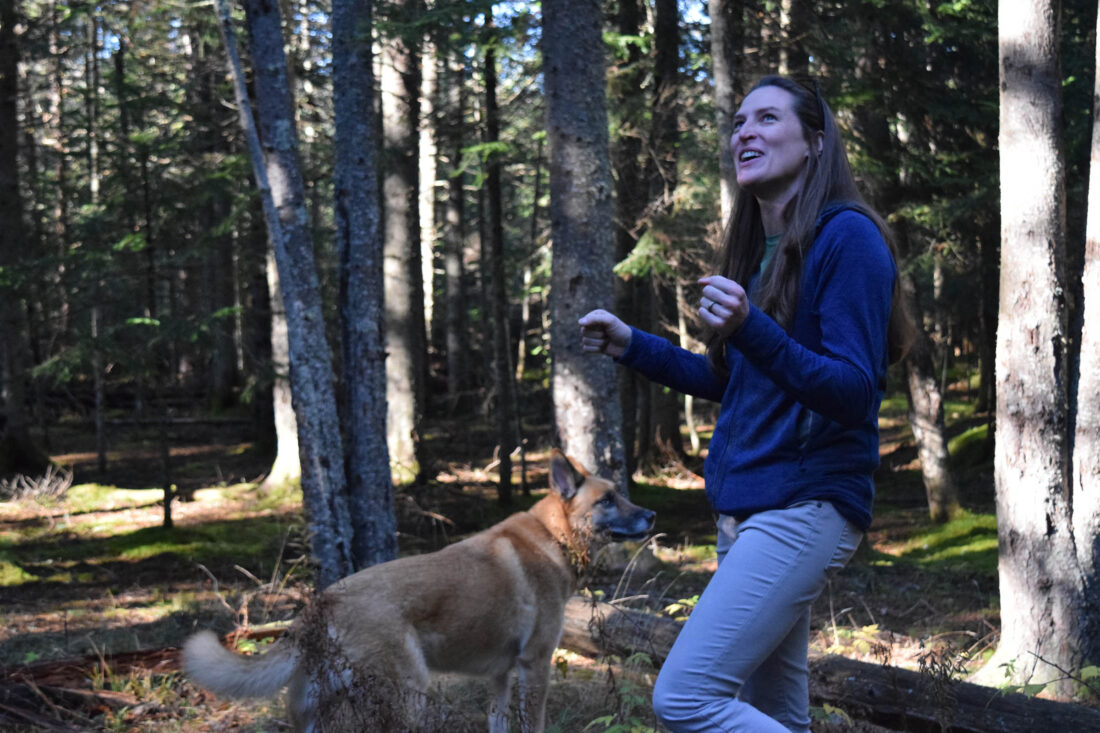
(News photo — Lauren Yates) WOODS founder Carolyn Walton talks at a campsite on a property in Onchiota, where Lake Placid high schoolers will have the opportunity to camp for three nights and learn wilderness skills.
ONCHIOTA — The sound of fallen leaves crunching beneath the feet of Lake Placid Central School District Superintendent Tim Seymour resounded at a property in Onchiota last week as he walked on a path that Lake Placid high schoolers will soon travel along as they learn wilderness skills and create connections with the region they call home.
A new wilderness program is coming to the school district starting in the spring, when students in grades 9 through 12 will have a chance to camp for three nights and four days in the woods of Onchiota. They’ll hike, learn how to tie knots, practice setting up tents and building fires — all the survival skills they’ll likely ever need in the woods.
LPCSD is piloting the program with Carolyn Walton, the founder of the ADK WOODS — or Wilderness Opportunity to Offer and Develop Skills — which is designed to “foster connection through wilderness immersion,” according to Walton.
“It’s connection with the natural world, and also reconnection to self and deepening connection with your peers, (with) the goal of them returning back to the community with an increased positive connection to the land that we live in,” she said.
Seymour said that elementary school students in the district are exposed to the wilderness through the 46er book club, but that “by the time they hit high school, those opportunities for kind of enhanced wilderness education dissipate.” The WOODS program will be free to students, and Seymour sees the trips as a way for students to better connect with the region they live in and to build some foundational wilderness knowledge that could support students who want to later attend Paul Smith’s College or other schools and work in environmental fields.
Walton is leasing the Onchiota property, which sits on more than 600 acres near the Six Nations Cultural Center. Now owned by Paul Smith’s College or other schools, the property was originally Mohawk land. There are now five cabins, five campsites and a main lodge on the site. The students will be camping as a group, alternating between campsites each night to get repeated practice with setting up camp and clearing brush.
–
Breaking wilderness barriers
–
Walton has taught Wilderness Therapy, a form of mental health treatment often geared toward adolescents, in states across the U.S. over the past 10 years. Originally from Syracuse, Walton said she formed a connection with the Adirondacks while attending SUNY Cortland. She worked at Whiteface Ski Center in her time off during college, and she said it was a “no-brainer” that she’d end up in the Adirondacks.
Walton was first inspired by wilderness survival in 2013, when she saw a woman camping in Indian Lake. The woman was brewing some coffee on a camp stove.
“I commented to my friend how bada** she seemed,” Walton said. “He said it was his cousin and she lives in the wilderness. I walked right over and asked where she works and if I could get a job.”
Later that year, Walton said she started working with Adirondack Leadership Expeditions, or ALE, which used to take campers out to the same Onchiota property Lake Placid high schoolers will go to for the WOODS program. Walton was mentored and trained as a therapist there by Bethany Garretson, a writer and former Paul Smith’s College instructor who is now one of the WOODS’ guides.
When ALE closed, Walton stayed in the Wilderness Therapy field. But Walton found that the programs she was involved in often catered to wealthier families — she said that the going rate for a day of wilderness therapy is around $470. For the last seven years, Walton has wanted to start a program that removes the financial barriers that can skew access to the wild woods of the Adirondacks.
Walton said she feels that barriers to entry to the wilderness among local families are vast — parents have to have the time, resources and energy to get their kids equipped with the proper gear, get outside and teach their kids wilderness knowledge. Walton sees the WOODS program as a way to bridge that resource gap, and the program will supply gear — including cold-weather boots and sleeping bags, tents and other survival supplies — and transportation to students for free. The Lake Placid Central School District is her first contracted client, but she’s hoping to start WOODS programs with high schools all over the High Peaks. Seymour said the district is paying for the $30,000 program.
–
Building connections
–
Walton hopes the WOODS program will provide experiences to students that she sees as lost in the modern world, like telling stories over the campfire and forming bonds between people who identify as the same gender. Each camping group will be separated by gender, with two groups of girls and two groups of boys. People who identify as nonbinary or genderfluid could join either group. And if a student participating in the program for a second year wants to switch gender groups from the one they were in the first year, Walton said, that’s OK.
“It’s empowering to come out (in the wilderness) with members of your own gender, to have that bonding experience that I think is lacking in modern society outside of athletic teams,” Walton said.
Walton has been hanging out in the high school cafeteria during lunch hours for the last few Wednesdays, gauging students’ interest in the WOODS program and listening to their feelings about the wilderness. She’s taken a few straw polls, too: Walton found that between 145 students, the average number of nights spent in a tent throughout their lives averaged around three nights. Her goal is to increase that number to around 20 nights for 14 to 18-year-olds so that they’re confident when going to the woods after they’ve graduated.
Walton said that the concept of going to the woods can sound arbitrary or “scary” to students, so she’s hoping to build connections with them and encourage them to sign up for the program. She said 93 students said they’d sign up, and 44 said they wouldn’t. One student said they’d rather stick a fork in their eye. The latter is the type of student Walton is especially focused on connecting with. She wants to encourage students who are hesitant about getting out in the wilderness to join the program, and she wants to group kids together who might not get along well at school — she hopes the WOODS program could mend those connections in an environment she sees as “more authentic” than those on common platforms like social media.
–
Into the woods
–
Walton doesn’t have a big list of rules for the trips — she’s not banning cell phones. There’s no cell service or electricity on the property, Walton said, so kids can bring their phones if they want to. They just won’t be able to charge them or send messages. Walton’s heard some concerns from people saying kids might bring e-cigarettes, but she thinks that if she or another adult on the trip sees a student vaping, it’d be an opportunity to have a conversation about it.
“The goal is to have less of, like, ‘these are the dos and don’ts,’ and rather, ‘come as you are, and however you are, we’ll get to talk about that and be with each other.'”
Adult supervision of the students is important to Walton, and she said there will be a 4 to 1 ratio of adults to students. There will be two guides — one for each gender group — along with staff from the high school. There will also be a resource guide on call for medical guidance, though Walton said that in her more than 500 days in the wilderness, the “worst things that happen are, like, a bee sting or a rolled ankle.”
The WOODS program has a policy that campers remain outside unless it’s -10 degrees Fahrenheit for four hours or more. Walton said she wants students to “buy into the wilderness piece” of the program, but there are always exceptions to the rule. If group morale is low, the students are miserable and they just want to sleep in a warm bed, Walton said they could move inside one of the five cabins and start a fire in the wood stove. There’s also a yurt on the property, where Walton said students could warm up and do some meditation, yoga, journaling, writing exercises or group discussion.
In addition to learning wilderness survival skills, students will have the chance to play games and do activities, practice self-reflection, yoga and meditation. But the activities that students do outside of learning wilderness skills will be largely dependent on the group dynamic, Walton said. She’s more interested in creating spaces for students to “authentically connect without the blinking, beeping, flashing and oversaturation” of technology.
Local News
VISITING LAKE PLACID : A different world: A winter climb up Mount Colden
KEENE — My heart pounded, not from the 2,500 or so feet we had ascended over the last couple of hours, but for ...
Forest ranger recalls saving hiker lost for two days in Dix Range
Snowshoer found dead in lean-to in Pharaoh Lakes Wilderness
SCHROON — A Florida man was found dead in a lean-to in the 44,400-acre Pharaoh Lakes Wilderness in southern Essex ...
Ad’k Life announces photography contest winners
Some see Olympic blueprint for a 3rd Lake Placid games
CORTINA D’AMPEZZO, Italy — Imagine: A sprawling world-class city and a small mountain village with a rich ...