GIVING BACK: Birding for all
Grant pays for bird-watching backpacks at libraries in Keene Valley, Saranac Lake
- Savannah sparrow (Photo provided — Derek Rogers)
- Birding backpack at Saranac Lake Free Library (Photo provided)
- Birding in the Adirondacks (Photo provided)
- Derek Rogers, stewardship manager at the Adirondack Land Trust, looks for birds Tuesday, July 12 at Heaven Hill Farm in Lake Placid. The land trust recently acquired a grant to pay for bird-watching backpacks, which are being lent to library card holders looking to get into the hobby of birding. (News photo — Lauren Yates)
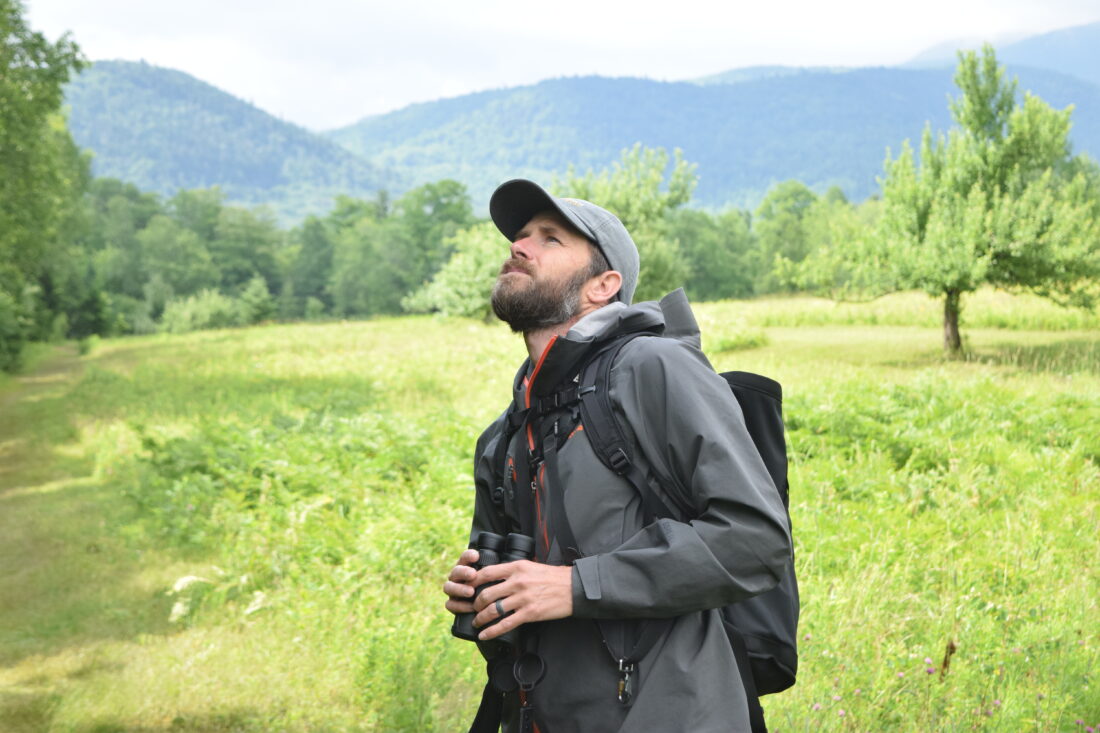
Derek Rogers, stewardship manager at the Adirondack Land Trust, looks for birds Tuesday, July 12 at Heaven Hill Farm in Lake Placid. The land trust recently acquired a grant to pay for bird-watching backpacks, which are being lent to library card holders looking to get into the hobby of birding. (News photo — Lauren Yates)
LAKE PLACID — Derek Rogers, stewardship manager at the Adirondack Land Trust, is a passionate birder and the catalyst behind the land trust’s new Adirondack Birding for All program, which seeks to make bird watching more accessible for locals.
For Rogers, a Long Island native, his love of birds started when he snapped a photo of a cedar waxwing right in his backyard around 22 years ago.
“It just kind of blew my mind that you could see something that beautiful in your own backyard,” he said. “I really started looking more closely after that.”
Rogers is still an avid birdwatcher, both in his own Willsboro Point backyard and across the Adirondack region. He said birding has been a huge part of his career, from his current work with the ALT to his previous work with The Nature Conservancy.
The cedar waxwing is what he called his “spark bird” — the bird that ignited his passion for bird watching. Now, he’s hoping to spark that same passion in others with the ALT’s new Birding for All program.
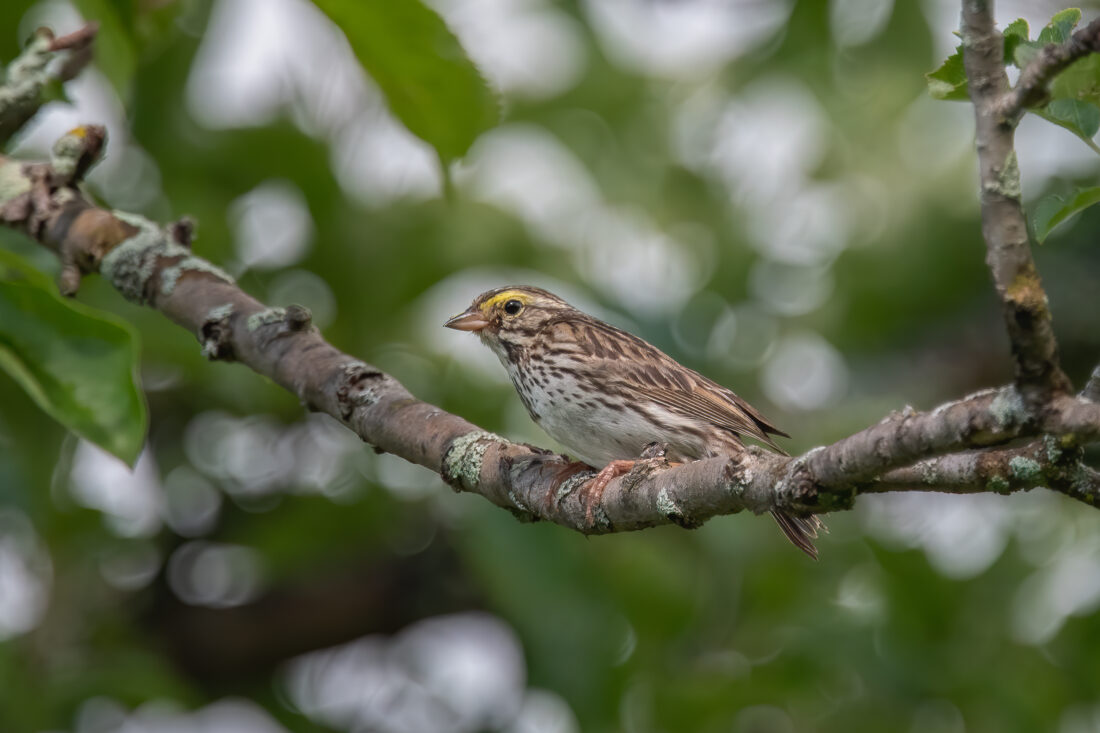
Savannah sparrow (Photo provided — Derek Rogers)
The ALT has assembled two backpacks that are each filled with basic birding supplies — informational books, binoculars and a notebook. One of the backpacks is available at the Keene Valley Library, and the other is ready for checkout at the Saranac Lake Free Library. Anyone with a library card can check the backpacks out and start their birding adventures.
“I’m hoping that this sort of creates more spark birds for people, like the cedar waxwing I had back in early 2000 — that somebody just really gets enthralled by using these (backpacks) and learns something about the natural world and connects with the Adirondacks (when) they may have not had the opportunity to do so without this program.”
The Birding for All program is funded by a grant from Northern NY Audubon. Rogers said that when he heard about the grant, he immediately thought about how the land trust could take advantage of the funds to get birding equipment in the hands of people in the Adirondacks who might not have access to it. ALT Stewardship and GIS Specialist Becca Halter suggested making birding supplies available to libraries, according to Rogers, and he ran with the idea. Rogers wrote up the grant, which received full funding. The grant also paid for an additional five pairs of binoculars that the land trust plans to offer to people attending its bird walks, which Rogers leads. The walks are free, and people can find out about them by signing up for the land trust’s email list.
Rogers was taking a walk through the Heaven Hill Trails in Lake Placid on Tuesday, July 12, looking and listening for birds with a Birding for All backpack. The wind was high, but he still stopped every few minutes to point out the call of a red-eyed vireo — “the most common forest bird in the Adirondacks,” he said — or the song of a hermit thrush.
As the trail led Rogers out into an open, sun-soaked meadow, he opened up his ALT birding backpack. The backpacks have a pair of Vortex binoculars and some information on how to use and care for them, along with a book about where to find birds in the Adirondacks, a bird identification book and a notebook that people can use to write about their experiences while using the backpacks and bird watching.
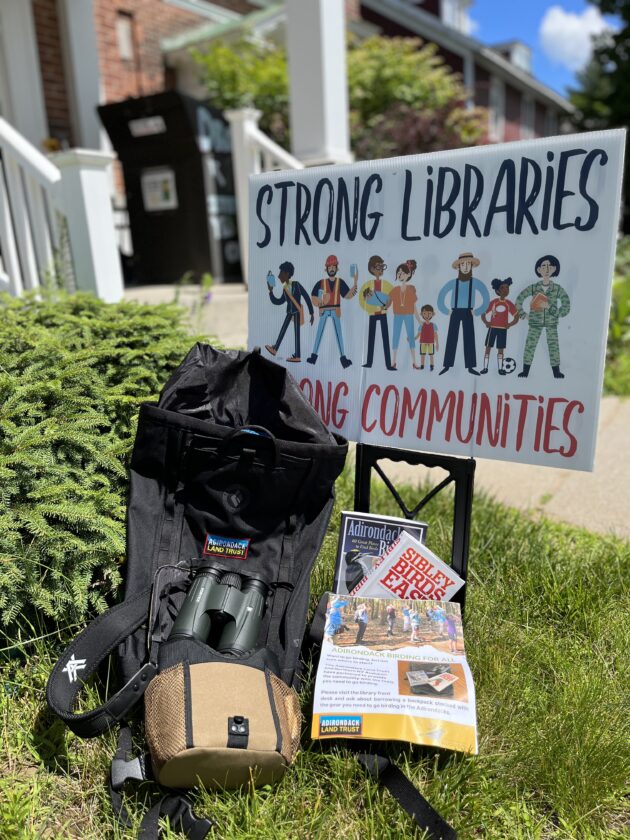
Birding backpack at Saranac Lake Free Library (Photo provided)
Rogers said the ALT is thinking of this year as the “pilot year” for the Birding for All program. The ALT is interested in how often the backpacks get checked out, and Rogers said they’re looking forward to reading the notebooks to learn more about people’s bird watching experiences, the birds they see and how the backpack program has influenced their interest in birding.
“Hearing from the people who are using them is going to be awesome and really important as we continue to evaluate the program,” he said.
Rogers said the ALT is thinking of how more backpacks could be spread out across the Adirondack Park.
–
Bird spotting
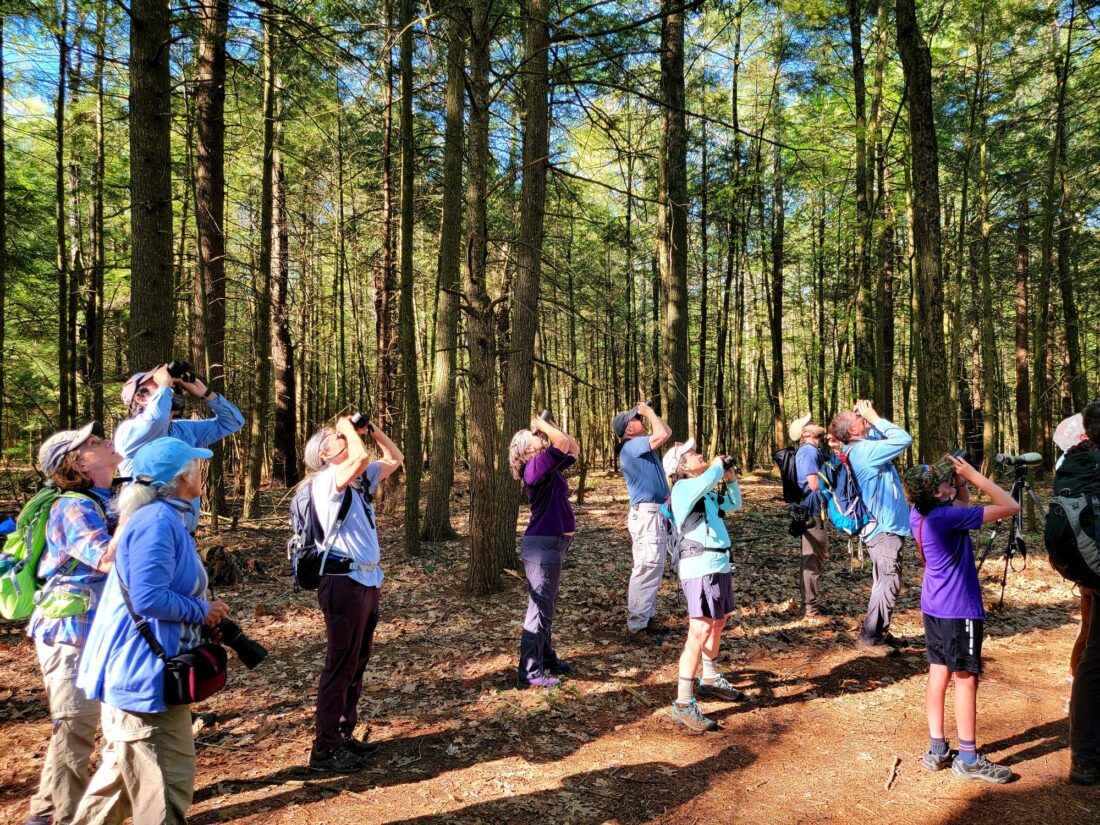
Birding in the Adirondacks (Photo provided)
–
Rogers said the Adirondacks are an “amazing place to bird” — you can look to the shores of Lake Champlain in the fall to watch shore birds during migration, then drive an hour to the boreal forest and see birds you can’t find anywhere else in the state.
Now is a great time to get into birding because there’s an abundance of mobile apps and online databases people can use to learn bird songs, calls and document bird sightings. Rogers recommends apps like Merlin, which can be used to identify bird calls and songs that you hear in nature, and the Sibley App, which has illustrations of birds and recordings of their songs that you can play to either identify birds you’re hearing or even encourage those birds to fly closer to you.
In the meadows of Heaven Hill on Tuesday, Rogers heard the song of a Savannah sparrow. He pulled up his Sibley Birds app and played the sparrow’s song, hoping to draw it nearer. He also made a sound he called “pishing,” which some ornithologists — people who study birds — use to attract small birds. In a few minutes, a flash of feathers were spotted in a nearby evergreen tree. Then, the bird landed even closer.
“Oh, right there!” Rogers said with hushed excitement. “No need for binoculars.”
The sparrow flickered from the nearby forest to a tree in the open meadow, perching on a branch across from Rogers in plain view. The bird’s head twitched this way and that, its eyes seemingly locked on Rogers as he looked back through his binoculars, then pulled out a camera to photograph it.
Bird spotting isn’t just exciting — it’s telling. Rogers said that the Savannah sparrow is a meadow grassland bird, what he called an “indicator species.” He said birds can indicate the nature and quality of a habitat. If you visit a meadow in the spring and don’t hear birdsong, he said, there might be something off with the health of that habitat.
“If you want to learn something about a site, go look at the birds who are using it,” he said.
While spring and fall bird watching are great for spotting migratory birds, Rogers said summer bird watching is a good time to learn about bird behavior and watch birds of leisure. In mid-July, he said, birds aren’t “super vocal” — they’re incubating eggs or feeding chicks, so they’re trying to be quiet and carry out their nesting processes. He said it’s more challenging to watch birds at this time of year, but it’s also more exciting.
He shared some of his top binocular tips for watching birds. One key thing to remember is to keep your eyes fixed on a bird you’ve spotted before holding the binoculars up to your eyes, instead of searching for birds through the binoculars.
There are also multiple ways to adjust the focus of the binoculars. People with impaired vision who have a different prescription in each eye have the option to change the focus of each binocular lens with something called a “diopter ring.” But don’t worry, using the binoculars isn’t as complicated as it sounds, and the birding backpacks come with step-by-step instructions on how to use the binoculars.
–
“Birds connect”
–
By nature, birds are international. From the southern tip of South America to the northern reaches of the Arctic Circle, Rogers said migratory birds in particular have a way of connecting everyone.
“Bird just connect the whole world. Everybody has a birding story to tell, which is what I love about birds — it doesn’t matter what your political affiliation is, or your religion or the color of your skin. Everybody can relate to birds and has a story to tell about birds,” he said. “They really just break barriers down.”
That’s what the Birding for All program is all about. And now, with all the apps that are available for new birders, Rogers said beginners can reach an advanced level in years as opposed to decades. When Rogers saw his first cedar waxwing in 2000, he didn’t have Merlin, the Sibley Birds app, or eBird. eBird is a citizen science database people can use to document birds they’re seeing and hearing in a particular location. That information is then collated and vetted by regional reviewers.
Rogers is the regional eBird reviewer for the Adirondacks. He said that’s given him the opportunity to have a comprehensive overview of regional birds, with his “fingers on the pulse” of everything happening with birds here.
Rogers’ knowledge of birds — his ability to identify calls from a distance and rattle off the names of local species — might seem unachievable, but it’s not. You can start right in your own backyard, he said. Spotting your first bird, like Rogers’ cedar waxing, could spark your interest in the field and connect you with hundreds of other locals who share that same interest.
“Birds connect,” Rogers said. “That’s for sure.”
Local News
VISITING LAKE PLACID : A different world: A winter climb up Mount Colden
KEENE — My heart pounded, not from the 2,500 or so feet we had ascended over the last couple of hours, but for ...
Forest ranger recalls saving hiker lost for two days in Dix Range
Snowshoer found dead in lean-to in Pharaoh Lakes Wilderness
SCHROON — A Florida man was found dead in a lean-to in the 44,400-acre Pharaoh Lakes Wilderness in southern Essex ...
Ad’k Life announces photography contest winners
Some see Olympic blueprint for a 3rd Lake Placid games
CORTINA D’AMPEZZO, Italy — Imagine: A sprawling world-class city and a small mountain village with a rich ...