Tourism not listed on initial phases of NYS re-opening
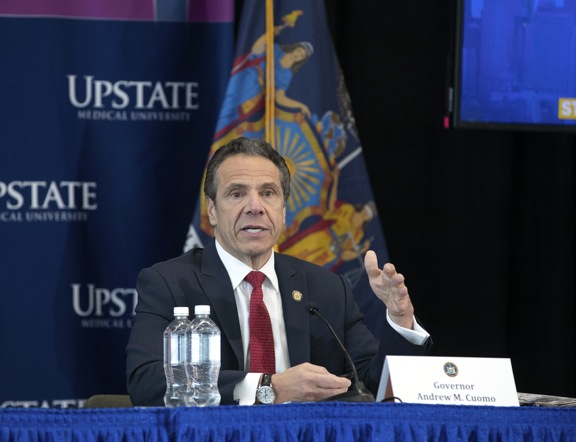
Gov. Andrew Cuomo provides a coronavirus briefing Tuesday, April 28 during a press conference in Syracuse. (Provided photo — Mike Groll/Office of Gov. Andrew M. Cuomo)
LAKE PLACID — Gov. Andrew Cuomo this week released details of New York’s re-opening of the state amid the COVID-19 pandemic, listing construction and manufacturing high on the list of business sectors that will open first. Attractions and activities that draw crowds — staples of the tourism industry — were actually discouraged from opening soon.
“The region must not open attractions or businesses that would draw a large number of visitors from outside the local area,” stated the governor’s outline to phase in the re-opening by region, released on Sunday, April 26.
The governor went further the next day, introducing the public to the concept of “attractive nuisances.”
“No attractive nuisances,” Cuomo said Monday during his daily COVID-19 briefing. “Attractive nuisance is a legal concept where a potentially dangerous situation that actually attracts people, normally children, to it. We can’t open an attraction that might bring many people from outside the region and then overwhelm people in that region.”
Attractive nuisances could include tourism destinations and activities such as museums, amusement parks, concerts, festivals, sporting events, lakeside attractions, parks and beaches.
During the Tuesday, April 28 COVID-19 briefing in Syracuse, CNY Central’s Michael Benny asked Cuomo about local attractive nuisances, pointing to the New York State Fair, set for Aug. 21 to Sept. 7, and lakeside towns.
“Central New York in the summer, in my estimation,” Benny said, “is an attractive nuisance. How can these things go on?”
“It breaks my heart, but they can’t,” Cuomo replied, “unless it’s done statewide and unless it’s done … with our neighboring states. … People will get in the car and drive several hours to go somewhere. Look, if you open the state fair this year, you’d have the highest attendance we ever had. That I can guarantee you. But it wouldn’t be good. Everything is about reducing density.”
Having regions open up their venues and events considered attractive nuisances without coordinating with other regions and states is not an option, according to the governor.
“You would have a massive infusion of people from everywhere. And that’s then density, and density is the problem. … Can you open the state fair unless the entire state is at a point where it’s opened? I don’t believe so.”
On Tuesday, Cuomo released the re-opening outline for the state’s regions: Capital Region, Central New York, Finger Lakes, Mid-Hudson Valley, Mohawk Valley, New York City, North Country, Long Island, Southern Tier and Western New York.
Each region must follow guidelines as part of the re-opening plan.
—
Re-opening guidelines
1. CDC guidelines: Based on CDC recommendations, once a region experiences a 14-day decline in the hospitalization rate they may begin a phased re-opening.
2. Industries: Businesses in each region will re-open in phases. Phase one will include opening construction and manufacturing functions with low risk. Phase two will open certain industries based on priority and risk level. Businesses considered “more essential” with inherent low risks of infection in the workplace and to customers will be prioritized, followed by other businesses considered “less essential” or those that present a higher risk of infection spread. Regions must not open attractions or businesses that would draw a large number of visitors from outside the local area.
3. Business precautions: Each business and industry must have a plan to protect employees and consumers, make the physical work space safer and implement processes that lower risk of infection in the business.
4. Building health care capacity: To maintain the phased re-opening plan, each region must have at least 30 percent of hospital beds and ICU beds available after elective surgeries resume.
5. Testing regimen: Regions must implement a testing regimen that prioritizes symptomatic persons and individuals who came into contact with a known COVID-positive person, and conducts frequent tests of frontline and essential workers. Regions must maintain an appropriate number of testing sites to accommodate its population and must fully advertise where and how people can get tested. The region must also use the collected data to track and trace the spread of the virus.
6. Tracing system: There must be at least 30 contact tracers for every 100,000 people. The region must also monitor the regional infection rate throughout the re-opening plan.
7. Isolation facilities: Regions must present plans to have rooms available for people who test positive for COVID-19 and who cannot self-isolate.
8. Regional coordination: Regions must coordinate the re-opening of schools, transportation systems, testing and tracing with other surrounding regions.
9. Re-imagining tele-medicine
10. Re-imagining tele-education
11. Regional control rooms: Each region must appoint an oversight institution as its control room to monitor regional indicators during the phased re-opening, including hospital capacity, rate of infection, PPE burn rate and businesses.
12. Protect and respect essential workers: Regions must continue to ensure protections are in place for essential workers.
Cuomo also announced the creation of the New York Forward Re-Opening Advisory Board to help guide the state’s re-opening strategy. It will be chaired by former secretaries to the governor Steve Cohen and Bill Mulrow and includes more than 100 business, community and civic leaders from industries around the state.
Local News
VISITING LAKE PLACID : A different world: A winter climb up Mount Colden
KEENE — My heart pounded, not from the 2,500 or so feet we had ascended over the last couple of hours, but for ...
Forest ranger recalls saving hiker lost for two days in Dix Range
Snowshoer found dead in lean-to in Pharaoh Lakes Wilderness
SCHROON — A Florida man was found dead in a lean-to in the 44,400-acre Pharaoh Lakes Wilderness in southern Essex ...

Ad’k Life announces photography contest winners
Some see Olympic blueprint for a 3rd Lake Placid games
CORTINA D’AMPEZZO, Italy — Imagine: A sprawling world-class city and a small mountain village with a rich ...