Local nurses talk lessons learned
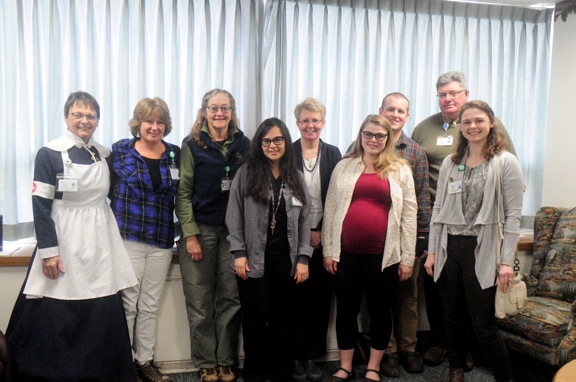
From left, nurses Linda McClarigan, Betsy Fuller, Trish Chartier, Lisa Keegan, Jill Barnard, Katelyn Atkinson, Joe Atkinson, Dave Mader and Emma Miller pose at the Adirondack Medical Center in Saranac Lake on Monday, May 13. (News photo — Elizabeth Izzo)
SARANAC LAKE – It was often that he landed in the emergency room, plagued by a condition that never seemed to leave him.
He was addicted to drugs, and there was a time in his life when he struggled to beat back against a tide that threatened to pull him under. Nearly every time this patient came to the hospital, registered nurse Lisa Keegan, 44, was there for him. She couldn’t share her patient’s name because of medical privacy laws.
“He came back to (the ER) one day and said to me, ‘I’m really sorry. I’m trying really hard for you,'” Keegan said. Tears formed in her eyes as she recalled the memory. She pushed a section of her long black hair behind her ear and cleared her throat.
“I told him, ‘It’s not about me. It’s about you,'” she continued. “‘You’ve got to get better for you.'”
On the second floor of the Adirondack Medical Center in Saranac Lake, Keegan sat in a sequestered meeting room alongside 10 other nurses on Monday, May 13.
The nurses ranged in age, gender, specialty and tenure. Some were two years into their career and just starting out, and others were upward of 45 years in and nearing retirement.
National Nurses Week, an event created by the American Nursing Association to celebrate and honor the work of nurses, had just concluded. The annual event started on National Nurses Day, May 6, and ended on the birthday of Florence Nightingale, May 12.
Keegan and her colleagues took a few moments following National Nurses Week to share anecdotes collected throughout their careers, talk about the ups and downs of working as a nurse and discuss what has changed in the nursing world over the years.
Keegan has worked at the Adirondack Medical Center in Saranac Lake for 19 years. She said that frequent ER patient she cared for over and over taught her a valuable lesson about her job.
“It made me re-evaluate my practice and reflect how I come across to my patients,” she said. “Sometimes we’re a little reserved, but that’s because we’re here to protect you. Our patients need to know that they need to get better for themselves, not for us.”
—
The patient care lifestyle
Keegan’s story wasn’t unique among her peers. Most of the nurses gathered at the Adirondack Medical Center had stories of times when they’d learned something from one of their patients – some of those lessons harder to learn than others.
The consensus: being a nurse isn’t easy. It’s a career that’s taxing on your body, your mind and your emotions – but it’s also an immensely fulfilling position.
For each of the men and women present, their profession – in particular the patient care aspect of it – at times felt more like a lifestyle than a job.
“You have to be in excellent physical shape as well as mental shape,” said 62-year-old Jill Barnard, who works in clinical documentation and improvement at Adirondack Health. She’s been a nurse for 39 years. “You need to go to bed early. It’s like taking a test every day. It’s a patient’s life that’s involved. It’s a tough, tough job.”
Emergency room nurse Jennifer Mcguoirk, 24, said it can be difficult to mentally leave work at work.
“A lot of times, we take a lot of our patients home with us,” she said. “Not literally, but we take home their problems, and we don’t stop thinking about them when we get home.”
“It’s hard to turn it off,” said Linda McClarigan.
McClarigan – a 67-year-old nurse who was dressed as Florence Nightingale, an English Victorian-era nurse thought to be the founder of modern nursing – serves as the interim chief operating officer at the hospital. She’s been a nurse for 45 years and previously held the post of chief nursing officer.
When a patient dies, it can be hard, according to Joe Atkinson, a nurse at Adirondack Health for the past two years. Nurses are often tasked with speaking to grieving families. They also sometimes go to calling hours and funerals.
“Everybody has that one patient that they take care of and then they do end up passing, whether it was expected or not. That’s something that’s always super difficult to deal with,” Atkinson said.
“You have to have a work-life balance, and you have to take care of yourself,” McClarigan said.
The best thing about nursing remains the same across generations: watching a patient get better.
“The best day I ever have is when I can titrate medications per physicians’ parameters and make that patient better, and see it clinically on my shift,” Barnard said. “To me, that’s one of the most thrilling, exciting parts of nursing.”
And the small signs that their work is appreciated often means a lot to them.
“I had a patient who just had a really big surgery,” Mcguoirk said. “I came in on my day off to check in on her and see how she was doing. She had a card and a present for me. It made me see that I was really making a difference in her life, which was really crazy.”
—
Constantly learning new things
Although a lot of things about nursing have remained the same over the years, much has changed and continues to change on a daily basis, according to McClarigan.
“There was minimal technology when I was starting out,” she said. “I don’t think I could deal with all the technology and equipment that’s out there today.”
McClarigan called her colleagues “rock stars” and said that learning how to use constantly evolving medical technology can be a challenge.
“Nursing isn’t just hold their hand at the bedside,” she said. “That’s a piece of it. It’s also about knowing what piece of equipment to use and when to put it on and when to take it off, and making sure that it’s working.
“These folks learn something new each and every day. I continue to learn something new every day.”
Local News
VISITING LAKE PLACID : A different world: A winter climb up Mount Colden
KEENE — My heart pounded, not from the 2,500 or so feet we had ascended over the last couple of hours, but for ...
Forest ranger recalls saving hiker lost for two days in Dix Range
Snowshoer found dead in lean-to in Pharaoh Lakes Wilderness
SCHROON — A Florida man was found dead in a lean-to in the 44,400-acre Pharaoh Lakes Wilderness in southern Essex ...
Ad’k Life announces photography contest winners
Some see Olympic blueprint for a 3rd Lake Placid games
CORTINA D’AMPEZZO, Italy — Imagine: A sprawling world-class city and a small mountain village with a rich ...