Completing the circuit
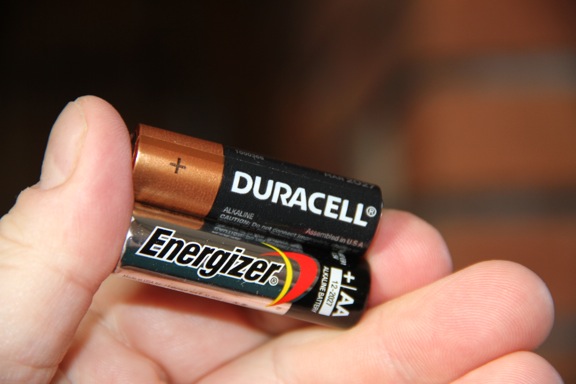
The village of Lake Placid’s battery recycling program is getting more popular. The village accepts all kinds of single-use and rechargeable batteries. (News photo — Andy Flynn)
LAKE PLACID – Residents of the Olympic Region don’t have many choices to recycle single-use alkaline batteries – such as those used in remote controls, radios and flashlights – so the village of Lake Placid has taken a lead role in this needed service.
Last summer, Village Treasurer Paul Ellis launched a battery recycling program at the village offices in the North Elba Town Hall. A recycling bucket, which holds about 40 pounds of batteries, has been there since July, and only recently did it fill up enough to be mailed to the recycler, Battery Solutions, based in Wixom, Michigan, he said Wednesday, Jan. 30.
The soft launch didn’t work so well, as not many people were aware of the free service, but that all changed after Dec. 19 when the village posted a reminder on its Facebook page.
“Did you know that the Village office is a collection site for used batteries?” the post stated.
The village takes single-use alkaline and rechargeable household batteries – AA, AAA, C, D, 9-volt, plus cellphone, camera, watch and hearing aid batteries.
Lake Placid resident Nancy Beattie was the first person to comment on the village’s Facebook post.
“Didn’t know,” she wrote. “DEC told us to throw them in the garbage, so that’s what we’ve been doing these last few months after the landfill didn’t take them for recycling anymore. Glad you’re doing it!”
Bob Maswick, of Lake Placid, replied to Beattie’s comment.
“I heard that very same thing; felt it was the wrong answer so I’ve been stockpiling them,” he wrote. “I’ll deliver my bucket of old batteries today.”
The Facebook post sparked an interest in recycling batteries, and Ellis said the village’s bucket that had been half full after seven months filled up quickly. It was shipped two weeks ago, and a new bucket is already half full.
“We weren’t getting much recycling, so it’s taken off really well now,” Ellis said.
It may be free for the public to recycle the batteries, but it’s not free for the village, which pays between $75 and $100 to ship a full bucket to the recycler, according to Ellis. In the future, the village may put a donation jar at the counter to help pay for the shipping.
“I know people have a lot of batteries,” Ellis said. “Batteries are a part of everyday life, and a lot of batteries go into the landfill. Environmentally, it’s the right thing to do.”
On Wednesday, the News called transfer stations in the Olympic Region to see what types of household batteries they recycle. The town of Keene transfer station accepts alkaline and rechargeable batteries. The town of North Elba transfer station only accepts rechargeable batteries. And the town of Wilmington transfer station does not accept any batteries for recycling.
In Lake Placid, people can drop off their used batteries at the village billing office window on the first floor, but they must adhere to the requirements below.
– Any leaking batteries must be cleaned and placed in a Ziploc bag.
– Any lithium or lithium ion batteries must have their ends taped over and placed in a separate Ziploc bag.
– The above items are to prevent electric discharge and potential electrical fire during storage and shipment.
For more information about the village’s battery recycling program, call 518-523-2597, extension 130.
—
Battery recycling laws
The Energizer battery brand reports on its website that Americans buy about 180 tons of batteries a year, and the only state to require the recycling of non-rechargeable alkaline batteries is California.
In 1996, the President Bill Clinton signed into law the Mercury-Containing and Rechargeable Battery Management Act. The Battery Act, as it is more popularly known, facilitated the recycling of nickel-cadmium (Ni-Cd) and small sealed lead acid (SSLA/Pb) rechargeable batteries. It also phased out the use of mercury in alkaline batteries, which made them more acceptable to be thrown into the landfills.
Even though, outside of California, it’s legal to throw single-use alkaline batteries out with the trash, Energizer strongly encourages people to find places to recycle them. More information can be found online at Call2Recycle.org, which has recycled more than 100 million pounds of used rechargeable batteries since 1994.
The New York State Rechargeable Battery Recycling Act was signed into law in 2010 and requires manufacturers of covered rechargeable batteries to collect and recycle the batteries statewide in a manufacturer-funded program at no cost to consumers, according to the state Department of Environmental Conservation website.
“Most rechargeable batteries contain toxic metals that can be released into the environment when improperly disposed,” the DEC states. “Consumers across the state will now be able to safely return to retailers rechargeable batteries, from a large number of electronic products, for recycling or proper management at the end of their useful life.”
The types of rechargeable batteries covered by the law are nickel-cadmium, sealed lead, lithium ion, nickel metal hydride, any other dry cell battery capable of being recharged and battery packs containing any of the above-mentioned batteries.
“The law does not cover: any of the above-mentioned batteries/packs weighing 25 pounds or more; batteries used as the principal power source for a vehicle, such as an automobile, boat, truck, tractor, golf cart or wheelchair; batteries for storage of electricity generated by an alternative power source, such as solar or wind-driven generators; batteries for backup that is an integral component of an electronic device; or any non-rechargeable batteries such as common alkaline batteries.”
The law affects manufacturers of covered rechargeable batteries, retailers of covered rechargeable batteries that sell batteries and consumers of covered rechargeable batteries.
Retailers that sell covered rechargeable batteries are required to accept used rechargeable batteries from consumers.
“Consumers should make every effort to responsibly recycle their used rechargeable batteries,” states the DEC, adding that it is illegal to throw out covered rechargeable batteries as solid waste at any time in the state.
Lead-acid batteries – found in cars, trucks, recreational vehicles and boats – also need to be recycled in New York, as it is illegal to throw them away in the trash. People must take dead batteries for recycling to a retail store, distributor or battery recycling facility. Also, retailers are required by law to accept used batteries from customers and distributors.
Local News
VISITING LAKE PLACID : A different world: A winter climb up Mount Colden
KEENE — My heart pounded, not from the 2,500 or so feet we had ascended over the last couple of hours, but for ...

Forest ranger recalls saving hiker lost for two days in Dix Range
Snowshoer found dead in lean-to in Pharaoh Lakes Wilderness
SCHROON — A Florida man was found dead in a lean-to in the 44,400-acre Pharaoh Lakes Wilderness in southern Essex ...

Ad’k Life announces photography contest winners
Some see Olympic blueprint for a 3rd Lake Placid games
CORTINA D’AMPEZZO, Italy — Imagine: A sprawling world-class city and a small mountain village with a rich ...