APA ruling buoys Saranac Lake marina project
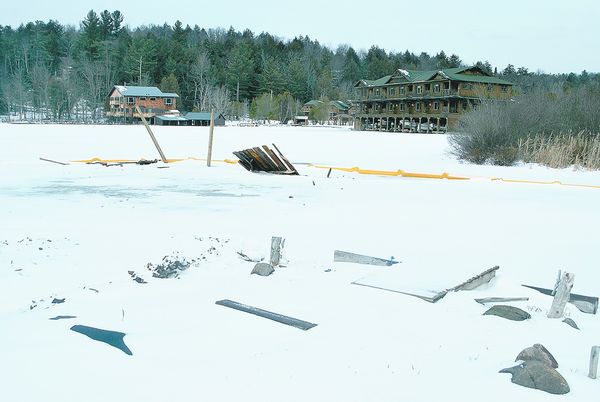
A piece of an old boathouse sticks out of the ice in Ampersand Bay in Saranac Lake. The dilapidated boathouses at this site and in Crescent Bay were removed last month as part of a plan to replace them with new covered docks. (News photo — Chris Knight)
SARANAC LAKE – The state Adirondack Park Agency has changed the classification of a wetland in Lower Saranac Lake where a local marina wants to expand its operations.
APA Executive Director Terry Martino issued a ruling last month that reclassifies a wetland in Ampersand Bay from class 1, which is considered the most valuable wetland and subject to the most stringent protections, to a less-valuable class 2 wetland. Martino based her decision on a fisheries survey conducted in August by a consulting firm hired by LS Marina LLC, the company behind the proposed Saranac Lake Marina expansion.
The decision could make it easier for the company to get a wetlands permit from the agency that’s critical to the project.
“I’m excited,” said Mike Damp, the marina’s managing partner. “It’s hopefully moving forward.”
LS Marina purchased the former Crescent Bay Marina properties in 2014 and renamed the business Saranac Lake Marina. It wants to build nearly 300 covered boat slips: 178 in Crescent Bay and 110 at an annex marina in Ampersand Bay.
The project went through a contentious, year-and-a-half long review with the town of Harrietstown Planning Board before it was approved in April of last year. A key issue in that debate was whether the proposed annex marina docks would impact fish spawning habitat in Ampersand Bay.
Based on data from a 2005 survey done by the state Department of Environmental Conservation, the APA had classified the wetlands in the annex site as class 1 because it said they contain emergent vegetation and a large number and wide range of fish species. LS Marina was urged to consider “alternative proposals which would avoid wetland loss and degradation at the annex site.”
Tom Ulasewicz, the marina’s lawyer, argued that the annex wetlands should be class 2, citing survey data from Lower Saranac Lake and other sites around the Park.
“The wetlands in the vicinity of the annex do not support an unusual species abundance or diversity in comparison to other locations in Lower Saranac Lake,” Ulasewicz wrote in an April 2015 petition seeking a reversal, “and the annex area wetlands do not support an unusual species abundance or diversity in comparison to other lakes in the Adirondack Park.”
The agency upheld its decision in May of last year, but Ulasewicz submitted another petition in October that included a fish survey conducted by Stantec Consulting Services. The survey was paid for by LS Marina.
“It’s not a price I really want to reflect on too long,” Damp said when asked how much the survey cost. “Tens of thousands of dollars, between the study, an attorney and a consultant to go back and forth with the APA on it.”
The purpose of the study was to compare the number and diversity of fish in the annex site to other deep water marsh wetlands in the lake. Using an electrofishing boat, fish were captured at the annex and nine comparable sites around the lake on Aug. 26. The survey found the annex “does not have an unusual fish species abundance or diversity.”
More specifically, the annex site yielded 14.2 fish per minute, the second highest catch number among the 10 sites but “not significantly higher than the mean catch per unit effort for the other survey sites.” Eight different species of fish were caught at the annex site, the second-highest number of species collected, but none of the annex fish species were unique to that site.
“Not surprisingly, perch and sunfish are abundant throughout the whole lake, not just in the annex area,” Damp said.
The study was submitted to the APA, and Martino ruled Dec. 18 that the annex wetland complex should be a Class 2 wetland, citing the Stantec survey.
“Based on this information, the annex site is used by a large number of fish and large number of species of fish,” Martino wrote. “However, the wetland does not meet the unusual species or diversity definition set forth in (state regulations).”
Damp said the decision means a full application to the APA will be submitted soon.
“Hopefully in a few months we’ll have a decision on a permit and build a new marina,” he said.
The reversal by the APA was disappointing to Bob Brown of Saranac Lake, who first raised concerns about the potential impact the annex docks could have on fish habitat in the lake.
“This is the first I’ve heard of it, and I haven’t seen the documents,” he said Jan. 14, “but it’s just frustrating. The (APA) is going by biologists hired by the company that wants to put in (the new docks). What do you expect they’re going to come up with?
“DEC is supposed to be in charge of fisheries. They’re the experts, not the APA. Now you have another group from the outside coming in with this – I’m just a little tired of fighting them.”
—
Docks removed
Meanwhile, the marina received approval from the agency this fall to remove dilapidated boathouses and other structures at both Crescent Bay and Ampersand Bay. Damp said crews took advantage of the warm weather in December to tear down the buildings, which he said were unsafe.
“Two cottages were removed, a pole barn on the back and everything on the water (was removed) except our main boathouse, which we’re keeping and rehabbing,” he said. “Luckily, the water was still open. Normally it would have been frozen. We’ll continue to clean up in the spring and be ready to install a new floating dock system.”
Local News
VISITING LAKE PLACID : A different world: A winter climb up Mount Colden
KEENE — My heart pounded, not from the 2,500 or so feet we had ascended over the last couple of hours, but for ...
Forest ranger recalls saving hiker lost for two days in Dix Range
Snowshoer found dead in lean-to in Pharaoh Lakes Wilderness
SCHROON — A Florida man was found dead in a lean-to in the 44,400-acre Pharaoh Lakes Wilderness in southern Essex ...
Ad’k Life announces photography contest winners
Some see Olympic blueprint for a 3rd Lake Placid games
CORTINA D’AMPEZZO, Italy — Imagine: A sprawling world-class city and a small mountain village with a rich ...